

Archive position — measured, not model output
0 likes on Devpost
2,263 of the 7,850 archived projects have more likes, and 5,587 share exactly 0 — so this project's #4,031 place in the like-ranked listing is a tie-break inside that group, not a ranking.
Projects (log scale)
Likes on Devpost. ▲ marks this project's group.
Show the figures
| Likes | Projects | Share of archive |
|---|---|---|
| 0 | 5,587 | 71.2% |
| 1 | 1,758 | 22.4% |
| 2 | 284 | 3.6% |
| 3–4 | 132 | 1.7% |
| 5–9 | 75 | 1.0% |
| 10+ | 14 | 0.2% |
 User Stories BotA demo video on every pull request
Get a demo video on every new feature
GitHub App that watches your pull requests and records a narrated, captioned demo.
Save time on demo prep and make informed decisions faster with a video walkthrough of every new feature.
Executive Summary
What the company appears to be
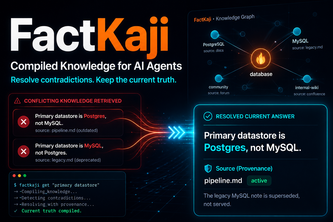
FactKaji is described as an incremental knowledge compiler for AI agents. The author states that it transforms evolving Markdown documents into smaller, state-aware, provenance-backed Knowledge Views. It is built as a compiler rather than a document search engine and supports both deterministic and hybrid (LLM-assisted) extraction methods.
What changed
The project evolved from an architectural idea into a working end-to-end system. The author reports that it now includes incremental Markdown compilation, current-state reduction, explicit disputes, source-level provenance, MCP integration, and reproducible full rebuilds.
Single most important open question
Is there evidence of real-world adoption or usage beyond the authors' own dogfooding and evaluation suites?
Note
This analysis is based solely on the self-reported, unverified description provided by the author. No external corroboration exists for any claims made in this document.
What The Product Actually Is
The description states that FactKaji is an incremental knowledge compiler designed to transform evolving Markdown documents into trusted, traceable knowledge for AI agents.
It operates through a series of steps:
- Artifact ingestion (Markdown sources like ADRs, design notes, etc.)
- Event extraction (structured or hybrid model-based)
- State reduction (canonical subject state determination with conflict detection)
- Knowledge View compilation (task-specific bounded context)
- Incremental compilation (recompiles only affected artifacts)
It also includes:
- CLI and MCP server interfaces
- Dashboard for dispute inspection and settlement
- Deterministic rebuilds using content-addressed caches
Claim
The product is described as a compiler, not a search engine.
Inference It aims to improve AI agent reliability by managing evolving knowledge more like software than documents.
Positioning & Claim Evolution
The author positions FactKaji as an alternative to traditional Retrieval-Augmented Generation (RAG), which they argue fails when dealing with dynamic knowledge.
Key claims:
- Knowledge should be compiled like software instead of retrieved like documents.
- It tracks how knowledge changes over time and distinguishes between decisions, corrections, rejections, etc.
- It provides a smaller and more reliable context for AI agents.
- The system supports deterministic builds even when LLMs are used during extraction.
Claim
"What if knowledge were compiled like software instead of retrieved like documents?"
Inference This reflects a shift from document-based retrieval to state-aware compilation, suggesting a new paradigm in agent knowledge management.
Target Customer & ICP
The description does not explicitly name target customers or personas. However, it implies usage by:
- AI agents (coding, research, enterprise assistants)
- Developers working with evolving documentation
- Teams managing large volumes of technical knowledge
It also mentions support for:
- Obsidian-style vaults
- Multi-note knowledge vaults
- Git-native workflows
Claim
The system targets users who need reliable, up-to-date knowledge for AI agents.
Inference Likely aimed at developers and teams using AI tools in software development or research contexts.
Business Model & Pricing Evidence
There is no evidence of pricing, business model, or monetization strategy in the description. The project appears to be a prototype submitted to a hackathon.
Claim
Not evidenced.
Inference No indication of revenue streams, customer acquisition plans, or commercial viability.
Technical & Delivery Signals
The system is built with:
- Next.js, React, Node.js, Python, TypeScript
- Tools: ai-agents, compiler, git, incremental-computing, json, knowledge-graph, llm, markdown, rag, vector-search, mcp
Core technical features include:
- Incremental compilation that guarantees full rebuild equivalence
- Hybrid deterministic and LLM-based extraction
- Content-addressed cache for reproducibility
- MCP tools integration
- Dashboard for dispute settlement
- Support for multiple languages (including Japanese)
Claim
The system supports both deterministic-only and hybrid operations.
Inference Suggests robustness in handling varied input types and ensuring consistency.
Traction & Maturity Signals
The author reports:
- End-to-end working system with real-world dogfooding
- Evaluation using realistic-prose benchmarks
- Adversarial review by Codex and Claude
- Real-vault testing and regression suite expansion
- Multiple validation methods including retrieval, knowledge-evolution, and adversarial testing
However, there is no evidence of:
- Customers or paying users
- Revenue or ARR
- Product-market fit metrics
- Market traction beyond internal use
Claim
The system has been validated through multiple testing approaches.
Inference Indicates maturity in development but not commercial traction.
Competitive Context
The description does not mention competitors directly. However, it contrasts its approach with:
- Traditional RAG systems
- Document search engines
- Conventional knowledge management tools
It references the broader trend of "KnowledgeOps" as an emerging discipline closer to compilation and continuous integration than conventional search.
Claim
Competes with traditional RAG and document-based retrieval.
Inference Suggests a niche in AI agent knowledge infrastructure, potentially overlapping with tools for managing evolving documentation or knowledge graphs.
Open Questions & Risks
- Lack of commercial evidence: No revenue, customers, or traction data provided.
- Unproven market demand: The project is described as a hackathon submission; no indication of real-world adoption.
- High technical complexity: Relies on hybrid extraction and deterministic rebuilds — may be difficult to scale or maintain.
- Limited scalability assumptions: No mention of performance at scale or multi-user environments.
- Dependency on LLMs: While reproducible, the system still uses LLMs in some modes, which introduces potential instability.
Claim
The project is not yet proven in production use cases.
Inference Risk of overstatement in claims due to lack of external validation or real-world usage.
Questions the description leaves open
- What specific AI agents or use cases are you targeting with FactKaji?
- How do you plan to scale incremental compilation for large knowledge bases?
- Have you identified any early adopters or pilot users beyond your own testing?
- What is the roadmap for monetization or commercial deployment?
- Can you provide examples of actual disputes detected and resolved by FactKaji?
- How does FactKaji handle integration with existing Git workflows or DevOps pipelines?
- Are there plans to support other formats beyond Markdown (e.g., PDFs, databases)?
- What are the performance implications of using LLMs in hybrid mode for large-scale knowledge compilation?
Overall Assessment
Not evidenced.
There is no evidence of revenue, ARR, headcount, funding rounds, or customer traction to assess investment potential or partnership viability.
The project appears to be a prototype developed for a hackathon with strong technical execution but limited commercial validation.
Claim
No evidence of financials, customers, or market traction.
Inference Likely too early-stage for traditional investment or strategic partnership consideration without further proof of concept or adoption.
User Stories BotA demo video on every pull request
Get a demo video on every new feature
GitHub App that watches your pull requests and records a narrated, captioned demo.
Save time on demo prep and make informed decisions faster with a video walkthrough of every new feature.
Source
Submitted to the OpenAI 2026 hackathon on Devpost. Project home on Devpost. Back to the full gallery on Devpost.
This competitive analysis was produced by top-founders.com (opens in a new tab)
Generated by a language model from this project's public Devpost page — its tagline, the author's own write-up and any built-with tags listed there — as captured in August 2026. Short quotations are the author's words. It is an opinion on the idea as a business, not on the people behind it, and it reflects the description as published then. If the project has moved on, request a correction below. The analysis is not independent research and contains no verified traction, revenue or customer data.
An independent guide by KFG International LLC — not affiliated with, endorsed by, or connected to Devpost or OpenAI.