

Archive position — measured, not model output
1 like on Devpost
505 of the 7,850 archived projects have more likes, and 1,758 share exactly 1 — so this project's #1,025 place in the like-ranked listing is a tie-break inside that group, not a ranking.
Projects (log scale)
Likes on Devpost. ▲ marks this project's group.
Show the figures
| Likes | Projects | Share of archive |
|---|---|---|
| 0 | 5,587 | 71.2% |
| 1 | 1,758 | 22.4% |
| 2 | 284 | 3.6% |
| 3–4 | 132 | 1.7% |
| 5–9 | 75 | 1.0% |
| 10+ | 14 | 0.2% |
 User Stories BotA demo video on every pull request
Get a demo video on every new feature
GitHub App that watches your pull requests and records a narrated, captioned demo.
Save time on demo prep and make informed decisions faster with a video walkthrough of every new feature.
Executive Summary
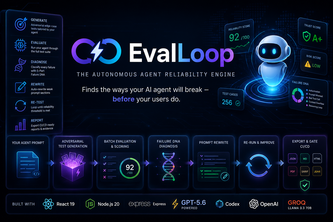
EvalLoop – Autonomous Agent Reliability Engine is a self-reported project submitted by Shital Parab to the OpenAI 2026 hackathon. The description states it uses Codex, GPT-5.6, Groq, OpenAI, React, and Vercel to generate adversarial tests, diagnose failures, rewrite prompts, and improve AI agent reliability. It is presented as a tool for identifying potential breakdowns in autonomous AI agents before users encounter them.
The project appears to be an early-stage concept or prototype, with no evidence of revenue, customers, or traction. The author describes it as a solution for AI agent reliability, but does not clarify how it would be monetized or deployed. The single team member and hackathon context suggest a proof-of-concept rather than a mature product.
The single most important open question
What is the actual mechanism by which EvalLoop generates adversarial tests and diagnoses failures? The description offers no technical detail, only self-reported claims about its functionality.
What The Product Actually Is
The description states that EvalLoop is an "Autonomous Agent Reliability Engine" built with Codex, GPT-5.6, Groq, OpenAI, React, and Vercel. It claims to generate adversarial tests, diagnose failures, rewrite prompts, and boost agent reliability.
Inference Based on the technology stack and self-reported functionality, EvalLoop likely operates as a software tool or platform that uses AI models (particularly GPT-5.6) to simulate failure conditions in autonomous agents and suggest improvements.
Not evidenced The actual architecture, user interface, or operational mechanism of EvalLoop is not described. The author provides no detail on how adversarial testing is implemented or what constitutes a "failure" in the context of an AI agent.
Positioning & Claim Evolution
The tagline states: “EvalLoop finds the ways your AI agent will break—before your users do.” This positions EvalLoop as a proactive reliability testing tool for autonomous AI agents, emphasizing early detection and prevention of failures.
Claim
The author claims that EvalLoop is built with Codex + GPT-5.6 and can generate adversarial tests, diagnose failures, rewrites prompts, and boosts agent reliability.
Not evidenced There is no evidence of prior positioning or evolution of the product’s claims beyond this single self-reported description. No mention of prior versions, market feedback, or iterative development.
Target Customer & ICP
The description states that EvalLoop is for users who want to improve AI agent reliability and prevent failures before they affect end-users.
Inference The target customer likely includes developers, AI engineers, or product teams working on autonomous agents or AI-powered systems. The tool may be aimed at those building or maintaining AI systems in enterprise or developer contexts.
Not evidenced No specific customer segments, personas, or use cases are described. There is no indication of whether EvalLoop targets startups, enterprises, or individual developers.
Business Model & Pricing Evidence
The description does not state anything about pricing, monetization, or business model.
Not evidenced No evidence of a business model, pricing structure, or revenue streams is provided. The project appears to be an early-stage idea or prototype, with no indication of commercial viability or monetization strategy.
Technical & Delivery Signals
The author states that EvalLoop was built using Codex, GPT-5.6, Groq, OpenAI, React, and Vercel.
Inference The tool likely integrates AI models (GPT-5.6, Codex) with a frontend built in React, hosted via Vercel. It may involve prompt engineering or adversarial testing workflows using these technologies.
Not evidenced There is no evidence of technical architecture, data flow, or delivery mechanism beyond the tools used. No details on how adversarial tests are generated or failures diagnosed are provided.
Traction & Maturity Signals
EvalLoop was submitted to the OpenAI 2026 hackathon and has a team size of one (Shital Parab).
Inference The project is likely in an early prototype or proof-of-concept stage, based on its hackathon submission and single-member team.
Not evidenced No evidence of traction, customer adoption, revenue, or product maturity. There is no indication of user feedback, usage metrics, or product development beyond the initial submission.
Competitive Context
The description does not mention any competitors or existing solutions in the AI agent reliability space.
Not evidenced No competitive landscape or differentiation strategy is described. The author does not reference similar tools or platforms that might address the same problem.
Open Questions & Risks
- Unclear mechanism: The description provides no technical details on how adversarial testing or failure diagnosis is implemented.
- Early-stage prototype: Submitted to a hackathon with one team member, suggesting limited development or commercial readiness.
- Unverified claims: All functionality is self-reported without evidence of performance or results.
- No monetization strategy: No indication of how EvalLoop would generate revenue or be deployed at scale.
Questions the description leaves open
- What specific adversarial testing methods does EvalLoop use, and how are failures diagnosed?
- How does EvalLoop integrate with existing AI agent frameworks or platforms?
- Is there a prototype or demo available for review?
- What is the intended deployment model (SaaS, API, on-premises)?
- How does EvalLoop handle prompt rewriting, and what is its accuracy in doing so?
Overall Assessment
EvalLoop is presented as an early-stage idea or hackathon project with no demonstrated traction, revenue, or customer base. The description lacks technical depth, business model clarity, or evidence of product-market fit.
Assessment Not ready for investment or partnership consideration at this stage. It requires significant development and validation to move beyond a prototype.
Confidence level Low — based on thin self-reported evidence only.
User Stories BotA demo video on every pull request
Get a demo video on every new feature
GitHub App that watches your pull requests and records a narrated, captioned demo.
Save time on demo prep and make informed decisions faster with a video walkthrough of every new feature.
Source
Submitted to the OpenAI 2026 hackathon on Devpost. Project home on Devpost. Back to the full gallery on Devpost.
This competitive analysis was produced by top-founders.com (opens in a new tab)
Generated by a language model from this project's public Devpost page — its tagline and any built-with tags listed there, since the author published no write-up — as captured in August 2026. Short quotations are the author's words. It is an opinion on the idea as a business, not on the people behind it, and it reflects the description as published then. If the project has moved on, request a correction below. The analysis is not independent research and contains no verified traction, revenue or customer data.
An independent guide by KFG International LLC — not affiliated with, endorsed by, or connected to Devpost or OpenAI.