

Archive position — measured, not model output
1 like on Devpost
505 of the 7,850 archived projects have more likes, and 1,758 share exactly 1 — so this project's #1,026 place in the like-ranked listing is a tie-break inside that group, not a ranking.
Projects (log scale)
Likes on Devpost. ▲ marks this project's group.
Show the figures
| Likes | Projects | Share of archive |
|---|---|---|
| 0 | 5,587 | 71.2% |
| 1 | 1,758 | 22.4% |
| 2 | 284 | 3.6% |
| 3–4 | 132 | 1.7% |
| 5–9 | 75 | 1.0% |
| 10+ | 14 | 0.2% |
 User Stories BotA demo video on every pull request
Get a demo video on every new feature
GitHub App that watches your pull requests and records a narrated, captioned demo.
Save time on demo prep and make informed decisions faster with a video walkthrough of every new feature.
Executive Summary
What the company appears to be
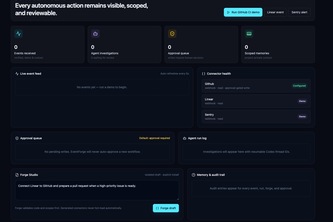
EventForge MCP is a self-reported plug-and-play Model Context Protocol (MCP) server and plugin that enables Codex to respond proactively to events via native hooks and on-demand connector forging. It claims to integrate with GitHub, Linear, Sentry, CI systems, and other tools, allowing developers to automate workflows using GPT-5.6-assisted dynamic tool generation.
What changed
The project was built as a hackathon submission (OpenAI 2026) over four days by one developer, Jorge de los Santos. It leverages Codex + GPT-5.6 for scaffolding and implementation, with an optional Electron overlay for user interaction.
Single most important open question
Is there any evidence of actual usage or traction beyond the author’s own development environment?
What The Product Actually Is
The description states that EventForge MCP is a plug-and-play MCP server + plugin, built as a native event hooks engine and dynamic forging tool. It includes:
- An Event Hooks Engine capable of listening for webhooks or polling from systems like GitHub, Linear, Sentry, CI tools.
- A Dynamic Forge Tool that allows users to type
/forgein Codex to generate connectors on-demand using GPT-5.6. - Persistent Memory & Observability, including vector + graph stores and auto-reviewer sub-agents.
- An optional Electron overlay for desktop integration.
The author claims the system was built with Codex + GPT-5.6, where ~80% of the code was generated by the agent, and the rest reviewed and polished manually.
Inference The product appears to be a developer tool aimed at enabling autonomous engineering workflows through event-driven automation within Codex.
Positioning & Claim Evolution
The author positions EventForge MCP as:
- A solution to a major gap in Codex: lack of native event hooks and automations.
- A plug-and-play MCP server + plugin that turns Codex into an “autonomous engineering teammate.”
- A tool that allows developers to forge connectors instantly, without leaving the app.
It is described as addressing a #1 requested feature on GitHub, suggesting it responds to community demand.
The claim evolution shows:
- From a hackathon prototype to a fully working MVP with safety, memory, and observability.
- From a proof-of-concept to a complete product experience.
- From community-driven inspiration to a potential open-source contribution or partnership.
Inference The positioning is focused on solving developer workflow inefficiencies in agent-based coding environments, especially around automation and integration.
Target Customer & ICP
The description states that EventForge MCP targets developers working with Codex, particularly those who:
- Monitor PRs, tickets, CI failures, and alerts manually.
- Want to reduce friction in custom integrations.
- Are looking for autonomous engineering teammates.
It is implied that the primary users are engineers or DevOps professionals using Codex as a coding agent, especially in environments where automation and tooling are critical.
There is no explicit mention of enterprise customers, end-users, or specific verticals beyond general software development.
Inference The ICP likely centers on technical users with access to Codex, who are interested in reducing manual oversight through event-driven workflows.
Business Model & Pricing Evidence
No evidence of pricing, monetization strategy, or business model is provided in the description. The author does not state whether EventForge MCP will be offered as:
- A freemium product,
- A paid SaaS offering,
- An open-source tool with optional enterprise support,
- Or something else.
The project is described as a hackathon submission, and there is no indication of revenue, customer acquisition, or monetization plans.
Inference The business model remains unknown. It may be open-source or part of a larger ecosystem, but this is not stated.
Technical & Delivery Signals
Key technical elements mentioned:
- Built using Codex + GPT-5.6, with ~80% of code generated by the agent.
- Uses Node.js, TypeScript, stdio/HTTP JSON-RPC, and Electron.
- Implements MCP server architecture, plugin manifests, and tool discovery.
- Includes dynamic forging logic, memory store, safety layers, and real-time UI sync.
- Features worktrees for parallel agent collaboration.
The author notes that the system was built in a tight 4-day timeline, which suggests rapid prototyping and possibly limited scalability or robustness.
Inference The technical stack is aligned with modern developer tooling, but delivery signals point to a prototype-level solution, not production-ready software.
Traction & Maturity Signals
There is no evidence of:
- Revenue,
- Customers,
- User adoption,
- Product usage metrics,
- Market traction,
- Any form of pilot or beta program.
The project is described as a hackathon submission and was built by one person over four days. The author emphasizes that it’s a fully working MVP, but does not provide any data on real-world impact or user feedback.
Inference There are no traction or maturity signals beyond the self-reported development effort and prototype functionality.
Competitive Context
The description does not mention specific competitors or direct substitutes for EventForge MCP. However, it implies a space involving:
- Agent-based coding tools (e.g., Codex),
- Event-driven automation platforms,
- MCP ecosystem integrations,
- Developer workflow automation tools.
It references the Codex community’s demand for native hooks and automations, suggesting that this is an unmet need in the current agent tooling landscape.
Inference The competitive context is unclear due to lack of competitor names or market positioning. It likely competes with or complements existing agent frameworks and automation tools, but no direct comparison is made.
Open Questions & Risks
- Unverified claims: All information comes from a single self-reported source.
- No traction or revenue data: No evidence of users, customers, or monetization.
- Prototype nature: Built in 4 days by one person; unclear if it’s scalable or production-ready.
- Dependency on GPT-5.6 and Codex: If these tools evolve or become unavailable, the product may lose relevance.
- Safety concerns: The system includes safety layers but lacks details on how they are enforced or tested.
- Single-founder model: No team or organizational structure is evident beyond one individual.
Inference The project is a highly speculative prototype, with no evidence of commercial viability, market traction, or long-term sustainability.
Questions the description leaves open
- What specific use cases have you validated in your own workflow?
- How does the system handle sensitive file access or edge-case failures?
- Are there any known limitations or scalability issues with the current implementation?
- What is the plan for open-sourcing or commercializing this tool?
- Have you tested the dynamic forging engine on real-world integrations beyond the MVP scope?
- How do you intend to onboard users or train them in using the system?
- Is there any interest from Codex or OpenAI teams in adopting or supporting this project?
Overall Assessment
Not evidenced.
The description provides no data on:
- Financials,
- Customer base,
- Market size,
- Competitive positioning,
- Go-to-market strategy,
- Team strength,
- Product roadmap,
- Any form of traction or validation.
This is a self-reported hackathon project with no independent verification, and no evidence of commercial readiness or market demand.
Inference Based on the available information, there is insufficient basis to assess whether this represents a viable investment or partnership opportunity. It remains a highly speculative idea, not a product with demonstrated traction or business potential.
User Stories BotA demo video on every pull request
Get a demo video on every new feature
GitHub App that watches your pull requests and records a narrated, captioned demo.
Save time on demo prep and make informed decisions faster with a video walkthrough of every new feature.
Source
Submitted to the OpenAI 2026 hackathon on Devpost. Project home on Devpost. Back to the full gallery on Devpost.
This competitive analysis was produced by top-founders.com (opens in a new tab)
Generated by a language model from this project's public Devpost page — its tagline, the author's own write-up and any built-with tags listed there — as captured in August 2026. Short quotations are the author's words. It is an opinion on the idea as a business, not on the people behind it, and it reflects the description as published then. If the project has moved on, request a correction below. The analysis is not independent research and contains no verified traction, revenue or customer data.
An independent guide by KFG International LLC — not affiliated with, endorsed by, or connected to Devpost or OpenAI.