

Archive position — measured, not model output
1 like on Devpost
505 of the 7,850 archived projects have more likes, and 1,758 share exactly 1 — so this project's #1,027 place in the like-ranked listing is a tie-break inside that group, not a ranking.
Projects (log scale)
Likes on Devpost. ▲ marks this project's group.
Show the figures
| Likes | Projects | Share of archive |
|---|---|---|
| 0 | 5,587 | 71.2% |
| 1 | 1,758 | 22.4% |
| 2 | 284 | 3.6% |
| 3–4 | 132 | 1.7% |
| 5–9 | 75 | 1.0% |
| 10+ | 14 | 0.2% |
 User Stories BotA demo video on every pull request
Get a demo video on every new feature
GitHub App that watches your pull requests and records a narrated, captioned demo.
Save time on demo prep and make informed decisions faster with a video walkthrough of every new feature.
Executive Summary
Company: Eventyx
Self-reported basis: The description is entirely from the author’s own submission to the OpenAI 2026 hackathon on Devpost. It is unverified and contains no evidence of revenue, customers, or traction.
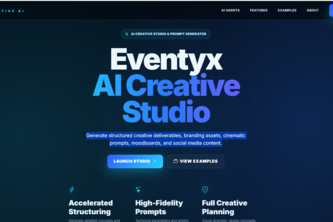
What it appears to be: A web-based creative ideation tool that uses AI to structure user-provided prompts into organized deliverables such as branding assets, cinematic prompts, moodboards, and social media content.
What changed: The author describes building a platform for creative professionals to organize ideas using AI, with an emphasis on simplicity and exportability in Markdown format.
Most important open question: Is there evidence of user adoption or product-market fit beyond the single developer's prototype?
What The Product Actually Is
The description states that Eventyx is a web-based platform for creative professionals (designers, content producers, etc.) to transform an initial idea into structured creative deliverables using AI. It supports:
- Generating visual directions, branding assets, cinematic prompts, moodboards, and social media content.
- Organizing outputs in sections.
- Exporting results in Markdown format.
- Maintaining a history of generations.
- Favoriting projects.
- Using different creative environments.
- Responsive UI for desktop and mobile.
The author notes that the tool was built with front-end development, AI API integration, and a focus on user experience, aiming to avoid technical complexity while enabling structured output from AI prompts.
Inference: The product is described as a prototype or MVP, not a commercial offering. It is not evidenced to be in production or used by others beyond the single developer.
Positioning & Claim Evolution
The author positions Eventyx as a tool for creative professionals who use AI in their workflows. The core claim is that it helps users:
- Transform simple ideas into structured, actionable outputs.
- Avoid losing good ideas in fragmented notes or disconnected prompts.
- Continue work seamlessly using Markdown exports.
It is described as a platform to organize and refine AI-generated content, not just generate text.
Inference: The positioning reflects an early-stage idea for a creative workflow tool. There is no evidence of market validation, branding, or messaging beyond the author’s own description.
Target Customer & ICP
The description states that Eventyx targets:
- Designers
- Content producers
- Creative professionals who use AI in their work
It is implied that these users are looking for tools to organize and structure AI-generated content, especially when dealing with fragmented ideas or prompts.
Inference: The ICP is not clearly defined beyond a general category of creative professionals. No segmentation, persona data, or user research is provided.
Business Model & Pricing Evidence
No business model or pricing information is provided in the description.
Not evidenced: There is no mention of monetization, subscriptions, freemium tiers, or any commercial structure.
Technical & Delivery Signals
The author states that Eventyx was built as a web application, using:
- Front-end technologies (HTML5, CSS3, JavaScript)
- AI APIs (via GROQ and other tools)
- Markdown export functionality
- Responsive design for desktop and mobile
It includes features like:
- History of generations
- Favorite projects
- Multiple creative environments
- Export to Markdown
Inference: The technical stack suggests a lightweight, modern web app. No evidence of scalability, infrastructure, or backend architecture beyond the author’s own development.
Traction & Maturity Signals
The description states that Eventyx is a prototype, built by one developer (Alexandre Salerno Neto) for the OpenAI 2026 hackathon.
Not evidenced: There is no evidence of:
- Revenue
- Customers
- User engagement or retention
- Product-market fit
- Any form of traction beyond the single-person development effort
Competitive Context
The description does not mention any competitors. It is unclear whether Eventyx is positioned against existing AI creative tools, such as MidJourney, DALL·E, Notion, or other prompt-based platforms.
Not evidenced: No competitive analysis, market positioning, or differentiation from similar tools is provided.
Open Questions & Risks
- Single developer: The project is built by one person, which raises questions about scalability and long-term maintenance.
- No commercial traction: There is no evidence of users, revenue, or adoption beyond the author’s own development.
- Unproven market fit: The description does not show any validation of demand or user feedback.
- Prototype-only: It is described as a hackathon submission, not a product in production.
- No monetization strategy: No pricing, business model, or revenue path is evident.
Questions the description leaves open
- What specific creative workflows does Eventyx address, and how do you know users need this?
- Have you tested the tool with real users beyond yourself?
- How do you plan to scale beyond a single developer?
- What are your plans for monetization or commercial viability?
- Do you have any feedback from users or early adopters?
- What is the long-term vision for the product, and how does it differ from existing tools?
Overall Assessment
Not evidenced: There is no evidence of revenue, customers, traction, or a clear path to monetization.
Confidence level: Low — the description is entirely self-reported and lacks any commercial data. It appears to be an early-stage prototype or hackathon project with no demonstrated product-market fit or business model.
Assessment: Not ready for investment or partnership at this stage. The author states that Eventyx is a prototype, and there is no evidence of traction, users, or commercial viability beyond the single developer’s effort.
User Stories BotA demo video on every pull request
Get a demo video on every new feature
GitHub App that watches your pull requests and records a narrated, captioned demo.
Save time on demo prep and make informed decisions faster with a video walkthrough of every new feature.
Source
Submitted to the OpenAI 2026 hackathon on Devpost. Project home on Devpost. Back to the full gallery on Devpost.
This competitive analysis was produced by top-founders.com (opens in a new tab)
Generated by a language model from this project's public Devpost page — its tagline, the author's own write-up and any built-with tags listed there — as captured in August 2026. Short quotations are the author's words. It is an opinion on the idea as a business, not on the people behind it, and it reflects the description as published then. If the project has moved on, request a correction below. The analysis is not independent research and contains no verified traction, revenue or customer data.
An independent guide by KFG International LLC — not affiliated with, endorsed by, or connected to Devpost or OpenAI.