

Archive position — measured, not model output
0 likes on Devpost
2,263 of the 7,850 archived projects have more likes, and 5,587 share exactly 0 — so this project's #2,990 place in the like-ranked listing is a tie-break inside that group, not a ranking.
Projects (log scale)
Likes on Devpost. ▲ marks this project's group.
Show the figures
| Likes | Projects | Share of archive |
|---|---|---|
| 0 | 5,587 | 71.2% |
| 1 | 1,758 | 22.4% |
| 2 | 284 | 3.6% |
| 3–4 | 132 | 1.7% |
| 5–9 | 75 | 1.0% |
| 10+ | 14 | 0.2% |
 User Stories BotA demo video on every pull request
Get a demo video on every new feature
GitHub App that watches your pull requests and records a narrated, captioned demo.
Save time on demo prep and make informed decisions faster with a video walkthrough of every new feature.
Executive Summary
Bos is described by its author as an AI-native operating system for physical businesses, intended to unify customer interactions and operational data into a real-time dashboard with AI-powered insights. The project was built during a hackathon and is presented as a foundational prototype for a future platform that could span all physical business types.
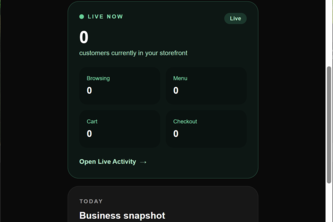
The description states Bos aims to replace fragmented tools used by owners—such as POS systems, reservation software, and analytics dashboards—with one integrated system powered by AI. It includes features like live customer activity tracking, an AI copilot, and order placement capabilities.
Key claims include:
- Bos is built using GPT-5 (self-reported)
- The architecture is event-driven
- It supports a customer-facing experience and owner-facing dashboard
- The long-term vision includes predictive intelligence, scheduling, inventory, marketing automation, and voice-first management
What Changed
The author describes the project as an experiment in building an AI-native operating system for physical businesses, rather than another ordering platform. This represents a shift from traditional point solutions to a foundational layer.
Single Most Important Open Question
Is there evidence that Bos has moved beyond prototype stage or demonstrated any traction with real users or customers?
What The Product Actually Is
The description states Bos is an AI-native operating system for physical businesses, combining customer interactions and operational data into a unified experience. It includes:
- A customer-facing interface allowing:
- Discovery of businesses
- Menu browsing
- Ordering
- Building relationships with the business
- An owner-facing dashboard providing:
- Real-time customer activity
- Live customer sessions
- AI-powered insights
- Unified business management
- AI Copilot assistance
The system is described as event-driven, where customer interactions generate structured events that power live business intelligence.
Inference The product appears to be a prototype built for demonstration purposes, not yet deployed in production at scale. It includes basic functionality such as login, menu browsing, ordering, and dashboard access, but no evidence of actual user adoption or revenue generation.
Positioning & Claim Evolution
The author positions Bos as an AI operating system for physical businesses, aiming to replace disconnected tools with a single integrated platform. The core claim is that AI should become the "operating layer" for businesses rather than just another chatbot.
Key claims:
- Bos is not another ordering platform but a foundational OS
- AI becomes more valuable with continuous operational context
- The system supports real-time understanding of customer behavior and business events
Inference The positioning evolved from a hackathon prototype to a long-term vision for all physical businesses. However, there is no evidence of market validation or product-market fit beyond the initial build.
Target Customer & ICP
The description states Bos targets physical business owners, particularly in the restaurant vertical as its first focus. It also mentions that the long-term goal is to support "every physical business."
The customer-facing side allows:
- Customers to discover businesses
- Browse live menus
- Place orders
- Begin building a relationship with the business
The owner-facing side provides:
- Live operational view of the business
- AI-powered insights
- Unified management tools
Inference The ICP appears to be small-to-medium-sized physical businesses, especially those in food service. However, no evidence is provided about actual customer acquisition or user feedback.
Business Model & Pricing Evidence
There is no evidence of pricing information, business model details, or monetization strategy in the description.
The author does not state whether Bos will charge per business, per user, or offer freemium tiers. No mention of revenue streams, subscriptions, or transaction fees.
Inference The business model remains undefined and speculative based on the self-reported content alone.
Technical & Delivery Signals
The project is built using:
- OpenAI GPT-5 (self-declared)
- Next.js
- React
- TypeScript
- Prisma
- Better Auth
- SQLite
- Railway
Architecture is described as event-driven, with structured events powering live business intelligence and enabling AI reasoning about customer behavior in real time.
Inference The tech stack suggests a modern full-stack web application built for rapid prototyping. However, no evidence of scalability, performance metrics, or production deployment beyond the demo environment.
Traction & Maturity Signals
The description states:
- Bos was built during a hackathon
- A live demo is available at https://business-os-production-1a44.up.railway.app/
- Demo account credentials are provided for access
- Accomplishments include:
- Live customer presence
- Event-driven activity tracking
- AI Copilot
- Customer ordering
- Reservation foundations
- Business operational dashboard
- Production deployment
Inference The project is at a prototype or demo stage. No evidence of real-world usage, user engagement, or revenue generation.
Competitive Context
The description does not mention competitors or direct market comparisons.
It implies Bos aims to unify fragmented tools used by physical business owners—such as POS systems, reservation software, delivery platforms, review sites, analytics dashboards, messaging apps, and spreadsheets—but no specific competitive landscape is described.
Inference The competitive context is unclear. No evidence of existing players or market positioning against them.
Open Questions & Risks
- Unverified claims: The use of GPT-5 is self-reported; no verification that this model was actually used.
- Prototype-only status: No evidence of real users, adoption, or monetization.
- No traction data: No customer base, revenue, or usage metrics are provided.
- Unclear business model: No indication of how Bos will generate value or income.
- Limited team size: Only one team member is listed (begintolern Ouano), raising questions about execution capacity.
Inference The project lacks commercial viability indicators and may be more of a concept than a product in development.
Questions the description leaves open
- What specific operational data sources does Bos integrate with, and how is that data collected?
- How does Bos differentiate itself from existing POS or restaurant management platforms?
- Are there any actual customers using Bos today, or is it purely a prototype?
- Has the team validated demand for this type of AI-native operating system among physical business owners?
- What are the technical limitations of the current architecture that would prevent scaling to multiple business types?
- How does Bos plan to monetize its platform, and what pricing structure is envisioned?
Overall Assessment
Not evidenced
There is no evidence of revenue, customers, traction, or a clear path to profitability. The project is presented as a hackathon prototype with limited commercial readiness.
The description makes strong claims about AI integration and business transformation but lacks substantiation in terms of real-world performance or market validation.
Confidence Level Low
This is a self-reported, unverified account of a product under development. No independent verification exists to support any commercial due-diligence conclusions.
User Stories BotA demo video on every pull request
Get a demo video on every new feature
GitHub App that watches your pull requests and records a narrated, captioned demo.
Save time on demo prep and make informed decisions faster with a video walkthrough of every new feature.
Source
Submitted to the OpenAI 2026 hackathon on Devpost. Project home on Devpost. Back to the full gallery on Devpost.
This competitive analysis was produced by top-founders.com (opens in a new tab)
Generated by a language model from this project's public Devpost page — its tagline, the author's own write-up and any built-with tags listed there — as captured in August 2026. Short quotations are the author's words. It is an opinion on the idea as a business, not on the people behind it, and it reflects the description as published then. If the project has moved on, request a correction below. The analysis is not independent research and contains no verified traction, revenue or customer data.
An independent guide by KFG International LLC — not affiliated with, endorsed by, or connected to Devpost or OpenAI.