

Archive position — measured, not model output
1 like on Devpost
505 of the 7,850 archived projects have more likes, and 1,758 share exactly 1 — so this project's #1,024 place in the like-ranked listing is a tie-break inside that group, not a ranking.
Projects (log scale)
Likes on Devpost. ▲ marks this project's group.
Show the figures
| Likes | Projects | Share of archive |
|---|---|---|
| 0 | 5,587 | 71.2% |
| 1 | 1,758 | 22.4% |
| 2 | 284 | 3.6% |
| 3–4 | 132 | 1.7% |
| 5–9 | 75 | 1.0% |
| 10+ | 14 | 0.2% |
 User Stories BotA demo video on every pull request
Get a demo video on every new feature
GitHub App that watches your pull requests and records a narrated, captioned demo.
Save time on demo prep and make informed decisions faster with a video walkthrough of every new feature.
Executive Summary
What the company appears to be
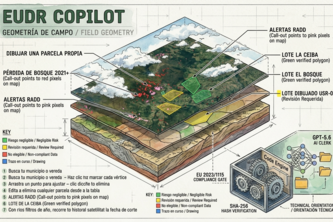
EUDR Copilot is a browser-based tool designed to help exporters comply with the EU Deforestation Regulation (EUDR). It enables users to map farm plots, validate their geometry, screen for forest presence using satellite data, and collect legality-related declarations. The system generates an auditable decision per plot or farm, which can be ready to declare, under human review, or blocked. It integrates with real APIs like Whisp (via Open Foris) and uses AI (GPT-5.6) for advisory support but not for final decisions.
What changed
The project was built as a hackathon submission (Devpost entry), likely in response to the complexity of EUDR compliance, particularly around proving that commodities are deforestation-free after 31 December 2020 and legally produced. The authors emphasize that their tool is not about scoring risk but about generating evidence that can be audited.
Single most important open question
Is there a viable commercial path from this prototype to a product used by real exporters or compliance officers, and how does it scale beyond the current browser-based monolith with limited backend integration?
What The Product Actually Is
The description states that EUDR Copilot is a browser-based modular monolith designed for EUDR compliance. It allows users to:
- Draw farm plots via satellite imagery or import them as GeoJSON/GPX.
- Validate plot geometry (e.g., self-intersections, overlaps).
- Screen each plot for forest presence using real satellite data from Whisp API.
- Collect legality-related declarations (tenure, land use, labour, FPIC) with SHA-256 hashed documents.
- Generate a draft Due Diligence Statement (DDS) per plot or farm, including geolocation, product, and all checks with source, version, date, and hash.
- Provide an AI advisor (GPT-5.6) that explains what is missing and why a plot went to review — without making compliance decisions.
It also includes:
- A deterministic engine separating validation logic from UI.
- Zero runtime dependencies.
- 63 automated tests covering safety-critical invariants.
- Persistent case files stored locally using localStorage, exportable as JSON.
Inference This is not a SaaS product yet — it's a prototype or proof-of-concept built for a hackathon. It lacks backend infrastructure and real-time data handling beyond local storage.
Positioning & Claim Evolution
The description states that EUDR Copilot was built "for the auditor, not for the dashboard." This reflects a positioning shift away from tools that offer compliance scores or dashboards toward ones that produce auditable evidence.
It claims:
- Compliance is not about risk scoring but about proving three things: deforestation-free status, legal production, and due diligence statement.
- Proof must be re-openable by third parties — not just a number.
- The tool refuses to issue a DDS unless both pillars (forest screening and legality) reach negligible risk.
Inference The positioning is rooted in regulatory rigor rather than ease-of-use or automation. It aims to be an enabler of compliance, not a decision-maker.
Target Customer & ICP
The description states that EUDR Copilot targets cocoa exporters in Colombia, who face the risk of shipment delays due to missing farm boundaries, ambiguous satellite signals, or unverifiable land titles.
It also implies:
- Exporters who must comply with Regulation (EU) 2023/1115.
- Users who need to generate auditable evidence for regulators or third-party auditors.
- Operators working in rural areas where field capture of plots is necessary due to lack of public data.
Inference The ICP appears to be small-to-medium-sized exporters or compliance teams within commodity supply chains, particularly those dealing with agricultural products like cocoa, coffee, or palm oil in regions where land tenure and satellite coverage are fragmented.
Business Model & Pricing Evidence
Not evidenced.
The description does not mention:
- Revenue model.
- Pricing structure.
- Customer acquisition strategy.
- Monetization approach.
- Any commercial relationships or pilot programs.
Inference There is no evidence of a business model or pricing plan. The product is presented as a prototype with a live demo, but no indication of how it would be monetized or sold.
Technical & Delivery Signals
The description states:
- Built with browser-based modular monolith, zero runtime dependencies.
- Uses OpenAI Codex and Claude Code for development.
- Integrates with real APIs like Whisp, Sentinel-1/2, Global Forest Watch, OpenStreetMap, Nominatim, Open Foris, EOX, ESRI, etc.
- Implements SHA-256 hashing for document integrity and evidence verification.
- Uses localStorage for persistent case files, exportable as JSON.
- Includes 63 automated tests covering safety-critical invariants.
- Engine is a pure module, separated from UI.
- Adheres to EUDR requirements like Art. 4(3) retention duty.
Inference The technical stack suggests a lightweight, client-side solution with strong emphasis on traceability and auditability. It shows awareness of regulatory constraints but lacks backend or cloud infrastructure for scaling.
Traction & Maturity Signals
Not evidenced.
The description does not provide:
- Revenue data.
- Customer base.
- Adoption metrics.
- Usage statistics.
- Pilot programs or partnerships.
- Product roadmap beyond the hackathon.
Inference This is a prototype, likely built in a short timeframe for a hackathon. No evidence of traction or maturity beyond initial development and testing.
Competitive Context
Not evidenced.
The description does not:
- Name competitors.
- Describe existing tools in the EUDR compliance space.
- Compare features or performance.
- Mention market size or competitive dynamics.
Inference There is no indication of awareness of the competitive landscape. The authors appear to be solving a problem without reference to prior solutions, suggesting either limited market research or that this is a niche area with few direct competitors.
Open Questions & Risks
- Prototype-only: The tool is presented as a hackathon prototype with no backend or cloud infrastructure.
- Limited scalability: Relies on localStorage and local file handling; not designed for enterprise use.
- No real-time API integration: Real Whisp API requires keys, but the public demo fakes responses by archiving real ones — this may not be sustainable.
- No commercialization path: No mention of pricing, monetization or go-to-market strategy.
- High dependency on field capture: The system assumes field-based plot capture due to lack of public data, which is labor-intensive and hard to scale.
- Limited AI role: GPT-5.6 is used for explanation only — not for decision-making — which may limit perceived utility.
Inference The tool is not ready for commercial deployment or enterprise adoption without significant engineering and business development work.
Questions the description leaves open
- What are the actual compliance workflows in Colombia, and how does this tool fit into them?
- How do you plan to transition from a browser-based prototype to a scalable backend solution?
- Are there any pilot users or partnerships with exporters already?
- How will you handle data retention and export compliance under Art. 4(3)?
- What is the long-term vision for integrating with TRACES schema or other regulatory systems?
- How do you intend to monetize this tool, and what is your go-to-market strategy?
- What are the limitations of the current Whisp API integration, and how will they be addressed?
- Can the system support multiple countries or regions beyond Colombia?
Overall Assessment
Not evidenced.
The description does not provide:
- Valuation.
- Funding history.
- Investor interest.
- Strategic partnerships.
- Exit potential.
Inference This is a pre-product, pre-revenue, pre-traction prototype. It shows strong technical understanding of EUDR compliance and regulatory requirements but lacks commercial viability indicators. A partnership or early-stage investment might make sense if the founders plan to build out backend infrastructure and target specific commodity exporters, but there is no evidence of such plans in the description.
User Stories BotA demo video on every pull request
Get a demo video on every new feature
GitHub App that watches your pull requests and records a narrated, captioned demo.
Save time on demo prep and make informed decisions faster with a video walkthrough of every new feature.
Source
Submitted to the OpenAI 2026 hackathon on Devpost. Project home on Devpost. Back to the full gallery on Devpost.
This competitive analysis was produced by top-founders.com (opens in a new tab)
Generated by a language model from this project's public Devpost page — its tagline, the author's own write-up and any built-with tags listed there — as captured in August 2026. Short quotations are the author's words. It is an opinion on the idea as a business, not on the people behind it, and it reflects the description as published then. If the project has moved on, request a correction below. The analysis is not independent research and contains no verified traction, revenue or customer data.
An independent guide by KFG International LLC — not affiliated with, endorsed by, or connected to Devpost or OpenAI.