

Archive position — measured, not model output
0 likes on Devpost
2,263 of the 7,850 archived projects have more likes, and 5,587 share exactly 0 — so this project's #2,987 place in the like-ranked listing is a tie-break inside that group, not a ranking.
Projects (log scale)
Likes on Devpost. ▲ marks this project's group.
Show the figures
| Likes | Projects | Share of archive |
|---|---|---|
| 0 | 5,587 | 71.2% |
| 1 | 1,758 | 22.4% |
| 2 | 284 | 3.6% |
| 3–4 | 132 | 1.7% |
| 5–9 | 75 | 1.0% |
| 10+ | 14 | 0.2% |
 User Stories BotA demo video on every pull request
Get a demo video on every new feature
GitHub App that watches your pull requests and records a narrated, captioned demo.
Save time on demo prep and make informed decisions faster with a video walkthrough of every new feature.
Executive Summary
What the company appears to be
Boplicity is a self-reported interactive bebop trainer built as a single-page web application. The author, Saul Sanchez, describes it as an improvisation training tool that listens to live MIDI solos, evaluates musical language, and converts performances into notation and feedback.
What changed
The project was developed during OpenAI Build Week by one person (Saul Sanchez) and is described as a prototype with no verified revenue, customers or traction. It uses AI tools like Codex and GPT-5.6 for development but does not appear to have moved beyond the hackathon stage.
Single most important open question
Is there any evidence that Boplicity has been used by users beyond its creator, or whether it has achieved any form of adoption or feedback from musicians?
What The Product Actually Is
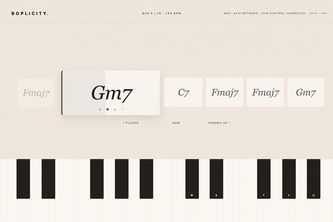
The description states that Boplicity is an interactive bebop improvisation trainer. It supplies a rhythm section and chord changes, listens to single-note MIDI solos, evaluates musical language, and converts performances into readable notation, feedback, and annotations.
It supports:
- Practice of 16-bar ii–V–I progressions in any of the 12 keys
- Tempo and feel selection
- Scoring difficulty options
- Recognition of musical devices such as guide tones, chord tones, arpeggios, enclosures, chromatic approaches, anticipations, rhythmic phrasing, and unresolved notes
The app provides two complementary evaluations:
- Arcade score (rewarding vocabulary and momentum)
- Musicianship grade (comparing performance with patterns from transcribed solos by jazz musicians)
After a solo, it presents the performance as musical notation using VexFlow, with color-coded notes indicating performance quality.
It also includes Learn Mode that turns feedback into exercises covering guide tones, chord tones, and arpeggios, followed by graded synthesis sessions.
Notably, Boplicity is described as a no-build, single-page application built with HTML, CSS, JavaScript, Web MIDI, Tone.js, VexFlow, and local storage for progress tracking.
Positioning & Claim Evolution
The author positions Boplicity as an educational tool that bridges the gap between subjective musical evaluation and concrete feedback. It aims to help both students and teachers by providing measurable evidence of performance.
Key claims:
- “I built Boplicity to give improvisers and teachers something more concrete.”
- “Instead of only hearing that something went wrong, the player can see what happened over the exact chord.”
- “Boplicity is not meant to replace a great teacher—it is designed to work alongside one.”
These statements suggest an intent to support music education through technology, particularly in jazz improvisation. However, there is no evidence of actual market positioning or messaging beyond the author’s own description.
Target Customer & ICP
The self-reported target audience includes:
- Jazz students and practitioners
- Music teachers who want to evaluate improvisations more precisely
- Improvisers seeking structured feedback on their performances
The description implies a focus on jazz musicians, especially those interested in bebop. The tool is designed for use with MIDI input, suggesting it targets users who have access to MIDI controllers or digital keyboards.
There is no evidence of segmentation beyond this general category, nor any indication of specific demographics or usage patterns.
Business Model & Pricing Evidence
The description does not provide any information about pricing, monetization strategies, or business model. It is unclear whether Boplicity intends to be free, subscription-based, one-time purchase, or otherwise.
No revenue streams, licensing terms, or commercial partnerships are mentioned.
Technical & Delivery Signals
Boplicity is described as a no-build, single-page application built with:
- HTML, CSS, JavaScript
- Web MIDI for input
- Tone.js for audio system and rhythm section
- VexFlow for music notation
- LocalStorage for storing progress and calibration data
Key technical features include:
- Separation of measured performance timing from displayed notation
- Latency calibration workflow
- Chord-aware spelling in all 12 keys
- Adaptive rhythmic quantization
- MIDI and computer-keyboard input support
- Deterministic Demo Mode data
- Browser-based regression fixtures
The author notes that the most important engineering decision was separating performance timing from notation, which allows for both scoring accuracy and legibility.
Traction & Maturity Signals
There is no evidence of traction or user adoption beyond the creator’s own testing. The project is described as a prototype built during a hackathon, with no mention of:
- Users
- Customer feedback
- Revenue
- Product usage metrics
- Market validation
The author explicitly states that turning this into a market-ready product would require substantial investment and development.
Competitive Context
No competitive landscape or comparison to existing tools is provided in the description. The author does not reference other music education platforms, apps, or tools used for jazz training or improvisation evaluation.
There is no indication of how Boplicity might differentiate itself from similar offerings, if any exist.
Open Questions & Risks
- No verified users or adoption: The product exists only as a prototype with no evidence of real-world usage.
- Single-person development: With only one team member (Saul Sanchez), scalability and long-term maintenance are uncertain.
- Limited input support: Currently works best with MIDI; acoustic piano and other instruments require additional development.
- Unproven commercial viability: No pricing, monetization or business model described.
- AI dependency without clear value proposition: While AI was used in development, the core product does not appear to rely on AI for its primary function.
Questions the description leaves open
- Has Boplicity been tested with real users beyond the creator?
- What is the plan for expanding beyond MIDI input and supporting acoustic instruments?
- Are there any plans for monetization or commercial partnerships?
- How does the scoring system account for different styles of jazz or individual player preferences?
- What are the key technical challenges that remain unresolved before launch?
Overall Assessment
Not evidenced.
There is no evidence of revenue, customer base, traction, or market validation to support an investment or partnership decision. The project remains a self-reported prototype developed during a hackathon with no verified commercial activity.
The author acknowledges the need for significant further development to make Boplicity market-ready, including audio processing, content creation, compatibility testing, and music education design. Without evidence of progress beyond this stage, any strategic move would be speculative at best.
User Stories BotA demo video on every pull request
Get a demo video on every new feature
GitHub App that watches your pull requests and records a narrated, captioned demo.
Save time on demo prep and make informed decisions faster with a video walkthrough of every new feature.
Source
Submitted to the OpenAI 2026 hackathon on Devpost. Project home on Devpost. Back to the full gallery on Devpost.
This competitive analysis was produced by top-founders.com (opens in a new tab)
Generated by a language model from this project's public Devpost page — its tagline, the author's own write-up and any built-with tags listed there — as captured in August 2026. Short quotations are the author's words. It is an opinion on the idea as a business, not on the people behind it, and it reflects the description as published then. If the project has moved on, request a correction below. The analysis is not independent research and contains no verified traction, revenue or customer data.
An independent guide by KFG International LLC — not affiliated with, endorsed by, or connected to Devpost or OpenAI.