

Archive position — measured, not model output
0 likes on Devpost
2,263 of the 7,850 archived projects have more likes, and 5,587 share exactly 0 — so this project's #6,913 place in the like-ranked listing is a tie-break inside that group, not a ranking.
Projects (log scale)
Likes on Devpost. ▲ marks this project's group.
Show the figures
| Likes | Projects | Share of archive |
|---|---|---|
| 0 | 5,587 | 71.2% |
| 1 | 1,758 | 22.4% |
| 2 | 284 | 3.6% |
| 3–4 | 132 | 1.7% |
| 5–9 | 75 | 1.0% |
| 10+ | 14 | 0.2% |
 User Stories BotA demo video on every pull request
Get a demo video on every new feature
GitHub App that watches your pull requests and records a narrated, captioned demo.
Save time on demo prep and make informed decisions faster with a video walkthrough of every new feature.
Executive Summary
What the company appears to be
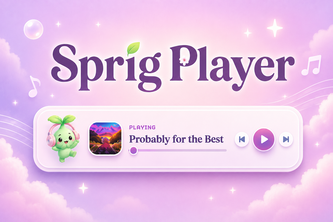
Sprig Music Player is a self-reported developer tool — a reusable web music player component with an animated companion character. The author states it was built as part of a hackathon project and intended for use in ChatGPT sites, with support for customization via a configuration-driven system.
What changed
The project evolved from a single idea into a reusable TypeScript package that can be integrated into websites. It includes features like animated companions, keyboard controls, accessibility support, and optional visual customization. The author also describes integrating the tool into two distinct website implementations (Pocket Goblin and Maple Was Here) using different companion characters.
Single most important open question
Is there any evidence of adoption or usage beyond the author’s own development work? The description does not indicate whether Sprig Player has been used by third parties, nor does it provide data on how many developers have integrated it or what kind of feedback they’ve given.
What The Product Actually Is
The description states that Sprig Player is a reusable, configuration-driven web music player. It includes:
- Play, pause, seeking, playlists, artwork, and playback persistence
- A built-in animated Sprig companion
- Support for custom companion artwork
- Dancing triggered by actual audio playback
- Optional musical notes and confetti
- Customizable colors, layouts, features, and storage behavior
- Keyboard controls, accessible labels, error handling, and reduced-motion support
- Paused-by-default behavior so websites never unexpectedly begin playing audio
It was built using React, TypeScript, HTML5 Audio, CSS, and tools like Codex through ChatGPT Work powered by GPT-5.6.
The author also mentions that it was integrated into two different website codebases — one using the built-in Sprig, another with a custom companion named DJ Neil.
Positioning & Claim Evolution
The author claims Sprig Player is designed to feel playful and alive without sacrificing accessibility or reliability, aiming to make music players feel less like control panels and more like companions.
It positions itself as a developer tool for embedding into ChatGPT sites, with the ability to customize the companion character. The core idea appears to be: “What if your music player enjoyed the song with you?”
This is a self-reported positioning, not validated by market data or customer feedback.
Target Customer & ICP
The description states that Sprig Player is intended for developers who want to embed a music player into websites, particularly those using ChatGPT sites. It supports configuration-driven customization, allowing developers to use either the built-in Sprig or their own character.
There is no indication of specific customer segments beyond this developer audience. No evidence of end-user targeting, pricing tiers, or segmentation strategies is provided.
Business Model & Pricing Evidence
Not evidenced.
The description does not mention any pricing model, monetization strategy, or business model. It is unclear whether Sprig Player is offered as open-source, freemium, paid, or otherwise.
Technical & Delivery Signals
- Built with React, TypeScript, HTML5 Audio, CSS
- Powered by Codex through ChatGPT Work, using GPT-5.6
- Includes automated tests (19 unit tests)
- Supports keyboard controls, accessibility labels, error handling, reduced-motion support
- Designed to be configuration-driven and reusable
- Integrated into two distinct website implementations
- Includes a Codex setup workflow that inspects a target site, asks about desired companion/config, creates wrapper, mounts player, and verifies result
These are all self-reported technical details. No independent validation or performance metrics are included.
Traction & Maturity Signals
Not evidenced.
There is no evidence of:
- Revenue
- Customers
- Usage statistics
- Adoption beyond the author’s own projects
- Product maturity beyond prototype stage
The project was submitted to a hackathon and described as a "developer tool" built in one week. No signs of commercial traction or long-term development are evident.
Competitive Context
Not evidenced.
There is no mention of existing competitors, nor any indication of how Sprig Player compares technically or functionally to other music player components or libraries.
Open Questions & Risks
- No evidence of adoption or usage beyond the author’s own work
- Self-reported only: All claims are unverified
- Limited scope: The tool appears to be a prototype, not a mature product
- Unproven market demand: No indication that developers or users have requested or adopted this solution
- No business model disclosed: Unclear how the project intends to generate value or revenue
Questions the description leaves open
- Has Sprig Player been used by other developers beyond your own projects?
- What is the intended pricing or monetization strategy for this tool?
- Are there any plans to expand beyond ChatGPT sites or web-based players?
- How does the configuration system handle edge cases or integration challenges with different website frameworks?
- Have you received any feedback from users or developers who tried integrating Sprig Player?
Overall Assessment
Not evidenced.
There is no evidence of commercial traction, revenue, or customer base to support an investment or partnership decision. The project is described as a hackathon submission and prototype — not a product with demonstrated market fit or scalability. Any potential for growth or commercialization remains speculative based on the author’s own claims.
User Stories BotA demo video on every pull request
Get a demo video on every new feature
GitHub App that watches your pull requests and records a narrated, captioned demo.
Save time on demo prep and make informed decisions faster with a video walkthrough of every new feature.
Source
Submitted to the OpenAI 2026 hackathon on Devpost. Project home on Devpost. Back to the full gallery on Devpost.
This competitive analysis was produced by top-founders.com (opens in a new tab)
Generated by a language model from this project's public Devpost page — its tagline, the author's own write-up and any built-with tags listed there — as captured in August 2026. Short quotations are the author's words. It is an opinion on the idea as a business, not on the people behind it, and it reflects the description as published then. If the project has moved on, request a correction below. The analysis is not independent research and contains no verified traction, revenue or customer data.
An independent guide by KFG International LLC — not affiliated with, endorsed by, or connected to Devpost or OpenAI.