

Archive position — measured, not model output
2 likes on Devpost
221 of the 7,850 archived projects have more likes, and 284 share exactly 2 — so this project's #314 place in the like-ranked listing is a tie-break inside that group, not a ranking.
Projects (log scale)
Likes on Devpost. ▲ marks this project's group.
Show the figures
| Likes | Projects | Share of archive |
|---|---|---|
| 0 | 5,587 | 71.2% |
| 1 | 1,758 | 22.4% |
| 2 | 284 | 3.6% |
| 3–4 | 132 | 1.7% |
| 5–9 | 75 | 1.0% |
| 10+ | 14 | 0.2% |
 User Stories BotA demo video on every pull request
Get a demo video on every new feature
GitHub App that watches your pull requests and records a narrated, captioned demo.
Save time on demo prep and make informed decisions faster with a video walkthrough of every new feature.
Executive Summary
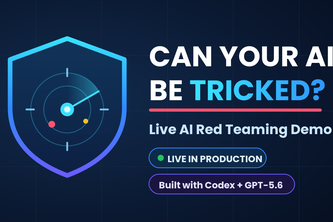
The Enterprise AI Security Red Teaming Platform is a self-reported tool that claims to test any AI model for security vulnerabilities using structured attack scenarios, CVSS scoring, and compliance mapping across six frameworks. It was built as part of an OpenAI 2026 hackathon submission by two founders, with the platform live in production on DigitalOcean. The description states it uses FastAPI, Next.js, React, GPT-5.6, and OpenAI Codex for development. No revenue, customer data, or traction evidence is provided.
Key commercial due-diligence read: The author claims the tool is "live right now" and can be used to run security tests against AI models. However, there is no evidence of actual customers, usage metrics, or financial performance. The platform's positioning as a solution for enterprise AI security is based on self-reported claims without verification.
What The Product Actually Is
The description states that the Enterprise AI Security Red Teaming Platform:
- Stress-tests any AI model for security and compliance weaknesses in minutes.
- Runs structured attack scenarios including prompt injection, sensitive data leakage, jailbreaking, hallucination, bias amplification, and promise violation.
- Transforms attacks through 10 stylistic techniques to bypass filters.
- Scores findings on CVSS v3.1.
- Maps results to six compliance frameworks (SOC 2, ISO 27001, GDPR, CCPA, NIST AI RMF, CPCSC).
- Compares vendors side by side.
- Generates an Executive Summary using OpenAI Codex and GPT-5.6.
The platform is described as built with FastAPI + PostgreSQL + SQLAlchemy for backend; Next.js, React, Tailwind for frontend; deployed on DigitalOcean.
Inference: The product appears to be a red-teaming tool focused on AI model security testing, designed for enterprise use cases involving compliance and vulnerability assessment.
Positioning & Claim Evolution
The author states that enterprises are adopting AI faster than they can secure it. They claim existing security scanners were built for deterministic software, not probabilistic AI — implying their platform fills a gap in the market.
They also state that the tool is designed to answer questions from legal and security teams about whether an AI can be tricked into leaking data, breaking rules, or violating compliance.
The positioning evolves from a hackathon demo to a production-ready tool that addresses real engineering challenges encountered during deployment.
Inference: The platform positions itself as a specialized solution for enterprise AI security testing, targeting organizations seeking audit-ready evidence and compliance mapping.
Target Customer & ICP
The description states the platform is intended for enterprises adopting AI models in customer support, internal tools, and decision-making processes. It is aimed at legal and security teams asking if their AI can be tricked into leaking confidential data or violating compliance.
It also mentions that non-engineers should be able to read the output — suggesting a need for executive-level summaries.
Inference: The primary ICP includes enterprise organizations using LLMs in critical functions, with internal stakeholders such as security officers, compliance teams, and executives who require plain-language reports on AI risks.
Business Model & Pricing Evidence
There is no evidence of pricing structure, revenue model, or monetization strategy in the provided description. The authors do not mention subscriptions, per-use fees, or any commercial arrangements.
Not evidenced: No indication of how the platform will generate revenue or what its business model entails.
Technical & Delivery Signals
The platform is described as live in production on DigitalOcean with an automated deploy pipeline. It uses FastAPI + PostgreSQL + SQLAlchemy for backend and Next.js, React, Tailwind for frontend.
Key technical details include:
- Use of OpenAI Codex and GPT-5.6 to build features like the Executive Summary.
- Deployment challenges encountered (e.g., database connection exhaustion, rolling-deploy deadlock) were resolved through engineering fixes.
- Features such as background job handling and error fallbacks were implemented using Codex.
Inference: The platform shows some technical maturity with production deployment and engineering problem-solving. However, no evidence of scalability or performance under load is provided.
Traction & Maturity Signals
The description states that the platform is “live right now” and can be opened and run a security test against AI models. It was built during a hackathon but has since been deployed in production.
Accomplishments mentioned include:
- Solving real engineering problems (e.g., database connection issues, deploy deadlocks).
- Shipping a new feature with Codex without breaking existing functionality.
- Producing outputs readable by non-engineers.
Not evidenced: No data on user adoption, customer engagement, or usage metrics. No evidence of revenue, customers, or product-market fit beyond the authors’ own claims.
Competitive Context
The description does not provide any information about competitors or market positioning relative to existing tools in AI security or red-teaming.
Not evidenced: No mention of competing platforms, market size, or competitive advantages.
Open Questions & Risks
- Unverified claims: The entire description is self-reported and unverified.
- No traction evidence: No customers, revenue, or usage data are provided.
- Limited team size: Only two members on the team.
- Unclear monetization: No business model or pricing strategy described.
- Hackathon origin: The product originated from a hackathon, which may imply limited commercial viability or long-term planning.
Inference: While the platform demonstrates engineering capability and addresses a potential market need, lack of traction, unclear monetization, and small team size raise concerns about scalability and commercial readiness.
Questions the description leaves open
- What specific AI models have you tested so far? Can you show examples of actual tests run?
- How many enterprises are currently using the platform, if any?
- What is your go-to-market strategy for reaching enterprise customers?
- Are there any known limitations or blind spots in the current testing capabilities?
- How do you plan to scale the platform beyond its current production setup?
- What is your roadmap for compliance certifications (e.g., SOC 2)?
- How are you handling data privacy and security concerns related to running tests on customer AI models?
Overall Assessment
The description states that the platform is live in production and can be used to test AI models, but there is no evidence of revenue, customers, or traction.
Confidence level: Low. The project is described as a hackathon demo turned into a production tool, but lacks key commercial signals such as users, monetization, or market validation.
Assessment: Not ready for investment or partnership at this stage. Further due diligence would require evidence of customer engagement, revenue, and product-market fit. The platform shows promise in addressing a niche but growing area of AI security, but current evidence does not support a commercial assessment beyond the authors’ own claims.
User Stories BotA demo video on every pull request
Get a demo video on every new feature
GitHub App that watches your pull requests and records a narrated, captioned demo.
Save time on demo prep and make informed decisions faster with a video walkthrough of every new feature.
Source
Submitted to the OpenAI 2026 hackathon on Devpost. Project home on Devpost. Back to the full gallery on Devpost.
This competitive analysis was produced by top-founders.com (opens in a new tab)
Generated by a language model from this project's public Devpost page — its tagline, the author's own write-up and any built-with tags listed there — as captured in August 2026. Short quotations are the author's words. It is an opinion on the idea as a business, not on the people behind it, and it reflects the description as published then. If the project has moved on, request a correction below. The analysis is not independent research and contains no verified traction, revenue or customer data.
An independent guide by KFG International LLC — not affiliated with, endorsed by, or connected to Devpost or OpenAI.