

Archive position — measured, not model output
0 likes on Devpost
2,263 of the 7,850 archived projects have more likes, and 5,587 share exactly 0 — so this project's #4,240 place in the like-ranked listing is a tie-break inside that group, not a ranking.
Projects (log scale)
Likes on Devpost. ▲ marks this project's group.
Show the figures
| Likes | Projects | Share of archive |
|---|---|---|
| 0 | 5,587 | 71.2% |
| 1 | 1,758 | 22.4% |
| 2 | 284 | 3.6% |
| 3–4 | 132 | 1.7% |
| 5–9 | 75 | 1.0% |
| 10+ | 14 | 0.2% |
 User Stories BotA demo video on every pull request
Get a demo video on every new feature
GitHub App that watches your pull requests and records a narrated, captioned demo.
Save time on demo prep and make informed decisions faster with a video walkthrough of every new feature.
Executive Summary
What the company appears to be
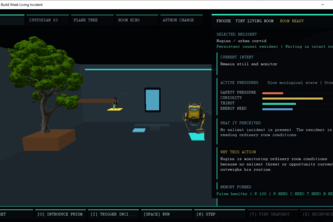
FROGUE: The Living Incident is a self-reported causal simulation engine built in C++20 for Windows, designed to model interactive worlds where entities (residents) perceive events through their own identity, embodiment, and memory. It uses a pulse-driven architecture with persistent residents that interpret the same incident differently based on their unique perspectives. A key feature is its integration of GPT-5.6 as a constrained natural-language interpreter for authoring changes, which are then validated by the simulation engine.
What changed
The project description indicates this is a vertical slice submitted to an OpenAI hackathon (Build Week), demonstrating a small but complete demonstration of the system's capabilities including resident perception, structural memory, counterfactual world branching, and natural-language authoring. It represents a focused implementation of a larger conceptual direction.
Single most important open question
Is there evidence that this simulation engine has been used beyond the hackathon context or in any production-like environment? The description does not indicate any commercial usage, revenue, or customer traction — only a self-contained demonstration project.
What The Product Actually Is
The description states that Frogue is a native C++ causal simulation and authoring engine. It includes:
- A pulse-driven framework for scheduling runtime work.
- A Watchtower system to record health and classify incidents.
- Tools such as:
- FrogueMesh: For mesh creation and material properties.
- FrogueEcho: Audio authoring with causal sound interaction (e.g., Doppler effect).
- Frogue Script: The engine’s native causal language used across all components.
- A custom runtime architecture using Win32, OpenGL, CMake.
- Integration of GPT-5.6 as a constrained interpreter for natural-language authoring.
It also claims to support:
- Self-awareness at 99.7% accuracy.
- Debugging during runtime.
- Deterministic event fixtures and guarded local interpreter.
- Persistent residents with memory, pressures, personality, and responsibility.
- Counterfactual world recalculations.
- Structural memory retention from incidents.
Inference: The system appears to be a simulation engine built for interactive storytelling or world-building where causality is central to how entities behave and react. It is not described as a general-purpose game engine or platform but rather a specialized toolset for creating persistent, explainable simulations.
Positioning & Claim Evolution
The author states that Frogue began from the question:
“What would an interactive world look like if every action remained grounded in visible causes?”
This suggests a positioning around causal simulation, explainability, and identity-driven interaction — not just AI-driven behavior or scripted responses.
Key claims:
- Residents perceive events through their own identity, embodiment, pressures, responsibilities, and memories.
- The system allows for counterfactual world recalculations instead of replaying alternatives.
- Natural-language authoring is constrained to ensure inspectability and validation by the simulation engine.
- GPT-5.6 is used only as a natural-language interpreter, not as an execution engine.
Inference: This project positions itself as a world-building tool with causal logic at its core, aimed at creators who want to build immersive, explainable simulations where entities have distinct and meaningful perspectives on shared events.
Target Customer & ICP
The description does not explicitly name target customers or define an Ideal Customer Profile (ICP). However, it implies:
- Developers interested in building living worlds with persistent residents.
- Content creators who want to explore identity-driven narratives in interactive environments.
- Researchers or academics studying simulation, causality, or embodied cognition.
It also mentions:
“The long-term aim is to help developers build living worlds that remain powerful without becoming opaque…”
This suggests a potential ICP of developers and studios working on advanced simulation or narrative systems, particularly those seeking tools for explainable AI in interactive media.
Inference: The target audience likely includes creators, developers, and researchers focused on interactive storytelling, simulation design, or embodied AI, though no specific customer segments are named.
Business Model & Pricing Evidence
There is no evidence of a business model or pricing structure. The project is described as a hackathon submission with no mention of monetization, licensing, or sales channels.
Inference: No commercial model has been reported; the system appears to be experimental and not yet in any revenue-generating phase.
Technical & Delivery Signals
The description provides several technical details:
- Built in C++20, using Win32, OpenGL, CMake, and custom runtime architecture.
- Uses a pulse-driven kernel for scheduling.
- Implements a Watchtower system for incident recording and health checks.
- Includes tools like:
- FrogueMesh
- FrogueEcho (audio)
- Frogue Script (native causal language)
- Integrates GPT-5.6 as a constrained interpreter, not full execution engine.
- Supports deterministic event fixtures, guarded local interpreter, and automated end-to-end testing.
- Designed for portable Windows package with no API key or network dependency.
Inference: The system is technically sophisticated, built for performance and control, and designed to be self-contained and inspectable. It uses modern C++ practices and integrates AI in a controlled way.
Traction & Maturity Signals
There is no evidence of traction, customers, revenue, or adoption beyond the hackathon submission.
The description states:
- This is a small vertical slice.
- The project was submitted to an OpenAI 2026 hackathon.
- It includes a demonstration but no mention of real-world usage or deployment.
Inference: No traction signals are evident. The system appears to be in early development, with only a proof-of-concept demonstration available.
Competitive Context
The description does not reference competitors directly. However, based on the stated goals — causal simulation, resident-based interaction, explainable AI, and interactive storytelling — potential categories include:
- Interactive narrative engines
- Simulation platforms for games or virtual environments
- AI-driven world-building tools
- Embodied AI or biosimulation frameworks
No specific competitor names or market positioning are given.
Inference: The project is positioned in a niche space involving causal simulation and explainable AI, but no competitive landscape is described.
Open Questions & Risks
- No commercial traction or revenue evidence: The system is presented as a hackathon demo with no indication of real-world use.
- Unverified claims about accuracy (e.g., 99.7% self-awareness): These are not substantiated.
- Use of GPT-5.6 in constrained mode: While this limits risk, it also raises questions about whether the system truly benefits from AI beyond interpretation.
- Single-person team: The project is attributed to one individual (Alex Cappleman), which may limit scalability or long-term development capacity.
- Limited scope and maturity: Described as a vertical slice, not a full product.
Inference: The lack of commercial evidence, combined with the experimental nature of the project, raises concerns about viability and scalability.
Questions the description leaves open
- What is the current status of the simulation engine beyond this hackathon demo?
- Has the system been tested in any real-world or production-like environments?
- How does the integration with GPT-5.6 work in practice — what are the limitations and constraints?
- Are there plans to expand beyond the single-person development model?
- What is the roadmap for moving from this vertical slice into a more complete product or platform?
- Is there any interest from developers, studios, or researchers in using this system?
- How does the engine handle scalability or performance issues at larger scales?
Overall Assessment
Not evidenced: There is no evidence of revenue, customers, traction, or commercial viability beyond a hackathon submission.
Confidence level: Low — based on self-reported information only, with no third-party validation or market data.
Assessment: This project appears to be an experimental prototype submitted for a hackathon. It shows technical sophistication and conceptual clarity but lacks any indication of commercial readiness or traction. Any investment or partnership consideration would require further evidence of real-world application, scalability, or product-market fit.
User Stories BotA demo video on every pull request
Get a demo video on every new feature
GitHub App that watches your pull requests and records a narrated, captioned demo.
Save time on demo prep and make informed decisions faster with a video walkthrough of every new feature.
Source
Submitted to the OpenAI 2026 hackathon on Devpost. Project home on Devpost. Back to the full gallery on Devpost.
This competitive analysis was produced by top-founders.com (opens in a new tab)
Generated by a language model from this project's public Devpost page — its tagline, the author's own write-up and any built-with tags listed there — as captured in August 2026. Short quotations are the author's words. It is an opinion on the idea as a business, not on the people behind it, and it reflects the description as published then. If the project has moved on, request a correction below. The analysis is not independent research and contains no verified traction, revenue or customer data.
An independent guide by KFG International LLC — not affiliated with, endorsed by, or connected to Devpost or OpenAI.