

Archive position — measured, not model output
0 likes on Devpost
2,263 of the 7,850 archived projects have more likes, and 5,587 share exactly 0 — so this project's #2,277 place in the like-ranked listing is a tie-break inside that group, not a ranking.
Projects (log scale)
Likes on Devpost. ▲ marks this project's group.
Show the figures
| Likes | Projects | Share of archive |
|---|---|---|
| 0 | 5,587 | 71.2% |
| 1 | 1,758 | 22.4% |
| 2 | 284 | 3.6% |
| 3–4 | 132 | 1.7% |
| 5–9 | 75 | 1.0% |
| 10+ | 14 | 0.2% |
 User Stories BotA demo video on every pull request
Get a demo video on every new feature
GitHub App that watches your pull requests and records a narrated, captioned demo.
Save time on demo prep and make informed decisions faster with a video walkthrough of every new feature.
Executive Summary
What the company appears to be
The description states that 2talk is an AI-mediated platform designed to help two people communicate across language barriers by translating messages, providing private coaching, and preserving each participant's authentic voice. It is described as a full-stack application built with FastAPI, React/TypeScript, PostgreSQL, and OpenAI models.
What changed
The author claims that 2talk explores whether AI can act as a neutral communication mediator instead of simply translating text. This represents a shift from traditional translation tools to an AI-assisted conversation platform that aims to improve clarity, respect, and understanding in interpersonal communication.
Single most important open question
Is there evidence of any real-world usage or user feedback beyond the hackathon submission? The description does not indicate whether 2talk has moved beyond prototype status or gained traction with users.
What The Product Actually Is
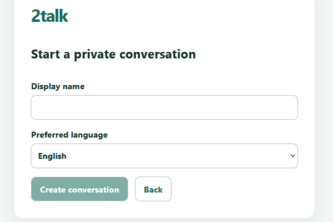
The description states that 2talk is a private conversation platform where AI mediates communication between two participants. Each message is processed by an AI mediation layer before reaching the other participant. It supports:
- Translation into the recipient's preferred language.
- Preservation of the sender’s original message for the sender.
- Private AI guidance tailored to each participant.
- Clear, respectful, and easier-to-understand conversations.
The system separates original messages from AI-mediated ones and generates different projections for each participant, ensuring privacy boundaries are maintained while delivering a seamless experience.
Inference The product is described as a full-stack application, built using FastAPI (backend), React/TypeScript (frontend), PostgreSQL (database), Docker Compose (deployment), and OpenAI models (AI mediation).
Positioning & Claim Evolution
The description states that the inspiration behind 2talk was to explore whether AI could act as a neutral communication mediator rather than just a translation tool. The author claims:
- Most communication problems stem from misunderstandings, emotional reactions, and message expression—not language differences.
- Traditional translation tools help understand words but not improve communication.
- 2talk aims to use AI to help people express themselves more clearly without speaking for them.
This positioning suggests that 2talk is not just a multilingual tool, but an AI-assisted communication enhancement platform focused on improving interpersonal clarity and emotional safety.
Inference The project evolved from a hackathon submission into a vision of a broader AI communication platform with group conversations, summaries, voice mediation, and more languages.
Target Customer & ICP
The description does not explicitly define the target customer or ideal customer profile (ICP). It only states that 2talk helps two people communicate across language barriers and preserves each participant's authentic voice.
Inference Based on the stated use case, potential users may include:
- Individuals in cross-cultural relationships.
- Remote teams with multilingual members.
- People who want to improve communication clarity or emotional safety in conversations.
However, no evidence is provided about actual user segments or personas.
Business Model & Pricing Evidence
The description does not contain any information about a business model or pricing strategy. It focuses entirely on the technical architecture and functionality of the platform.
Not evidenced
Technical & Delivery Signals
The description states that 2talk was built as a full-stack application using:
- FastAPI for backend API.
- React and TypeScript for frontend.
- PostgreSQL for persistent conversation storage.
- Docker Compose for local deployment.
- OpenAI models for mediation, translation, and guidance.
It also mentions:
- Automated tests (pytest).
- Clean separation between backend services, AI workers, and frontend.
- Handling of privacy boundaries in message delivery.
- Challenges around frontend rendering logic and state management.
- Asynchronous processing and user experience design.
Inference The technical implementation shows attention to software engineering best practices such as modularity, testability, and privacy-aware design. However, no evidence exists about production readiness or scalability beyond the hackathon prototype.
Traction & Maturity Signals
The description indicates that 2talk was submitted to the OpenAI 2026 hackathon, and it is described as an MVP (minimum viable product) focused on two-person conversations. There is no mention of:
- Revenue or monetization.
- Customers or user adoption.
- Product usage metrics.
- Post-hackathon development or launch.
Not evidenced
Competitive Context
The description does not provide any information about competitors or the competitive landscape. It does not reference existing platforms that offer similar AI-mediated communication or multilingual conversation tools.
Not evidenced
Open Questions & Risks
- Prototype-only status: The project is described as a hackathon submission with no evidence of real-world usage or traction.
- Unverified claims: All descriptions are self-reported and unverified; there is no independent validation of the platform’s effectiveness or user experience.
- Privacy complexity: While privacy boundaries are emphasized, the description does not clarify how these are enforced in practice or whether they have been tested with users.
- Limited scope: The current version only supports two-person conversations. Expansion into group or voice-based communication is stated as future work but not demonstrated.
Questions the description leaves open
- What specific user problems were you trying to solve, and how did you validate those needs?
- How do you plan to scale beyond the current MVP (two-person conversation)?
- Have you conducted any usability testing or gathered feedback from actual users?
- What are your plans for monetization or revenue generation?
- How do you ensure that AI mediation does not introduce bias or misinterpretation in communication?
- Are there any legal or ethical considerations around AI-mediated conversations, especially regarding data privacy and consent?
Overall Assessment
Not evidenced
The description provides no information about financials, traction, or market opportunity beyond the hackathon submission. It is unclear whether 2talk has moved past prototype stage or gained any meaningful adoption.
Given that this is a self-reported, unverified account of a hackathon project with no evidence of revenue, customers, or product-market fit, the commercial due-diligence read is: very early-stage, speculative, and lacking in traction signals.
The author states that the platform is ambitious and technically sound, but without external validation or usage data, it remains a concept rather than a validated business.
User Stories BotA demo video on every pull request
Get a demo video on every new feature
GitHub App that watches your pull requests and records a narrated, captioned demo.
Save time on demo prep and make informed decisions faster with a video walkthrough of every new feature.
Source
Submitted to the OpenAI 2026 hackathon on Devpost. Project home on Devpost. Back to the full gallery on Devpost.
This competitive analysis was produced by top-founders.com (opens in a new tab)
Generated by a language model from this project's public Devpost page — its tagline, the author's own write-up and any built-with tags listed there — as captured in August 2026. Short quotations are the author's words. It is an opinion on the idea as a business, not on the people behind it, and it reflects the description as published then. If the project has moved on, request a correction below. The analysis is not independent research and contains no verified traction, revenue or customer data.
An independent guide by KFG International LLC — not affiliated with, endorsed by, or connected to Devpost or OpenAI.