

Archive position — measured, not model output
0 likes on Devpost
2,263 of the 7,850 archived projects have more likes, and 5,587 share exactly 0 — so this project's #2,279 place in the like-ranked listing is a tie-break inside that group, not a ranking.
Projects (log scale)
Likes on Devpost. ▲ marks this project's group.
Show the figures
| Likes | Projects | Share of archive |
|---|---|---|
| 0 | 5,587 | 71.2% |
| 1 | 1,758 | 22.4% |
| 2 | 284 | 3.6% |
| 3–4 | 132 | 1.7% |
| 5–9 | 75 | 1.0% |
| 10+ | 14 | 0.2% |
 User Stories BotA demo video on every pull request
Get a demo video on every new feature
GitHub App that watches your pull requests and records a narrated, captioned demo.
Save time on demo prep and make informed decisions faster with a video walkthrough of every new feature.
Executive Summary
The description states that 3D Forge is a desktop application built with Electron, React, and Three.js, designed to perform image-to-3D conversion offline. It claims to use specialist models for different categories of 3D assets (e.g., cloth, creatures, body/face rigging) and includes features like boundary-preserving smoothing, semantic part reconstruction, and facial grafting. The author, Sameek Kundu, describes it as a private, offline-first workflow that routes each problem to a specialist model.
The project is self-reported and unverified; no revenue, customers, or traction data are provided. It was submitted to the OpenAI 2026 hackathon, suggesting this is an early-stage prototype or proof-of-concept. The single most important open question is whether there is any evidence of actual commercial use cases or adoption beyond the author’s own development efforts.
What The Product Actually Is
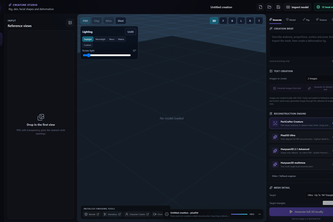
The description states that 3D Forge is a desktop application built using Electron + React + Three.js, with local Python/Blender workers. It performs image-to-3D conversion offline and uses specialist models for different asset types such as cloth, creatures, and body/face rigging.
It includes:
- Garment Particles 2026 for preserving separate panels and applying boundary-preserving smoothing.
- PartCrafter Creature for reconstructing semantic parts and removing disconnected debris.
- SkinTokens / TokenRig for predicting skeleton and skin weights with containment gates rejecting outside joints.
- Facial grafting that applies controls onto the learned skeleton without rewriting learned weights.
The app is described as routing each problem to a specialist model, using GPU-safe job scheduling, topology diagnostics, deterministic fallback exports, and tests for various aspects of asset creation. All references and meshes stay on the workstation; the UI shows selected engine and offline-ready state.
Positioning & Claim Evolution
The description states that 3D Forge positions itself as an offline-first desktop workflow that routes each problem to a specialist model, contrasting with generic image-to-3D tools that often fail in specific cases like cloth openings being sealed or facial rigging failing due to lack of prepared topology.
It claims to address limitations in existing tools by using explicit specialist routing and deterministic fallbacks. The author notes that the hardest challenge was facial rigging, which led to implementing validation gates and procedural fallbacks when learned results are unsafe.
This evolution suggests a move from general-purpose image-to-3D conversion toward more specialized workflows tailored to specific asset types, aiming for higher fidelity in complex areas like clothing and facial features.
Target Customer & ICP
Not evidenced. The description does not state who the target customer or ideal customer profile (ICP) is. No information about end-users, industries, or use cases beyond the author’s own development efforts is provided.
Business Model & Pricing Evidence
Not evidenced. There is no mention of pricing, monetization strategy, or business model in the description. The project appears to be a prototype or hackathon submission with no indication of how it would generate revenue or be sold.
Technical & Delivery Signals
The description states that 3D Forge is built using:
- Electron + React + Three.js for the UI
- Local Python/Blender workers for processing
- GPU-safe job scheduling
- Topology diagnostics
- Deterministic fallback exports
- Tests for cloth boundaries, semantic creature cleanup, rig health, facial grafting, and deformation
It also mentions that all references and meshes stay on the workstation, and the UI shows selected engine and offline-ready state. The author used Codex with GPT-5.6 to implement specialist workers, routing logic, learned-weight safety gates, facial topology repair, proof renderers, tests, demo assets, and this submission package.
Traction & Maturity Signals
Not evidenced. There is no evidence of traction, adoption, or maturity beyond the author’s own development efforts. The project was submitted to a hackathon, indicating it may be an early-stage prototype or proof-of-concept rather than a mature product.
Competitive Context
Not evidenced. No information is provided about competitors or the competitive landscape. The description does not mention existing tools or platforms in the image-to-3D space, nor does it compare 3D Forge to them.
Open Questions & Risks
- Unverified claims: All statements are self-reported and unverified.
- No commercial traction: No evidence of revenue, customers, or adoption beyond the author’s own use.
- Prototype nature: Submitted to a hackathon; likely an early-stage prototype.
- Limited scope: Only one team member (Sameek Kundu) is involved, suggesting limited development capacity.
- Offline-first approach: May limit scalability or accessibility compared to cloud-based solutions.
- Specialist routing complexity: While claimed as an advantage, it introduces potential complexity in implementation and maintenance.
Questions the description leaves open
- What specific problems are you solving that existing tools do not?
- How does your specialist routing approach scale across different asset types?
- Have you validated the utility of your solution with any external users or partners?
- Is there a plan to move beyond the current prototype into a commercial product?
- What is your roadmap for expanding beyond the current set of supported asset types (cloth, creatures, face)?
- How do you intend to monetize this tool if at all?
Overall Assessment
Not evidenced. There is insufficient information to assess whether 3D Forge represents a viable investment or partnership opportunity. The project appears to be an early-stage prototype submitted to a hackathon with no evidence of traction, revenue, or customer adoption. Any commercial viability remains speculative without further data.
User Stories BotA demo video on every pull request
Get a demo video on every new feature
GitHub App that watches your pull requests and records a narrated, captioned demo.
Save time on demo prep and make informed decisions faster with a video walkthrough of every new feature.
Source
Submitted to the OpenAI 2026 hackathon on Devpost. Project home on Devpost. Back to the full gallery on Devpost.
This competitive analysis was produced by top-founders.com (opens in a new tab)
Generated by a language model from this project's public Devpost page — its tagline, the author's own write-up and any built-with tags listed there — as captured in August 2026. Short quotations are the author's words. It is an opinion on the idea as a business, not on the people behind it, and it reflects the description as published then. If the project has moved on, request a correction below. The analysis is not independent research and contains no verified traction, revenue or customer data.
An independent guide by KFG International LLC — not affiliated with, endorsed by, or connected to Devpost or OpenAI.