

Archive position — measured, not model output
0 likes on Devpost
2,263 of the 7,850 archived projects have more likes, and 5,587 share exactly 0 — so this project's #2,281 place in the like-ranked listing is a tie-break inside that group, not a ranking.
Projects (log scale)
Likes on Devpost. ▲ marks this project's group.
Show the figures
| Likes | Projects | Share of archive |
|---|---|---|
| 0 | 5,587 | 71.2% |
| 1 | 1,758 | 22.4% |
| 2 | 284 | 3.6% |
| 3–4 | 132 | 1.7% |
| 5–9 | 75 | 1.0% |
| 10+ | 14 | 0.2% |
 User Stories BotA demo video on every pull request
Get a demo video on every new feature
GitHub App that watches your pull requests and records a narrated, captioned demo.
Save time on demo prep and make informed decisions faster with a video walkthrough of every new feature.
Executive Summary
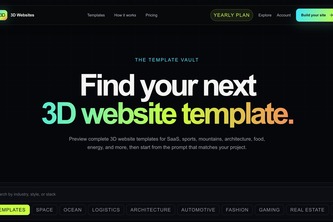
The description states that "3D Website Templates" is a project submitted to the OpenAI 2026 hackathon, built with Cloudflare and Node.js. The author claims it allows users to turn an ambitious 3D concept into a polished website in about 15 minutes using one production-ready prompt. This appears to be a tool or service for generating 3D websites from prompts, likely targeting developers or designers who want to rapidly prototype or build interactive web experiences.
The single most important open question is: What is the actual functionality and commercial viability of this tool? The description provides no evidence of revenue, customers, traction, or even a clear definition of what "3D website" means in practice. It also does not clarify whether this is a SaaS product, a plugin, an API, or something else entirely.
What The Product Actually Is
The description states that the project allows users to "turn an ambitious 3D concept into a polished website in about 15 minutes" using "one production-ready prompt". It was built with Cloudflare and Node.js.
This is a self-reported claim, not verified. The author does not describe what the tool actually does beyond this high-level statement. There is no evidence provided about:
- The specific technology stack or architecture
- Whether it generates code, visual assets, or both
- How the prompt-to-website conversion works
- What constitutes a "3D concept" in this context
The author also does not describe what kind of output is produced (e.g., WebGL-based site, Unity integration, etc.), nor whether it's a web app, browser extension, CLI tool, or API.
Positioning & Claim Evolution
The description states that the product enables users to "start with one production-ready prompt and turn an ambitious 3D concept into a polished website in about 15 minutes."
This is a self-reported positioning claim. It does not indicate:
- Whether this was the original idea or evolved from something else
- How it differentiates from existing tools for generating websites or 3D content
- If there's any evolution in how the tool works, or what it was initially intended to do
The tagline is a single sentence that implies speed and ease of use, but does not provide evidence of prior positioning or evolution.
Target Customer & ICP
The description does not state who the target customer is. It does not describe:
- Who uses this tool
- What kind of users (developers, designers, marketers, etc.)
- Whether it's aimed at individuals or enterprises
- If there are specific use cases or industries targeted
There is no evidence in the self-description to support any claims about ideal customer profile (ICP), including whether the tool targets technical users, non-technical users, or a hybrid.
Business Model & Pricing Evidence
The description does not state anything about pricing, monetization, or business model. It does not indicate:
- If this is a paid product
- How it would be sold (SaaS, freemium, one-time purchase)
- What features are included in different tiers
- Whether there's any subscription or usage-based pricing
No evidence of commercial structure or revenue model is provided.
Technical & Delivery Signals
The description states that the project was built with Cloudflare and Node.js. This suggests:
- A serverless or edge computing approach
- Use of JavaScript/Node.js for backend logic
- Possibly integration with AI APIs (given hackathon context)
However, it does not provide evidence about:
- Technical architecture beyond these two technologies
- Scalability or performance characteristics
- How the 3D-to-website conversion works technically
- If there are integrations with AI models or other services
Traction & Maturity Signals
The description provides no evidence of traction or maturity. It does not mention:
- Number of users or customers
- Revenue or monetization status
- Product usage metrics
- Any form of adoption or feedback from early users
- Iteration history or versioning
It also does not indicate whether this is a prototype, MVP, or production-ready product.
Competitive Context
The description does not provide any information about the competitive landscape. It does not mention:
- Who the competitors are
- How this compares to existing tools for generating websites or 3D content
- Whether there are similar products in the market
- What differentiates this from other offerings
There is no evidence of competitive positioning or awareness.
Open Questions & Risks
Key risks and open questions based on the self-reported description:
- Lack of clarity: No clear definition of what "3D website" means, how it works, or what output is generated.
- No traction evidence: No data on users, adoption, or revenue.
- Unverified claims: The 15-minute turnaround and "production-ready prompt" are self-reported without verification.
- Limited scope: Only one team member listed (Digital Islam), suggesting a small team with limited resources.
- Hackathon origin: The project was submitted to a hackathon, which often implies early-stage development or experimental nature.
Questions the description leaves open
- What exactly does "3D website" mean in practice? Can you show an example of what is generated?
- How does the prompt-to-website conversion process work technically?
- Is this a standalone product, or does it integrate with other tools (e.g., AI APIs)?
- What are the key assumptions behind the 15-minute turnaround claim?
- Are there any existing users or customers? If so, what feedback have you received?
- How do you plan to monetize this tool?
- What is your roadmap for development and scaling?
Overall Assessment
Not evidenced.
The description does not provide sufficient information to assess the commercial viability, traction, or potential for investment or partnership. The author has not provided any evidence of:
- Product functionality
- Market demand
- Revenue or monetization
- Customer feedback
- Technical depth
- Competitive positioning
This is a very early-stage project, likely in prototype form, submitted to a hackathon. Without further information, it's impossible to evaluate whether this represents a viable business opportunity or product direction.
User Stories BotA demo video on every pull request
Get a demo video on every new feature
GitHub App that watches your pull requests and records a narrated, captioned demo.
Save time on demo prep and make informed decisions faster with a video walkthrough of every new feature.
Source
Submitted to the OpenAI 2026 hackathon on Devpost. Project home on Devpost. Back to the full gallery on Devpost.
This competitive analysis was produced by top-founders.com (opens in a new tab)
Generated by a language model from this project's public Devpost page — its tagline and any built-with tags listed there, since the author published no write-up — as captured in August 2026. Short quotations are the author's words. It is an opinion on the idea as a business, not on the people behind it, and it reflects the description as published then. If the project has moved on, request a correction below. The analysis is not independent research and contains no verified traction, revenue or customer data.
An independent guide by KFG International LLC — not affiliated with, endorsed by, or connected to Devpost or OpenAI.