

Archive position — measured, not model output
0 likes on Devpost
2,263 of the 7,850 archived projects have more likes, and 5,587 share exactly 0 — so this project's #2,280 place in the like-ranked listing is a tie-break inside that group, not a ranking.
Projects (log scale)
Likes on Devpost. ▲ marks this project's group.
Show the figures
| Likes | Projects | Share of archive |
|---|---|---|
| 0 | 5,587 | 71.2% |
| 1 | 1,758 | 22.4% |
| 2 | 284 | 3.6% |
| 3–4 | 132 | 1.7% |
| 5–9 | 75 | 1.0% |
| 10+ | 14 | 0.2% |
 User Stories BotA demo video on every pull request
Get a demo video on every new feature
GitHub App that watches your pull requests and records a narrated, captioned demo.
Save time on demo prep and make informed decisions faster with a video walkthrough of every new feature.
Executive Summary
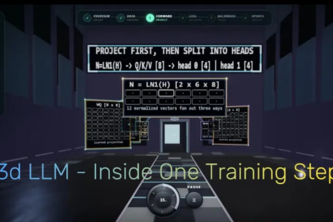
What the company appears to be: A self-contained educational visualization tool that renders a small-scale, 3D representation of a large language model (LLM) training process using a GPT-2-style decoder-only transformer. The project is built for learning and demonstration purposes, not commercial use.
What changed: The author reports building this as an extension of personal philosophical and engineering inquiry into LLMs, leveraging recent advancements in AI tools like GPT-5.6 Sol to realize the concept.
Single most important open question: Is there any evidence that this project has traction or adoption beyond its creator’s own use case? The description contains no data on users, revenue, or market interest.
This analysis is based solely on the self-reported, unverified account provided by the author. No external corroboration exists for any claims made in the project description.
What The Product Actually Is
The description states that 3D LLM Training:
- Visualizes one complete LLM training step in 3D.
- Uses a GPT-2-style decoder-only transformer, scaled down for educational purposes.
- Includes 25 interactive chambers covering data preparation, forward pass, loss calculation, backpropagation, and AdamW weight update.
- Offers multiple views: Story, Structure, Math, and Code.
- Features an optional real-time voice guide using OpenAI Realtime Audio API.
- Connects to a local PyTorch trainer via a Custom Training Chamber.
Inference: The tool is not a commercial product but a prototype or educational demo. It is described as runnable code with mathematical fidelity, yet scaled down for clarity rather than production use.
Positioning & Claim Evolution
The author positions the project as:
- An immersive 3D experience that helps users understand LLM training.
- A way to walk through an artwork in a gallery-like environment.
- A bridge between visual storytelling and real mathematics and code.
- Not just a diagram, but a coherent representation of a full training step.
Inference: The positioning is educational and exploratory. It does not claim commercial viability or market readiness. The author frames it as a personal learning tool extended into public-facing visualization.
Target Customer & ICP
The description states:
- The project targets individuals interested in understanding LLM internals.
- It is intended for educational purposes, especially those with engineering or philosophical backgrounds.
- Users can choose between quick overview or free exploration modes.
Not evidenced: No specific customer segments, personas, or target industries are named. There is no indication of who would pay for this tool or how it might be monetized.
Business Model & Pricing Evidence
The description states:
- The project is built for educational purposes.
- It includes runnable training code and visualizations.
- No mention of pricing, subscriptions, or monetization strategy.
Inference: There is no evidence of a business model. The tool appears to be a personal or academic effort without commercial intent.
Technical & Delivery Signals
The description states:
- Built with React, TypeScript, Next.js, Three.js, WebGL.
- Trainer written in Python and Pytorch.
- Uses GPT-5.6 Sol for initial scaffolding.
- Voice guide uses OpenAI Realtime Audio API.
- Single deterministic trace ensures consistency between displayed values and math.
Inference: The technical stack is modern and appropriate for a web-based 3D visualization tool. However, the project is not described as scalable or production-ready.
Traction & Maturity Signals
The description states:
- Submitted to the OpenAI 2026 hackathon.
- Built in response to GPT-5.6 Sol release and personal curiosity.
- No mention of users, downloads, or engagement metrics.
Not evidenced: There is no evidence of traction, adoption, or user base. The project appears to be a one-person effort with no external validation or usage data.
Competitive Context
The description states:
- The author was inspired by philosophical and engineering curiosity.
- No mention of competitors or similar tools in the market.
- The tool is described as unique in its 3D visualization approach for LLM training.
Inference: There is no evidence of a competitive landscape. The project seems to be an original idea, but without any indication that it addresses a known market need or fills a gap in existing solutions.
Open Questions & Risks
- No commercial intent: The tool is described as educational and personal, not for sale.
- No traction or adoption: No evidence of users, customers, or engagement.
- Single-person team: Limited capacity for scaling or development.
- Unverified claims: All descriptions are self-reported and unverified.
- No monetization strategy: No indication of how the project might generate revenue.
Questions the description leaves open
- What is your plan to scale beyond this prototype?
- Are you considering any form of commercialization or monetization?
- How do you intend to validate that users find value in this tool beyond personal learning?
- Have you considered partnerships with educational institutions or AI research groups?
- What are the technical limitations of the current implementation, and how would you address them?
Overall Assessment
Not evidenced: There is no evidence of a viable business model, revenue, or market demand for this project. It is described as an educational prototype with no indication of commercial potential.
Inference: This project does not appear to be a candidate for investment or partnership at this stage. It lacks traction, monetization strategy, and clear customer need beyond the creator’s own use case.
User Stories BotA demo video on every pull request
Get a demo video on every new feature
GitHub App that watches your pull requests and records a narrated, captioned demo.
Save time on demo prep and make informed decisions faster with a video walkthrough of every new feature.
Source
Submitted to the OpenAI 2026 hackathon on Devpost. Project home on Devpost. Back to the full gallery on Devpost.
This competitive analysis was produced by top-founders.com (opens in a new tab)
Generated by a language model from this project's public Devpost page — its tagline, the author's own write-up and any built-with tags listed there — as captured in August 2026. Short quotations are the author's words. It is an opinion on the idea as a business, not on the people behind it, and it reflects the description as published then. If the project has moved on, request a correction below. The analysis is not independent research and contains no verified traction, revenue or customer data.
An independent guide by KFG International LLC — not affiliated with, endorsed by, or connected to Devpost or OpenAI.