

Archive position — measured, not model output
0 likes on Devpost
2,263 of the 7,850 archived projects have more likes, and 5,587 share exactly 0 — so this project's #6,206 place in the like-ranked listing is a tie-break inside that group, not a ranking.
Projects (log scale)
Likes on Devpost. ▲ marks this project's group.
Show the figures
| Likes | Projects | Share of archive |
|---|---|---|
| 0 | 5,587 | 71.2% |
| 1 | 1,758 | 22.4% |
| 2 | 284 | 3.6% |
| 3–4 | 132 | 1.7% |
| 5–9 | 75 | 1.0% |
| 10+ | 14 | 0.2% |
 User Stories BotA demo video on every pull request
Get a demo video on every new feature
GitHub App that watches your pull requests and records a narrated, captioned demo.
Save time on demo prep and make informed decisions faster with a video walkthrough of every new feature.
Executive Summary
Company: QuestLearn
Self-reported basis: The description is from a Devpost submission for the OpenAI 2026 hackathon. It is unverified and self-reported.
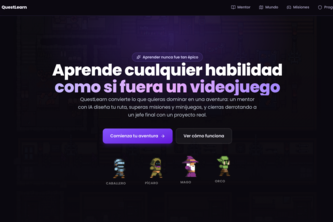
What it appears to be: A learning platform that uses AI to generate adaptive missions and provide personalized feedback on real-world projects, framed as a gamified educational tool.
What changed: The project was submitted to a hackathon; no evidence of prior traction or commercial activity.
Single most important open question: What is the actual product, and how does it differ from existing AI-powered learning platforms?
What The Product Actually Is
The description states that QuestLearn "usa IA para crear misiones adaptadas a tu nivel y evaluar proyectos reales con retroalimentación personalizada" — which translates to using AI to create missions adapted to your level and evaluate real projects with personalized feedback.
Inference: It appears to be an educational platform that leverages AI for adaptive learning and project-based assessment, with gamification elements implied by the tagline "Aprende cualquier tema jugando" (Learn any topic by playing).
Evidence: The author states this is a tool for creating missions and evaluating projects using AI. No further detail on product functionality or interface is provided.
Positioning & Claim Evolution
The description states:
- “Aprende cualquier tema jugando” — Learn any topic by playing.
- “Questler usa IA para crear misiones adaptadas a tu nivel y evaluar proyectos reales con retroalimentación personalizada.” — Questler uses AI to create missions adapted to your level and evaluate real projects with personalized feedback.
Inference: The positioning is that of an adaptive, gamified learning platform using AI for mission creation and project evaluation.
Claim vs. Fact: These are claims about the product’s intent and positioning, not evidence of traction or adoption.
Evidence: No indication of prior positioning or evolution in messaging; this is a single self-reported description.
Target Customer & ICP
The description does not state who the target customer is or what the ideal customer profile (ICP) might be.
Inference: Based on the tagline and claim, it may be aimed at learners or students who prefer gamified, AI-assisted learning.
Evidence: Not evidenced. No mention of specific user personas, demographics, or use cases.
Business Model & Pricing Evidence
The description does not include any information about pricing, monetization, or business model.
Inference: If the platform is built for educational purposes, it may be free or subscription-based, but this is speculative.
Evidence: Not evidenced.
Technical & Delivery Signals
The author states that the project was built with:
- Codex
- Next.js
- Prisma
- Supabase
Inference: The tech stack suggests a modern web application using AI tools (Codex), a frontend framework (Next.js), and backend/database services (Prisma, Supabase).
Evidence: These are self-reported technical choices. No evidence of deployment, scalability, or performance.
Traction & Maturity Signals
The project was submitted to the OpenAI 2026 hackathon on Devpost.
- Team size: 4
- Members listed: Paula Márquez, Adolfo C, Santiago Esquetini, drahcirok
Inference: This is a hackathon project; no evidence of prior traction, revenue, or customer adoption.
Evidence: Not evidenced.
Competitive Context
The description does not mention any competitors or market positioning relative to existing platforms.
Inference: The product may compete with AI-powered learning platforms like Duolingo, Coursera, or Khan Academy, but no such comparison is made.
Evidence: Not evidenced.
Open Questions & Risks
- Thin evidence: No revenue, customers, or traction are mentioned.
- Unverified claims: All descriptions are self-reported and unverified.
- No product demo or interface details: The platform’s actual functionality is not described.
- Hackathon project: No indication of post-hackathon development or commercialization.
- Lack of clarity on AI use: While AI is mentioned, no detail on how it is applied in mission creation or feedback.
Evidence: Not evidenced — all are inferred from the lack of information.
Questions the description leaves open
- What specific problem does QuestLearn solve, and how does it differ from existing platforms?
- How is AI used in creating missions and evaluating projects?
- Is there a plan for monetization or customer acquisition beyond the hackathon?
- What are the key features of the platform that users would interact with?
- Are there any early adopters or pilot users?
- What is the roadmap for product development post-hackathon?
Overall Assessment
Not evidenced: No information on revenue, traction, customer base, or commercial viability is provided.
Inference: This is a hackathon project with no demonstrated product-market fit or business traction. It may be an early-stage idea or prototype, but there is no evidence of progress beyond the submission phase.
Confidence level: Low — based entirely on self-reported description and no external validation.
User Stories BotA demo video on every pull request
Get a demo video on every new feature
GitHub App that watches your pull requests and records a narrated, captioned demo.
Save time on demo prep and make informed decisions faster with a video walkthrough of every new feature.
Source
Submitted to the OpenAI 2026 hackathon on Devpost. Project home on Devpost. Back to the full gallery on Devpost.
This competitive analysis was produced by top-founders.com (opens in a new tab)
Generated by a language model from this project's public Devpost page — its tagline and any built-with tags listed there, since the author published no write-up — as captured in August 2026. Short quotations are the author's words. It is an opinion on the idea as a business, not on the people behind it, and it reflects the description as published then. If the project has moved on, request a correction below. The analysis is not independent research and contains no verified traction, revenue or customer data.
An independent guide by KFG International LLC — not affiliated with, endorsed by, or connected to Devpost or OpenAI.