

Archive position — measured, not model output
0 likes on Devpost
2,263 of the 7,850 archived projects have more likes, and 5,587 share exactly 0 — so this project's #6,208 place in the like-ranked listing is a tie-break inside that group, not a ranking.
Projects (log scale)
Likes on Devpost. ▲ marks this project's group.
Show the figures
| Likes | Projects | Share of archive |
|---|---|---|
| 0 | 5,587 | 71.2% |
| 1 | 1,758 | 22.4% |
| 2 | 284 | 3.6% |
| 3–4 | 132 | 1.7% |
| 5–9 | 75 | 1.0% |
| 10+ | 14 | 0.2% |
 User Stories BotA demo video on every pull request
Get a demo video on every new feature
GitHub App that watches your pull requests and records a narrated, captioned demo.
Save time on demo prep and make informed decisions faster with a video walkthrough of every new feature.
Executive Summary
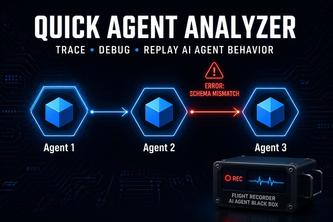
The company appears to be a solo developer project named Quick Agent Analyzer, built as part of the OpenAI 2026 hackathon. The author states it is a tool that traces multi-agent AI pipelines and identifies where silent coordination failures occur — specifically pinpointing the exact step, agent, and field where divergence happens. It uses Codex to build itself from a single prompt and simulates failure modes like schema drift, field rename, and context loss in a 3-agent pipeline (Intake → Validator → Executor). The tool outputs structured JSON spans comparing failed runs against baseline success cases.
What changed: This is a self-reported prototype built in under 5 minutes using Codex. It represents an early-stage idea for AI observability or debugging tools targeting multi-agent systems, but there is no evidence of any commercial traction, revenue, customers, or product-market fit beyond the author's own description.
Single most important open question: Is this a viable product concept that can be extended to real-world use cases, or is it a proof-of-concept with limited scalability?
This analysis is based solely on the self-reported project description provided by the author. No external verification, funding history, customer data, or revenue information is available.
What The Product Actually Is
The description states that Quick Agent Analyzer:
- Traces multi-agent AI pipelines.
- Identifies where silent coordination failures happen.
- Pinpoints the exact step, agent, and field where divergence occurs.
- Simulates failure modes such as schema drift, field rename, and silent context loss.
- Compares failed runs against a successful baseline.
- Outputs an evidence-based report naming the exact step, agent, and field that diverged.
- Uses structured JSON spans for input/output tracing.
- Was built using Codex from a single prompt.
Inference: The tool is described as a debugging or observability utility for AI agents, particularly in distributed systems where data flows between multiple agents. It does not appear to be a general-purpose AI platform but rather a specialized diagnostic tool for agent-based workflows.
The product is described as a prototype built during a hackathon; no production-ready features or commercial functionality are evidenced.
Positioning & Claim Evolution
The author claims:
- The tool automates finding break points in multi-agent pipelines instead of manually digging through logs.
- It addresses a problem they personally encounter: silent failures in agent coordination.
- The tool is built using Codex, which allows it to self-generate code from a single prompt.
Inference: The positioning seems to be that this is a lightweight, developer-centric debugging tool for AI agents — particularly useful in environments where agent collaboration is complex and failure modes are hard to trace. It positions itself as an alternative to traditional log inspection methods.
No evidence of prior positioning or evolution of claims beyond the hackathon submission.
Target Customer & ICP
The description states:
- The inspiration came from a job posting for an AI Agent Developer role.
- Core responsibilities listed were "monitor agent performance" and "support multi-agent collaboration".
Inference: The target customer appears to be developers working on or managing multi-agent AI systems — especially those who face challenges in debugging agent coordination failures.
No evidence of actual customers, personas, or market segmentation beyond the author’s personal experience.
Business Model & Pricing Evidence
Not evidenced.
There is no mention of pricing, monetization strategy, or business model in the description.
Technical & Delivery Signals
The description states:
- Built using Codex with a single detailed spec.
- Codex wrote the entire implementation including agent chain, tracer, failure injection logic, and analyzer.
- Took about 4 minutes and 17 seconds to build and test.
- Encountered usage limits but resolved them by switching models.
- Had to change integration approach due to Build Week credit limitations (ChatGPT sign-in vs. API key).
- Decided which failure modes to simulate based on real production issues.
Inference: The tool leverages AI code generation (Codex) and is designed for rapid prototyping or debugging in development environments. It shows early signs of automation capability but lacks scalability or enterprise-grade delivery signals.
No evidence of deployment, infrastructure, or scalability beyond the prototype.
Traction & Maturity Signals
Not evidenced.
There is no evidence of revenue, customers, usage metrics, or product maturity beyond the hackathon prototype.
Competitive Context
Not evidenced.
No mention of competitors, market landscape, or competitive positioning in the description.
Open Questions & Risks
- Prototype-only: The tool is described as a hackathon prototype with no evidence of further development or commercialization.
- Limited scope: It currently simulates only 3-agent pipelines and specific failure modes; no indication it works with real-world frameworks like LangGraph or CrewAI.
- Dependency on AI tools: Relies heavily on Codex, which may not be stable or scalable for enterprise use.
- No commercial viability: No evidence of monetization, customer feedback, or product-market fit beyond the author’s own experience.
These are inferences drawn from the lack of any traction or commercial signals.
Questions the description leaves open
- What is your plan for extending this beyond the demo pipeline to real-world multi-agent frameworks?
- Have you validated the tool with actual developers working on agent-based systems?
- How do you intend to monetize or scale this idea beyond a hackathon prototype?
- Are there any technical dependencies (e.g., Codex) that could limit long-term viability?
- What are your thoughts on adding confidence scoring and human review workflows?
These questions aim to probe the depth of the founder’s vision, validation efforts, and scalability plans.
Overall Assessment
Not evidenced.
No evidence of funding rounds, valuation, or investment interest is available. The project appears to be a solo developer experiment with no commercial traction.
User Stories BotA demo video on every pull request
Get a demo video on every new feature
GitHub App that watches your pull requests and records a narrated, captioned demo.
Save time on demo prep and make informed decisions faster with a video walkthrough of every new feature.
Source
Submitted to the OpenAI 2026 hackathon on Devpost. Project home on Devpost. Back to the full gallery on Devpost.
This competitive analysis was produced by top-founders.com (opens in a new tab)
Generated by a language model from this project's public Devpost page — its tagline, the author's own write-up and any built-with tags listed there — as captured in August 2026. Short quotations are the author's words. It is an opinion on the idea as a business, not on the people behind it, and it reflects the description as published then. If the project has moved on, request a correction below. The analysis is not independent research and contains no verified traction, revenue or customer data.
An independent guide by KFG International LLC — not affiliated with, endorsed by, or connected to Devpost or OpenAI.