

Archive position — measured, not model output
0 likes on Devpost
2,263 of the 7,850 archived projects have more likes, and 5,587 share exactly 0 — so this project's #2,284 place in the like-ranked listing is a tie-break inside that group, not a ranking.
Projects (log scale)
Likes on Devpost. ▲ marks this project's group.
Show the figures
| Likes | Projects | Share of archive |
|---|---|---|
| 0 | 5,587 | 71.2% |
| 1 | 1,758 | 22.4% |
| 2 | 284 | 3.6% |
| 3–4 | 132 | 1.7% |
| 5–9 | 75 | 1.0% |
| 10+ | 14 | 0.2% |
 User Stories BotA demo video on every pull request
Get a demo video on every new feature
GitHub App that watches your pull requests and records a narrated, captioned demo.
Save time on demo prep and make informed decisions faster with a video walkthrough of every new feature.
Executive Summary
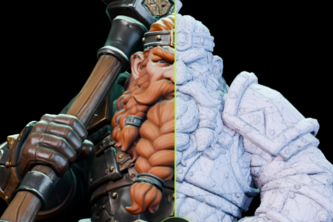
The description states that 3DGenAI Optimizer is a tool designed to reduce the triangle count of AI-generated 3D models while preserving visual quality, making them suitable for real-time platforms like games. The author, a solo developer, built it using a hybrid CPU/GPU pipeline and integrated AI assistance (Codex) into development. It is positioned as solving a problem in the 3D asset workflow where high-quality AI-generated meshes are too heavy for practical use.
What changed: The project appears to be a prototype or early-stage tool developed by one person, with no evidence of prior traction, revenue, or customers. It was submitted to an OpenAI hackathon and is described as self-developed using personal tools and AI assistance.
Single most important open question: Is there any evidence that this tool has been used in production workflows or tested on real-world 3D assets beyond the author's own experiments?
Note: This analysis is based solely on the self-reported, unverified description provided by the author. No third-party validation, revenue data, customer base, or traction metrics are available.
What The Product Actually Is
The description states that 3DGenAI Optimizer is a tool for reducing triangle count in AI-generated 3D models while preserving visual quality. It supports CPU, GPU, and hybrid processing paths and integrates with Blender and game workflows.
- The system loads meshes, selects an appropriate processing path (CPU/GPU/hybrid), simplifies the mesh, preserves required attributes, and outputs a model usable in Blender or game engines.
- It was built using technologies including C++, CUDA, Python, React, FastAPI, PostgreSQL, Redis, S3, Three.js, TypeScript, and Docker.
Inference: The tool is described as being designed for AI-generated 3D assets that are too heavy for real-time use. However, no specific technical specifications or performance benchmarks are provided.
Positioning & Claim Evolution
The author claims the product addresses a gap in current AI-generated 3D workflows: models are visually impressive but not practical due to high triangle counts.
- The project evolved from a personal challenge of creating game-ready assets from AI models.
- It is positioned as a solution that allows creators to avoid manual optimization, splitting, or repairing of meshes.
- The author emphasizes the importance of preserving fine details and structures during simplification.
Claim: “3D AI generators can now create high-quality models, but their extreme face counts often limit them to references. What if those models could be made much lighter?”
This is a self-stated positioning statement, not verified traction or market demand.
Target Customer & ICP
The description does not name specific customers or personas. However, it implies the tool targets:
- Game developers
- 3D artists working with AI-generated assets
- Creators who want to streamline workflows and avoid manual mesh optimization
Inference: Based on the author’s stated use case (game development), the ICP likely includes indie game devs or small studios using AI tools for content creation.
Business Model & Pricing Evidence
There is no evidence of a business model, pricing structure, or monetization strategy in the description.
- The project was submitted to a hackathon and appears to be a prototype.
- No mention of licensing, subscriptions, or paid features.
Not evidenced: No indication of how this would be sold or whether it will be commercialized.
Technical & Delivery Signals
The author describes building a pipeline with:
- CPU, GPU, and hybrid processing paths
- Integration with Blender and game engines
- Use of Codex for development assistance
- Validation and repair steps that were tested empirically
Inference: The tool is described as iterative and experimental, built using personal resources and AI tools. No evidence of scalability or enterprise-grade delivery.
Traction & Maturity Signals
There is no evidence of traction, adoption, or usage beyond the author’s own development process.
- The project was submitted to a hackathon.
- It is described as a solo effort with no external contributors or users.
- No metrics on performance improvements, user feedback, or real-world testing are provided.
Not evidenced: No data on customer acquisition, retention, or usage patterns.
Competitive Context
The description does not mention competitors or existing solutions in the 3D mesh optimization space.
- The author focuses on solving a problem with AI-generated meshes specifically.
- No comparison to other tools or platforms is made.
Not evidenced: No competitive landscape or differentiation strategy described.
Open Questions & Risks
Several risks and open questions are implied by the lack of evidence:
- Solo development: One-person team may limit scalability, feature depth, or long-term maintenance.
- No traction or customers: The tool has not been tested in production or used by others.
- Unproven commercial viability: No pricing, monetization, or business model described.
- Limited validation: Only the author’s own testing and AI-assisted development are referenced.
Inference: Without real-world usage or feedback, the product may not meet actual market needs.
Questions the description leaves open
- What specific types of AI-generated 3D assets does this tool optimize?
- How does it compare to existing mesh optimization tools in terms of quality and performance?
- Have you tested this with real-world datasets or external users?
- Is there a plan for monetization or commercial deployment?
- What are the scalability limitations of the current architecture?
- Are there any known issues with integrating into Blender or game engines?
Overall Assessment
The description indicates that 3DGenAI Optimizer is an early-stage prototype developed by one individual, submitted to a hackathon. There is no evidence of revenue, customers, traction, or commercial viability.
Assessment: Not ready for investment or partnership at this stage. The tool shows potential but lacks validation and market proof. Further development and demonstration of real-world utility are needed before considering deeper engagement.
User Stories BotA demo video on every pull request
Get a demo video on every new feature
GitHub App that watches your pull requests and records a narrated, captioned demo.
Save time on demo prep and make informed decisions faster with a video walkthrough of every new feature.
Source
Submitted to the OpenAI 2026 hackathon on Devpost. Project home on Devpost. Back to the full gallery on Devpost.
This competitive analysis was produced by top-founders.com (opens in a new tab)
Generated by a language model from this project's public Devpost page — its tagline, the author's own write-up and any built-with tags listed there — as captured in August 2026. Short quotations are the author's words. It is an opinion on the idea as a business, not on the people behind it, and it reflects the description as published then. If the project has moved on, request a correction below. The analysis is not independent research and contains no verified traction, revenue or customer data.
An independent guide by KFG International LLC — not affiliated with, endorsed by, or connected to Devpost or OpenAI.