

Archive position — measured, not model output
0 likes on Devpost
2,263 of the 7,850 archived projects have more likes, and 5,587 share exactly 0 — so this project's #4,243 place in the like-ranked listing is a tie-break inside that group, not a ranking.
Projects (log scale)
Likes on Devpost. ▲ marks this project's group.
Show the figures
| Likes | Projects | Share of archive |
|---|---|---|
| 0 | 5,587 | 71.2% |
| 1 | 1,758 | 22.4% |
| 2 | 284 | 3.6% |
| 3–4 | 132 | 1.7% |
| 5–9 | 75 | 1.0% |
| 10+ | 14 | 0.2% |
 User Stories BotA demo video on every pull request
Get a demo video on every new feature
GitHub App that watches your pull requests and records a narrated, captioned demo.
Save time on demo prep and make informed decisions faster with a video walkthrough of every new feature.
Executive Summary
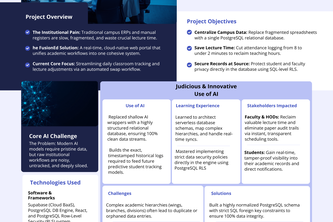
FusionEd: Campus Management System is a self-reported project by one individual (KAUSTUBH DESHPANDE) submitted to the OpenAI 2026 hackathon. The author describes it as an ERP-like system for colleges, aiming to centralize attendance management, notices, calendars, and other administrative tasks. It is built using React, TypeScript, Tailwind, and Supabase.
The description states that the project was built in a short timeframe (presumably during a hackathon), with no evidence of revenue, customers, or traction. The author claims to have learned how to prompt and use AI effectively, and that the system can be rented to institutions at low cost, but provides no data to support these claims.
The single most important open question
Is there any evidence of actual usage or adoption by colleges, or any indication of a viable business model beyond the author's self-reported intentions?
What The Product Actually Is
- The description states that FusionEd is a campus management system, designed to centralize college administration tasks.
- It includes features such as attendance management, notices, calendars, and day-to-day college operations.
- The system is described as having faculty, HoD, and administration roles, with attendance marked by teachers instantly reflected across the platform.
- It is built using React, TypeScript, Tailwind, and Supabase.
Note
This is a self-reported description. No independent verification or demonstration of functionality exists beyond the author’s account.
Positioning & Claim Evolution
- The author positions FusionEd as a solution to inefficiencies in current college ERP systems, particularly around attendance tracking.
- It is described as addressing the problem of manual attendance updates and information loss due to lack of backup or real-time updates.
- The system is framed as an alternative to traditional ERP systems, using modern web technologies like Supabase for backend.
Inference The positioning suggests a move from fragmented communication (e.g., WhatsApp groups) to a centralized digital platform. However, this is a claim, not a fact.
Target Customer & ICP
- The target customer is described as colleges and educational institutions.
- The system is intended for use by faculty, HoDs, and administration.
- The author mentions the goal of renting it to institutions, implying a B2B model.
Note
No evidence of actual customers or institutional partnerships exists. The description does not clarify whether the target customer is K-12, higher education, or specific types of colleges.
Business Model & Pricing Evidence
- The author states that FusionEd will be rented to institutions at dirt cheap prices, with pricing varying based on selected features.
- There is no evidence of pricing tiers, revenue model, or monetization strategy beyond the author’s self-reported intention.
Inference The business model appears to be SaaS-based, but no details are provided about how it will be sold or priced.
Technical & Delivery Signals
- Built with React, TypeScript, Tailwind, and Supabase.
- The system is described as using "vibe coding", which may refer to rapid prototyping or AI-assisted development.
- It is claimed that the system was built in a short time (presumably during a hackathon).
- Challenges included using Supabase instead of traditional ERP backend systems.
Note
No evidence of scalability, security, or production readiness. The use of Supabase suggests a modern, serverless approach, but no deployment details are provided.
Traction & Maturity Signals
- Not evidenced.
- The project is described as a hackathon submission, with no mention of user testing, feedback loops, or real-world usage.
- No evidence of customer acquisition, retention, or revenue generation.
Absence of evidence
There is no indication that FusionEd has moved beyond the prototype stage or has any traction.
Competitive Context
- Not evidenced.
- The author does not reference existing ERP or campus management systems.
- No competitive analysis or differentiation strategy is provided.
Absence of evidence
No information on competitors, market size, or positioning in the broader education technology landscape.
Open Questions & Risks
- The project is a single-person hackathon submission, with no team or external validation.
- The author claims to have used AI for development ("how to prompt", "correct use of AI") — this may indicate a lack of deep technical or product experience.
- No evidence of real-world testing, user feedback, or adoption.
- The business model is highly speculative, with no pricing, customer data, or revenue projections.
Inference The project lacks commercial viability indicators and may be in early conceptual stages.
Questions the description leaves open
- What specific problems in current college ERP systems are you solving, and how do you know?
- Have you tested this with any real users or institutions?
- How does the pricing model work, and what features are included in each tier?
- What is your plan for scaling beyond a single developer?
- Are there any existing partnerships or pilot programs with colleges?
Overall Assessment
- Not evidenced.
- The project is described as a hackathon prototype, with no evidence of traction, revenue, or market validation.
- The author’s stated intention to turn it into a startup is speculative and unproven.
Confidence Low. This is a self-reported idea with no external validation or commercial proof of concept.
User Stories BotA demo video on every pull request
Get a demo video on every new feature
GitHub App that watches your pull requests and records a narrated, captioned demo.
Save time on demo prep and make informed decisions faster with a video walkthrough of every new feature.
Source
Submitted to the OpenAI 2026 hackathon on Devpost. Project home on Devpost. Back to the full gallery on Devpost.
This competitive analysis was produced by top-founders.com (opens in a new tab)
Generated by a language model from this project's public Devpost page — its tagline, the author's own write-up and any built-with tags listed there — as captured in August 2026. Short quotations are the author's words. It is an opinion on the idea as a business, not on the people behind it, and it reflects the description as published then. If the project has moved on, request a correction below. The analysis is not independent research and contains no verified traction, revenue or customer data.
An independent guide by KFG International LLC — not affiliated with, endorsed by, or connected to Devpost or OpenAI.