

Archive position — measured, not model output
2 likes on Devpost
221 of the 7,850 archived projects have more likes, and 284 share exactly 2 — so this project's #315 place in the like-ranked listing is a tie-break inside that group, not a ranking.
Projects (log scale)
Likes on Devpost. ▲ marks this project's group.
Show the figures
| Likes | Projects | Share of archive |
|---|---|---|
| 0 | 5,587 | 71.2% |
| 1 | 1,758 | 22.4% |
| 2 | 284 | 3.6% |
| 3–4 | 132 | 1.7% |
| 5–9 | 75 | 1.0% |
| 10+ | 14 | 0.2% |
 User Stories BotA demo video on every pull request
Get a demo video on every new feature
GitHub App that watches your pull requests and records a narrated, captioned demo.
Save time on demo prep and make informed decisions faster with a video walkthrough of every new feature.
Executive Summary
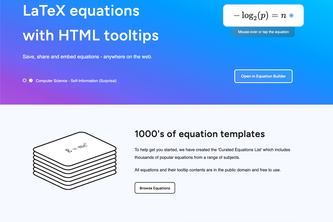
What the company appears to be: EQBuilder is an interactive equation builder tool that allows users to create LaTeX equations with HTML tooltips and generate "Equation Flashcards" for self-testing. The author states it was built using AI tools (ChatGPT, Codex) and a stack including Supabase, Cloudflare, KaTeX, and Vite.
What changed: The project evolved from an initial idea pitched to a professor in early 2025 into a functional tool over five months of development, with the author describing significant progress made using AI assistance.
The single most important open question: Is there any evidence of user adoption or traction beyond the author's own use and testing?
What The Product Actually Is
The description states that EQBuilder:
- Allows users to create LaTeX equations with HTML tooltips
- Enables saving, sharing, or embedding these equations anywhere on the web
- Supports creation of "Equation Flashcards" where users write answers by hand and receive AI feedback (scored out of 100) for accuracy
The author describes building this using:
- Initial prompt generation via ChatGPT 5.3
- Development with VSCode + Codex
- GitHub for version control
- KaTeX for rendering LaTeX
- Supabase for database infrastructure
- Cloudflare for hosting and CDN
- Vite for build tooling
Inference: The product appears to be a web-based application designed for STEM education, combining equation creation with self-assessment features.
Positioning & Claim Evolution
The author states:
- Inspiration came from a conversation with a professor about public outreach solutions
- The idea evolved from "Equations with tooltips" to include "Equation flashcards"
- The tool is positioned as potentially helping millions of people in STEM learning
Inference: The positioning has shifted from a niche academic support tool to a broader educational platform, though no evidence suggests this shift has been validated by users or market feedback.
Target Customer & ICP
The description states:
- The author was inspired by a professor’s research program and outreach needs
- The tool is intended for use in STEM education
- Users input their own equations and test knowledge through flashcards
Not evidenced: No specific customer segments, personas, or target institutions are identified. No evidence of existing users or user groups beyond the author.
Business Model & Pricing Evidence
The description states:
- No explicit business model is described
- The tool supports saving, sharing, and embedding equations
- There is no mention of monetization strategies, pricing tiers, or revenue streams
Inference: The business model remains undefined in the self-reported materials. No evidence of any paid features or commercialization plans.
Technical & Delivery Signals
The author states:
- Built using AI tools (ChatGPT 5.3–5.6), Codex, VSCode
- Uses Supabase for database infrastructure
- KaTeX for rendering LaTeX equations
- Cloudflare for hosting and CDN
- Vite for build tooling
- GitHub for version control
Inference: The technical stack suggests a modern web application built with AI-assisted development practices. However, no evidence of production deployment or performance metrics.
Traction & Maturity Signals
The description states:
- Development took place over five months (since early 2026)
- The author has generated a tool they are "very proud" of
- No mention of users, usage data, or adoption metrics
- The project was submitted to an OpenAI hackathon
Not evidenced: No evidence of user engagement, retention, or any form of traction beyond the author’s own development and testing.
Competitive Context
The description states:
- No direct competitors are named
- The author claims it is "the worlds first equation builder with HTML tooltips"
- No evidence of similar tools or market analysis provided
Inference: The competitive landscape is unknown. The claim of being the first such tool is unverified.
Open Questions & Risks
Key risks and open questions based on the description:
- No revenue, customer, or traction data
- The author is a single individual (team size: 1)
- Product is described as self-developed using AI tools but lacks independent validation
- No evidence of monetization strategy or business plan beyond MVP definition
- Claim of helping "millions" without supporting data
Inference: The lack of any measurable traction, revenue, or user feedback raises concerns about viability and scalability.
Questions the description leaves open
- What specific STEM subjects or educational levels is the tool intended for?
- How do you plan to monetize this product if at all?
- Have you conducted any user testing or gathered feedback from educators or students?
- Are there any existing users or early adopters of EQBuilder?
- What are your plans for scaling beyond a single developer?
- How do you intend to differentiate from other equation tools or educational platforms?
Overall Assessment
Assessment: Not evidenced.
The description provides no information on revenue, customers, traction, or business model. The author is a solo developer working on an idea that has not yet demonstrated adoption or commercial viability. Any potential investment or partnership opportunity remains speculative without further evidence of product-market fit, user engagement, or financial performance.
Confidence Level: Low — based entirely on self-reported materials with no external validation or traction data.
User Stories BotA demo video on every pull request
Get a demo video on every new feature
GitHub App that watches your pull requests and records a narrated, captioned demo.
Save time on demo prep and make informed decisions faster with a video walkthrough of every new feature.
Source
Submitted to the OpenAI 2026 hackathon on Devpost. Project home on Devpost. Back to the full gallery on Devpost.
This competitive analysis was produced by top-founders.com (opens in a new tab)
Generated by a language model from this project's public Devpost page — its tagline, the author's own write-up and any built-with tags listed there — as captured in August 2026. Short quotations are the author's words. It is an opinion on the idea as a business, not on the people behind it, and it reflects the description as published then. If the project has moved on, request a correction below. The analysis is not independent research and contains no verified traction, revenue or customer data.
An independent guide by KFG International LLC — not affiliated with, endorsed by, or connected to Devpost or OpenAI.