

Archive position — measured, not model output
5 likes on Devpost
54 of the 7,850 archived projects have more likes, and 35 share exactly 5 — so this project's #65 place in the like-ranked listing is a tie-break inside that group, not a ranking.
Projects (log scale)
Likes on Devpost. ▲ marks this project's group.
Show the figures
| Likes | Projects | Share of archive |
|---|---|---|
| 0 | 5,587 | 71.2% |
| 1 | 1,758 | 22.4% |
| 2 | 284 | 3.6% |
| 3–4 | 132 | 1.7% |
| 5–9 | 75 | 1.0% |
| 10+ | 14 | 0.2% |
 User Stories BotA demo video on every pull request
Get a demo video on every new feature
GitHub App that watches your pull requests and records a narrated, captioned demo.
Save time on demo prep and make informed decisions faster with a video walkthrough of every new feature.
Executive Summary
What the company appears to be
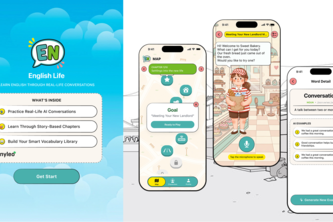
The description states that English Life is an AI-powered English-learning app designed as a voice-first role-playing game where users assume the identity of a newcomer in a foreign town and progress through real-life scenarios. The app uses AI for conversation feedback, mission guidance, character generation, and vocabulary building.
What changed
This project was submitted to the OpenAI 2026 hackathon by a team of three (Nam Thai, Nam Nguyen, Hien Van). It represents an experimental approach to language learning that emphasizes immersive roleplay over traditional lessons. The app is built with native iOS technologies and integrates OpenAI tools for voice interaction and content generation.
Single most important open question
Is there evidence of any traction, revenue, or user adoption beyond the hackathon submission? The description does not indicate whether this product has moved beyond prototype status or if it has been tested with real users.
What The Product Actually Is
The description states that English Life is a voice-first, AI-powered English-learning game where users role-play as newcomers in a foreign town. It includes:
- A personalized five-chapter study path with fifty real-life situations.
- Real-time AI conversation feedback, including transcription and mission keyword tracking.
- AI-generated characters and backgrounds for each scenario.
- Features such as:
- Character book
- Vocabulary library
- Progress tracking
- Mission-based progression
The app is built using SwiftUI, MVVM architecture, and integrates with OpenAI’s Realtime API, Chat Completions, and image generation models.
Inference: The product appears to be a prototype or proof-of-concept built for a hackathon. There is no evidence of commercial deployment or user base beyond the team's own description.
Positioning & Claim Evolution
The description states that English Life aims to make English practice feel like an adventure instead of a classroom, using roleplay and real-life scenarios.
It positions itself as an alternative to vocabulary lists or scripted dialogues, focusing on:
- Immersive experience
- Purposeful speaking practice
- Immediate feedback through progress tracking
The team claims they have built a system that combines:
- Structured prompting
- Realtime speech transcription
- Voice interaction
- Generated visuals
- Persistent game progression
Claim: This is a new approach to language learning using AI-driven roleplay.
Not evidenced: Whether this approach has been validated with users or shown to improve learning outcomes.
Target Customer & ICP
The description states that the app targets English learners who want to practice speaking in realistic, everyday situations. It is designed for users at various levels — from beginner to advanced — who are learning English in a foreign environment.
It implies a focus on:
- Learners who benefit from immersive and contextual learning
- Users interested in voice-based interaction
- People seeking motivation through narrative progression
Inference: The ICP likely includes self-directed learners aged 16–35, particularly those with access to iOS devices and interest in gamified or experiential education.
Business Model & Pricing Evidence
The description does not provide any information about:
- Revenue streams
- Pricing model
- Monetization strategy
- Subscription plans or one-time purchases
Not evidenced: No indication of how the product would be monetized or whether it has a defined business model beyond its hackathon prototype.
Technical & Delivery Signals
The description states that English Life was built using:
- SwiftUI and MVVM for native iOS development
- OpenAI Realtime API for live voice conversations
- OpenAI transcription within the Realtime session
- gpt-5.6-luna (via Chat Completions) for study-path generation, mission guidance, vocabulary definitions
- gpt-image-2 for character portraits and backgrounds
- iOS Vision foreground extraction to remove portrait backgrounds
- Structured JSON prompting for stable paths and data consistency
- Semantic VAD and playback/input gating for natural turn-taking
- Local caching of progress, media, and mission data
Inference: The team has technical depth in iOS development and AI integration. However, there is no evidence that this was deployed at scale or used in production environments.
Traction & Maturity Signals
The description states:
- It was built for the OpenAI 2026 hackathon
- It includes a five-chapter study path with fifty situations
- It supports voice-first interaction and real-time feedback
- It has features like character books, vocabulary libraries, and progress tracking
However, there is no evidence of:
- User adoption or retention
- Revenue or monetization
- Product-market fit validation
- Any live users or beta testers
Not evidenced: No signs of traction, user engagement, or product maturity beyond the hackathon submission.
Competitive Context
The description does not mention any competitors. It does not reference existing English-learning apps or platforms such as Duolingo, Babbel, or Busuu.
Inference: The competitive landscape is unknown based on this description alone. The app may be positioned to differentiate itself through immersive roleplay and AI-driven conversation feedback.
Open Questions & Risks
- Prototype-only status: The product appears to exist only as a hackathon submission with no evidence of commercial viability or user traction.
- No monetization strategy: There is no indication of how the product would generate revenue.
- Limited scope: The app focuses on one language (English) and one platform (iOS).
- Dependency on AI tools: Heavy reliance on OpenAI APIs may create scalability, cost, or availability risks.
- Unproven learning effectiveness: No evidence that this approach improves language acquisition compared to traditional methods.
Inference: The project lacks commercial readiness and user validation. It is unclear whether it has moved beyond experimental design.
Questions the description leaves open
- Has the app been tested with real users? If so, what were the results?
- What is your plan for monetization and long-term sustainability?
- Have you considered expanding to other languages or platforms (e.g., Android)?
- How do you intend to scale beyond the current prototype?
- What are the technical challenges you expect in production deployment?
- Are there any legal or ethical concerns around AI-generated content or voice data collection?
Overall Assessment
The description states that English Life is a voice-first, AI-powered English-learning game built for a hackathon. It includes features such as roleplay-based learning, real-time conversation feedback, and AI-generated characters.
However:
- There is no evidence of traction, revenue, or user adoption.
- No business model or monetization strategy is described.
- The project remains in prototype form with no indication of commercial deployment.
Assessment: This is a conceptual idea with strong technical execution, but not yet a viable investment or partnership opportunity. It requires further validation through user testing, product development, and market traction before it can be considered for serious investment or strategic interest.
User Stories BotA demo video on every pull request
Get a demo video on every new feature
GitHub App that watches your pull requests and records a narrated, captioned demo.
Save time on demo prep and make informed decisions faster with a video walkthrough of every new feature.
Source
Submitted to the OpenAI 2026 hackathon on Devpost. Project home on Devpost. Back to the full gallery on Devpost.
This competitive analysis was produced by top-founders.com (opens in a new tab)
Generated by a language model from this project's public Devpost page — its tagline, the author's own write-up and any built-with tags listed there — as captured in August 2026. Short quotations are the author's words. It is an opinion on the idea as a business, not on the people behind it, and it reflects the description as published then. If the project has moved on, request a correction below. The analysis is not independent research and contains no verified traction, revenue or customer data.
An independent guide by KFG International LLC — not affiliated with, endorsed by, or connected to Devpost or OpenAI.