

Archive position — measured, not model output
5 likes on Devpost
54 of the 7,850 archived projects have more likes, and 35 share exactly 5 — so this project's #66 place in the like-ranked listing is a tie-break inside that group, not a ranking.
Projects (log scale)
Likes on Devpost. ▲ marks this project's group.
Show the figures
| Likes | Projects | Share of archive |
|---|---|---|
| 0 | 5,587 | 71.2% |
| 1 | 1,758 | 22.4% |
| 2 | 284 | 3.6% |
| 3–4 | 132 | 1.7% |
| 5–9 | 75 | 1.0% |
| 10+ | 14 | 0.2% |
 User Stories BotA demo video on every pull request
Get a demo video on every new feature
GitHub App that watches your pull requests and records a narrated, captioned demo.
Save time on demo prep and make informed decisions faster with a video walkthrough of every new feature.
Executive Summary
What the company appears to be
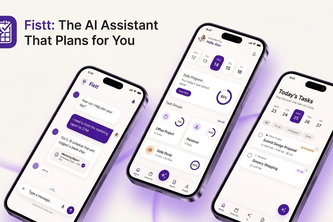
Fistt is an AI-powered daily planner and task automation assistant that transforms unstructured text or voice goals into structured, time-blocked schedules. It leverages OpenAI's GPT models (specifically Codex and GPT-5.6) with structured outputs for deterministic scheduling, and is built using Flutter, Firebase, and VS Code.
What changed
The project was submitted as a hackathon entry to the OpenAI 2026 hackathon. It is described as a self-contained prototype built by one developer (Faisal Ismail), using AI-assisted engineering tools like Codex and GPT-5.6, with no evidence of prior traction or commercial deployment.
Single most important open question
Is there any evidence that Fistt has achieved product-market fit or user adoption beyond the author’s own development environment?
What The Product Actually Is
The description states that Fistt is an intelligent daily planner and task automation assistant. It turns raw, unstructured text or voice goals into structured, time-blocked schedules using AI.
- It supports natural language input for day planning.
- It parses AI responses into deterministic JSON models via OpenAI Structured Outputs.
- It offers interactive task cards with category tags, recurring badges, priority indicators, and time spans.
- Subtasks are automatically broken down and tracked dynamically.
- It includes custom alerts and notes per task.
- It uses a dynamic bottom sheet form for editing or adding tasks.
Inference The product is described as an AI-powered personal productivity tool that aims to reduce manual effort in planning by automating scheduling from conversational input. However, no evidence of actual users, usage metrics, or real-world deployment exists.
Positioning & Claim Evolution
The author positions Fistt as a world-class AI productivity app that listens, thinks, plans, and organizes the user’s day effortlessly.
- The tagline claims it is suitable for a “world-class AI productivity app.”
- The inspiration section frames it as an evolution from traditional task managers and simple chat assistants.
- It aims to bridge the gap between natural human conversation and structured planning.
Inference The positioning is aspirational, focusing on ease-of-use and automation. However, no evidence of market validation or competitive differentiation beyond self-description exists.
Target Customer & ICP
The description does not explicitly define a target customer segment or ideal customer profile (ICP). It implies the product targets individuals who struggle with chaotic to-do lists and want AI-driven scheduling assistance.
Inference The intended user is likely a self-employed individual, freelancer, or professional seeking personal productivity tools. No evidence of specific personas, buyer types, or segmentation strategies is provided.
Business Model & Pricing Evidence
There is no mention of pricing, monetization strategy, or business model in the description.
Inference The project appears to be a prototype with no commercialization plan evident. The author does not describe how revenue would be generated or whether any paid features are planned.
Technical & Delivery Signals
The product was built using:
- AI Tools: Codex, GPT-5.6, OpenAI API with Structured Outputs
- Frontend: Flutter (cross-platform)
- Backend: Firebase (Firestore, Firebase Auth)
- Voice Capabilities: Real-time voice streaming via WebSockets
- Development Environment: VS Code with Codex CLI
Inference The technical stack suggests a modern, AI-integrated mobile/web application. However, no evidence of scalability, performance testing, or production-grade infrastructure is provided.
Traction & Maturity Signals
The project was submitted to the OpenAI 2026 hackathon and is described as a one-person development effort.
- It has not been released publicly.
- No user base, customer data, or adoption metrics are mentioned.
- The author notes it was built in a short timeframe (hackathon context).
- There is no evidence of product-market fit or iterative feedback loops.
Inference The project shows early-stage development maturity but lacks any signs of traction or long-term viability. It remains unproven in real-world usage.
Competitive Context
The description does not reference existing competitors or market positioning relative to them.
Inference No competitive analysis is evident. The author does not discuss how Fistt compares with other task managers, planners, or AI productivity tools such as Notion, Todoist, or Calendly.
Open Questions & Risks
- Single Developer Dependency: The entire project was built by one person (Faisal Ismail), raising concerns about scalability and continuity.
- Unproven Market Fit: No evidence of user feedback, market testing, or adoption.
- Prototype Nature: Built for a hackathon; no indication of production readiness or long-term roadmap.
- AI Reliance Without Oversight: Heavy dependence on LLMs with structured outputs may not be robust in edge cases or under high load.
- No Commercialization Plan: No mention of monetization, pricing, or go-to-market strategy.
Inference The risk profile is high due to lack of traction, limited team capacity, and absence of a clear business model.
Questions the description leaves open
- What specific user problems does Fistt solve that current tools don’t?
- Have you conducted any user interviews or usability tests beyond your own experience?
- How do you plan to scale the AI engine for multiple concurrent users?
- Are there any plans to integrate with existing calendar systems or productivity platforms?
- What is your long-term vision for monetization and product development?
- Can you describe how you would handle edge cases in natural language interpretation (e.g., ambiguous inputs)?
- How do you intend to ensure data privacy and security, especially with Firebase integration?
Overall Assessment
Not evidenced.
There is no evidence of revenue, customers, traction, or a clear path to monetization. The project is described as a hackathon prototype built by one developer. No commercial due-diligence signals are present.
Confidence Level Low This analysis is based entirely on self-reported information and lacks any external validation or historical data. Any conclusions drawn should be treated as speculative and not indicative of actual performance or potential.
User Stories BotA demo video on every pull request
Get a demo video on every new feature
GitHub App that watches your pull requests and records a narrated, captioned demo.
Save time on demo prep and make informed decisions faster with a video walkthrough of every new feature.
Source
Submitted to the OpenAI 2026 hackathon on Devpost. Project home on Devpost. Back to the full gallery on Devpost.
This competitive analysis was produced by top-founders.com (opens in a new tab)
Generated by a language model from this project's public Devpost page — its tagline, the author's own write-up and any built-with tags listed there — as captured in August 2026. Short quotations are the author's words. It is an opinion on the idea as a business, not on the people behind it, and it reflects the description as published then. If the project has moved on, request a correction below. The analysis is not independent research and contains no verified traction, revenue or customer data.
An independent guide by KFG International LLC — not affiliated with, endorsed by, or connected to Devpost or OpenAI.