

Archive position — measured, not model output
1 like on Devpost
505 of the 7,850 archived projects have more likes, and 1,758 share exactly 1 — so this project's #2,028 place in the like-ranked listing is a tie-break inside that group, not a ranking.
Projects (log scale)
Likes on Devpost. ▲ marks this project's group.
Show the figures
| Likes | Projects | Share of archive |
|---|---|---|
| 0 | 5,587 | 71.2% |
| 1 | 1,758 | 22.4% |
| 2 | 284 | 3.6% |
| 3–4 | 132 | 1.7% |
| 5–9 | 75 | 1.0% |
| 10+ | 14 | 0.2% |
 User Stories BotA demo video on every pull request
Get a demo video on every new feature
GitHub App that watches your pull requests and records a narrated, captioned demo.
Save time on demo prep and make informed decisions faster with a video walkthrough of every new feature.
Executive Summary
What the company appears to be
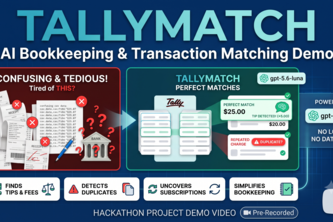
TallyMatch is a self-reported receipt reconciliation tool for freelancers and small businesses. It claims to run entirely in-memory, without login or database storage, using exact-match logic followed by AI review of ambiguous cases.
What changed
The project was submitted as part of the OpenAI 2026 hackathon. No prior version or evolution is described; this is a new build.
Single most important open question
Is there any evidence that TallyMatch has been used beyond the author’s own test data, or that it has gained traction among freelancers or small businesses?
What The Product Actually Is
The description states that TallyMatch:
- Accepts two CSV uploads: a bank/card statement and a list of receipts.
- First performs exact-match logic to pair transactions with receipts based on amount (within one cent) and date (within three days).
- Then sends unmatched items, along with matched pairs as context, to an AI model (gpt-5.6-luna) for review.
- The AI identifies likely tips, fees, partial refunds, duplicate charges, or unexplained items, returning plain-English explanations per item.
- Displays all results in a single combined table.
It is described as running entirely in-memory with no login, database, or saved history.
Evidence
- Author's own write-up
- Technology stack includes JavaScript, Python, HTML/CSS, OpenAI API
Inference The product appears to be a proof-of-concept or prototype built for a hackathon, not a production-ready SaaS offering.
Positioning & Claim Evolution
The description states that TallyMatch is:
- A secure, in-memory receipt reconciliation app.
- Designed for freelancers and small businesses doing their own bookkeeping.
- Built to help users spot missing receipts and duplicate charges.
- Claims to run entirely without login or database — no saved history.
Evidence
- Tagline
- Author's write-up
Inference The positioning is minimalistic and privacy-focused, emphasizing ease-of-use and security. It does not appear to have evolved from a prior version or product line; it is presented as a new idea.
Target Customer & ICP
The description states that TallyMatch targets:
- Freelancers
- Small businesses doing their own bookkeeping
Evidence
- Inspiration section of write-up
Inference No further segmentation or customer persona details are provided. The target is not clearly defined beyond general user types.
Business Model & Pricing Evidence
The description does not mention:
- Any pricing model
- Revenue streams
- Monetization strategy
- Subscription plans or usage fees
Evidence
- No business model described
Inference This appears to be a prototype, not a commercial product. There is no indication of how it would generate revenue.
Technical & Delivery Signals
The description states:
- Built in four days using Codex and Claude for planning.
- Uses exact-match logic first, then AI (gpt-5.6-luna) for ambiguous cases.
- Implements an optional OPENAI_BASE_URL variable to route requests through AICredits due to Indian card restrictions.
- API keys are never written to disk and discarded after use.
- Includes a fallback mechanism if no API key is available.
Evidence
- How we built it section
- Accomplishments section
Inference The technical approach shows an incremental, test-driven development process. The architecture is privacy-focused but not scalable for production use without further engineering.
Traction & Maturity Signals
The description does not mention:
- Any users or customers
- Revenue or monetization
- Product adoption or usage metrics
- Prior versions or iterations of the product
Evidence
- No traction data provided
Inference This is a new, unproven prototype. There is no evidence of real-world usage or customer feedback.
Competitive Context
The description does not mention:
- Competitors
- Market landscape
- Existing solutions in the receipt reconciliation space
Evidence
- No competitive analysis provided
Inference No information is available to assess how TallyMatch compares to existing tools, if any. It is unclear whether such a tool already exists.
Open Questions & Risks
Key risks and open questions based on the description:
- The product is described as a hackathon submission with no prior version or traction.
- No evidence of customer adoption or revenue.
- The AI component uses gpt-5.6-luna, which may not be available in production environments without proper licensing or billing infrastructure.
- The app runs entirely in-memory and does not store data — this could limit scalability or usability for real-world use cases.
- The author is a single individual (team size = 1), suggesting limited development capacity.
Evidence
- Project description
- Author's write-up
Inference The product lacks commercial viability without further development, funding, and user validation.
Questions the description leaves open
- Has TallyMatch been used beyond the author’s own test data?
- Are there any users or customers currently using it?
- What is the plan for monetization or scaling beyond a prototype?
- How does the AI integration handle edge cases or ambiguous matches in real-world data?
- Is there a roadmap for supporting PDF/image uploads instead of CSV?
- What are the long-term plans for API access, data persistence, and user accounts?
Overall Assessment
Assessment Not evidenced.
The description provides no evidence of traction, revenue, or customer adoption. It is a self-reported hackathon prototype with no commercial viability or scalability demonstrated.
Confidence Level Low — based on minimal evidence and lack of any commercial data.
Next Steps
If this were to be considered for investment or partnership, further due diligence would require:
- Proof of usage
- Evidence of customer feedback or early adopters
- A clear business model
- Demonstrated product-market fit
User Stories BotA demo video on every pull request
Get a demo video on every new feature
GitHub App that watches your pull requests and records a narrated, captioned demo.
Save time on demo prep and make informed decisions faster with a video walkthrough of every new feature.
Source
Submitted to the OpenAI 2026 hackathon on Devpost. Project home on Devpost. Back to the full gallery on Devpost.
This competitive analysis was produced by top-founders.com (opens in a new tab)
Generated by a language model from this project's public Devpost page — its tagline, the author's own write-up and any built-with tags listed there — as captured in August 2026. Short quotations are the author's words. It is an opinion on the idea as a business, not on the people behind it, and it reflects the description as published then. If the project has moved on, request a correction below. The analysis is not independent research and contains no verified traction, revenue or customer data.
An independent guide by KFG International LLC — not affiliated with, endorsed by, or connected to Devpost or OpenAI.