

Archive position — measured, not model output
1 like on Devpost
505 of the 7,850 archived projects have more likes, and 1,758 share exactly 1 — so this project's #2,030 place in the like-ranked listing is a tie-break inside that group, not a ranking.
Projects (log scale)
Likes on Devpost. ▲ marks this project's group.
Show the figures
| Likes | Projects | Share of archive |
|---|---|---|
| 0 | 5,587 | 71.2% |
| 1 | 1,758 | 22.4% |
| 2 | 284 | 3.6% |
| 3–4 | 132 | 1.7% |
| 5–9 | 75 | 1.0% |
| 10+ | 14 | 0.2% |
 User Stories BotA demo video on every pull request
Get a demo video on every new feature
GitHub App that watches your pull requests and records a narrated, captioned demo.
Save time on demo prep and make informed decisions faster with a video walkthrough of every new feature.
Executive Summary
What the company appears to be: Tamie is a visual planning application built as a hackathon project, designed to make scheduling more playful and tangible through drag-and-drop interactions with physics-based activity blocks.
What changed: The author describes building a tool that shifts planning from traditional calendar views into an interactive experience where users create and arrange time blocks visually. This represents a shift in how people interact with scheduling tools — from static input to physical manipulation.
Single most important open question: Is there evidence of user adoption or product-market fit beyond the single developer’s prototype? The description states no revenue, customers, or traction data are available.
Note: This analysis is based entirely on the self-reported, unverified project description provided by the author. All claims are attributed to that description and not independently verified.
What The Product Actually Is
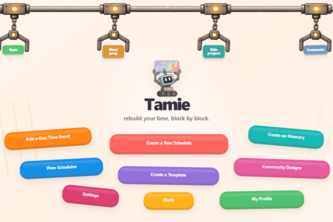
The description states that Tamie is a visual planning app for building weekly schedules, trip itineraries, reusable templates, and one-time events. Users create colorful activity blocks with a name and duration, then drag them from a "playful factory workspace" onto a schedule where they snap into time slots.
It supports saving plans, exporting as PDFs, and sending to Google Calendar or Outlook. It also includes community designs for inspiration and collectible dispenser “Shells” that personalize the experience.
Inference: The product appears to be a prototype built using React, TypeScript, Vite, Tailwind CSS, Supabase, Matter.js, and various calendar integrations. It is described as an interactive tool with a physics engine (Matter.js) for creating tangible feel in its factory workspace.
Positioning & Claim Evolution
The author positions Tamie as a way to make planning "feel more visual, playful, and human." The tagline says: “Time blocking made fun and easy. A playful, hands-on way to turn plans into a schedule you can actually see.”
It claims to offer a distinct interaction model compared to traditional calendars — one where users physically create, move, and arrange their time.
Claim: Tamie redefines planning by shifting from static calendar views to a tactile, visual workflow.
Inference: The positioning reflects an attempt to differentiate from existing tools like Google Calendar or Outlook by focusing on user experience and engagement over functionality alone.
Target Customer & ICP
The description does not name specific target customers. However, it implies that Tamie targets individuals who find traditional planning methods overwhelming or unengaging — particularly those looking for a more intuitive way to organize time.
It suggests use cases include weekly schedules, trip itineraries, and reusable templates, which may appeal to students, professionals, or travelers.
Claim: The product is aimed at people who want a more engaging and visual approach to planning.
Inference: Based on the context of a hackathon submission and lack of explicit targeting, the ICP likely centers around early adopters or tech-savvy individuals interested in playful digital tools.
Business Model & Pricing Evidence
There is no evidence in the description of any business model, pricing strategy, monetization plans, or revenue streams. The project is presented as a prototype built for a hackathon.
Not evidenced: No information about how Tamie would generate value or income.
Technical & Delivery Signals
The app was built using:
- Frontend: React, TypeScript, Vite, Tailwind CSS
- Backend/Database: Supabase (for auth and data persistence)
- Physics Engine: Matter.js
- Export Tools: html2canvas, jsPDF
- Calendar Integrations: Google Calendar, Microsoft Outlook
The author notes challenges in balancing a playful physics-based workspace with precise scheduling behavior.
Claim: Tamie uses modern web technologies to deliver an interactive experience.
Inference: The technical stack suggests a lightweight, web-based solution that could scale with minimal infrastructure. Use of Supabase implies early-stage data handling and authentication capabilities.
Traction & Maturity Signals
There is no evidence of traction or maturity beyond the single developer’s prototype. No customers, revenue, usage metrics, or product adoption are mentioned.
Not evidenced: No signs of real-world usage, user feedback, or growth indicators.
Competitive Context
The description does not mention competitors directly. However, it implies a space similar to calendar and scheduling tools such as Google Calendar, Outlook, Notion, or Trello — but with a focus on visual interaction and playfulness.
Inference: Tamie competes in the broader category of time management and planning apps, but distinguishes itself through its unique interface design and physical simulation elements.
Open Questions & Risks
- Single Developer Prototype: The entire project is attributed to one person (Nabil Said), suggesting limited development resources or team size.
- No Traction or Revenue: No evidence of users, customers, or monetization exists.
- Unproven Market Fit: The product is described as a hackathon submission with no indication of market validation.
- Limited Scope for Scaling: The app appears to be a proof-of-concept rather than a scalable commercial offering.
Open Question: Lack of team, traction, and business model makes it difficult to assess viability beyond prototype stage.
Questions the description leaves open
- What is the intended path from this prototype to a full product?
- Have you tested the app with real users? If so, what feedback did you get?
- How do you plan to monetize Tamie if you move beyond the prototype phase?
- Are there plans for team expansion or partnerships to support growth?
- What are your long-term goals for the product — is it meant to be a standalone tool or integrated into other platforms?
Overall Assessment
There is no evidence of traction, revenue, or customer base to suggest that Tamie has reached a stage suitable for investment or partnership consideration.
Assessment: At this point, Tamie appears to be an early-stage prototype with potential for development. It lacks commercial viability indicators and requires further validation before any strategic move can be made.
Confidence Level: Low — due to lack of data beyond the author’s own account.
User Stories BotA demo video on every pull request
Get a demo video on every new feature
GitHub App that watches your pull requests and records a narrated, captioned demo.
Save time on demo prep and make informed decisions faster with a video walkthrough of every new feature.
Source
Submitted to the OpenAI 2026 hackathon on Devpost. Project home on Devpost. Back to the full gallery on Devpost.
This competitive analysis was produced by top-founders.com (opens in a new tab)
Generated by a language model from this project's public Devpost page — its tagline, the author's own write-up and any built-with tags listed there — as captured in August 2026. Short quotations are the author's words. It is an opinion on the idea as a business, not on the people behind it, and it reflects the description as published then. If the project has moved on, request a correction below. The analysis is not independent research and contains no verified traction, revenue or customer data.
An independent guide by KFG International LLC — not affiliated with, endorsed by, or connected to Devpost or OpenAI.