

Archive position — measured, not model output
1 like on Devpost
505 of the 7,850 archived projects have more likes, and 1,758 share exactly 1 — so this project's #2,031 place in the like-ranked listing is a tie-break inside that group, not a ranking.
Projects (log scale)
Likes on Devpost. ▲ marks this project's group.
Show the figures
| Likes | Projects | Share of archive |
|---|---|---|
| 0 | 5,587 | 71.2% |
| 1 | 1,758 | 22.4% |
| 2 | 284 | 3.6% |
| 3–4 | 132 | 1.7% |
| 5–9 | 75 | 1.0% |
| 10+ | 14 | 0.2% |
 User Stories BotA demo video on every pull request
Get a demo video on every new feature
GitHub App that watches your pull requests and records a narrated, captioned demo.
Save time on demo prep and make informed decisions faster with a video walkthrough of every new feature.
Executive Summary
What the company appears to be
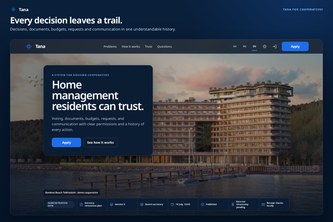
Tana is a mobile-first governance platform for housing cooperatives in Georgia, designed to make decisions, voting, documents, budgets and communications transparent, verifiable and tamper-evident. It uses versioned records and cryptographic principles to support trust without requiring residents to understand complex technology.
What changed
The project began as a personal experience of the founder with a cooperative in Batumi, Georgia. The author states that tana.ge was built during a hackathon using Codex as an engineering collaborator, and it is currently in prototype form. It is described as a multi-tenant platform intended to replace paper-based or chat-based processes with a system where actions are verifiable on-chain.
The single most important open question
Is there evidence that the cooperative in Batumi (the inspiration for tana.ge) has agreed to pilot the product, and if so, what is the timeline and scope of that engagement?
What The Product Actually Is
The description states that tana.ge is a mobile-first governance and operations platform for housing cooperatives. It brings together decisions, voting, documents, budgets, expenses, maintenance requests and communication into one system.
It is described as:
- Multi-tenant from the beginning.
- Supporting versioned records instead of overwritten ones.
- Providing verifiable receipts and tamper-evident actions.
- Designed to work on mobile devices with support for Georgian, Russian and English.
- Using cryptographic principles such as hashes and audit chains to support trust.
The system is built using:
- Django backend
- React PWA frontend
- PostgreSQL database
- Tools like Codex, GitHub, Playwright, Vitest, Tailwind, etc.
Inference The product appears to be a prototype or early-stage platform focused on governance transparency for housing cooperatives in Georgia. It is not yet proven in production or with real users beyond the pilot in Batumi.
Positioning & Claim Evolution
The author states that tana.ge was inspired by a personal experience with a cooperative in Batumi, where decisions were made through fragmented group chats and unclear processes.
Key claims:
- The problem is not just about management dashboards but about creating a “shared source of truth.”
- Residents need a single place to understand proposals, see who published them, access documents, vote securely, and verify outcomes.
- The platform aims to replace blind trust with independently verifiable actions.
- It is designed around several “trust principles,” including tenant isolation, versioned records, idempotent actions, secret ballots, and offline draft handling.
Inference The positioning evolved from a personal pain point into a broader solution for cooperative governance. The author frames it as a tool to restore trust in shared ownership systems by making processes transparent and auditable.
Target Customer & ICP
The description states that tana.ge targets housing cooperatives in Georgia, specifically those with many residents (e.g., nearly 600 owners in Batumi).
It is described as:
- For cooperatives managing shared property, repairs, expenses, rules.
- Designed for residents who are over 60 or not comfortable with technology.
- Supporting three languages: Georgian, Russian and English.
Inference The ICP appears to be housing cooperatives in Georgia that currently rely on Facebook Messenger or WhatsApp for decision-making. It is not described as targeting other countries or types of organizations.
Business Model & Pricing Evidence
The description does not provide any evidence of pricing, business model, monetization strategy or revenue streams.
Not evidenced No mention of fees, subscriptions, licensing, or how the platform will be funded or sold.
Technical & Delivery Signals
The author states that:
- The system is built using Django, React PWA, PostgreSQL, and other tools.
- It supports multi-tenancy from the start.
- It uses cryptographic principles such as versioning, hashes, audit trails, and future blockchain anchoring.
- It includes features like secret ballots, offline drafts, and verification states.
- The interface is designed to translate technical concepts into understandable statuses: “Your action was received,” “It was anchored in the external record,” “It was included in the final protocol.”
Inference The platform is built with a focus on security, auditability, and usability. It uses modern web technologies and has some integration of AI tools like Codex and GPT-5.6 for future development.
Traction & Maturity Signals
The description states that:
- The prototype demonstrates versioned records, tamper-evident actions, and verifiable receipts.
- The next step is to test tana.ge with the cooperative in Batumi (the inspiration for the project).
- Before real voting begins, they will complete legal review, translation review, security testing, and usability sessions with older residents.
Not evidenced No evidence of actual users, revenue, customer adoption, or traction beyond the pilot in one cooperative. The platform is described as a prototype, not yet in production.
Competitive Context
The description does not provide any information about competitors, including other governance platforms, housing management systems, or blockchain-based tools for cooperatives.
Not evidenced No mention of existing solutions or competitive landscape.
Open Questions & Risks
- The platform is described as a prototype and has not yet been tested with real users beyond the pilot in Batumi.
- There is no evidence of traction, revenue, or customer validation.
- The description states that AI-generated content will never be published silently, but it does not clarify how this will be enforced or audited.
- The platform is described as supporting blockchain anchoring in the future, but this functionality is not yet active.
- The team size is only two members (Sharia Peter and Felix), which may limit execution capacity.
Inference The main risk is that tana.ge has not yet proven its value or scalability beyond a single pilot. Execution risks are high due to limited team size and unproven adoption.
Questions the description leaves open
- Has the cooperative in Batumi agreed to pilot tana.ge, and if so, what is the timeline and scope of that engagement?
- What specific legal or regulatory challenges have you encountered in Georgia regarding cooperative governance platforms?
- How do you plan to scale beyond one cooperative to multiple cooperatives across Georgia?
- What are the technical limitations of the current prototype that would need to be addressed before production use?
- How will you ensure that residents with limited digital literacy can effectively use the platform?
- What is your strategy for integrating AI tools like GPT-5.6 into the platform, and how do you plan to maintain auditability while using such tools?
Overall Assessment
The description states that tana.ge is a prototype built during a hackathon and is currently in the pilot phase with one cooperative in Batumi.
Not evidenced No financials, revenue, traction or market validation are provided. The platform has not yet demonstrated product-market fit or scalability.
Inference At this stage, tana.ge is a concept with strong potential for solving a real problem in Georgia’s housing cooperatives. However, it lacks evidence of commercial viability, user adoption, or a clear path to monetization. It may be an early-stage opportunity for investment or partnership if the pilot proves successful and leads to broader adoption.
User Stories BotA demo video on every pull request
Get a demo video on every new feature
GitHub App that watches your pull requests and records a narrated, captioned demo.
Save time on demo prep and make informed decisions faster with a video walkthrough of every new feature.
Source
Submitted to the OpenAI 2026 hackathon on Devpost. Project home on Devpost. Back to the full gallery on Devpost.
This competitive analysis was produced by top-founders.com (opens in a new tab)
Generated by a language model from this project's public Devpost page — its tagline, the author's own write-up and any built-with tags listed there — as captured in August 2026. Short quotations are the author's words. It is an opinion on the idea as a business, not on the people behind it, and it reflects the description as published then. If the project has moved on, request a correction below. The analysis is not independent research and contains no verified traction, revenue or customer data.
An independent guide by KFG International LLC — not affiliated with, endorsed by, or connected to Devpost or OpenAI.