

Archive position — measured, not model output
0 likes on Devpost
2,263 of the 7,850 archived projects have more likes, and 5,587 share exactly 0 — so this project's #3,993 place in the like-ranked listing is a tie-break inside that group, not a ranking.
Projects (log scale)
Likes on Devpost. ▲ marks this project's group.
Show the figures
| Likes | Projects | Share of archive |
|---|---|---|
| 0 | 5,587 | 71.2% |
| 1 | 1,758 | 22.4% |
| 2 | 284 | 3.6% |
| 3–4 | 132 | 1.7% |
| 5–9 | 75 | 1.0% |
| 10+ | 14 | 0.2% |
 User Stories BotA demo video on every pull request
Get a demo video on every new feature
GitHub App that watches your pull requests and records a narrated, captioned demo.
Save time on demo prep and make informed decisions faster with a video walkthrough of every new feature.
Executive Summary
What the company appears to be
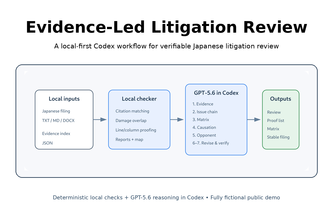
The project described by the caller is a local-first Codex plugin for reviewing Japanese litigation filings. It is presented as a tool that converts evidence into reusable text dossiers, records source and verification states, draws two-sided chronologies, and lists deterministic inconsistency candidates between filings, claims, and exhibits. The system uses a two-layer architecture: deterministic processing (Python-based) for structural checks and GPT-5.6 in Codex for reasoning.
What changed
The author describes building a self-contained, privacy-conscious tool for legal document review that separates deterministic logic from model judgment. It is not a commercial product but a hackathon submission with no real-world deployment or customer data.
Single most important open question
Is there any evidence of traction, revenue, or adoption beyond the author’s solo development and fictional demo?
What The Product Actually Is
The description states that Evidence-Led Litigation Review is a local-first Codex plugin for reviewing Japanese litigation filings. It performs:
- Conversion of supported local evidence into reusable text dossiers
- Recording of source and verification states
- Generation of two-sided chronology (for self, opponent, and neutral material)
- Listing of deterministic inconsistency candidates between filings, claims, and exhibits
- Production of proofreading lists for mistypes, registered misconversions, duplicate input, punctuation defects, unknown exhibit references, and exhibit-number repairs
The system includes a seven-pass review process:
- Evidence inventory
- Issue chain
- Evidence-claim matrix
- Causation and damages
- Strongest-opponent review
- Expression
- Filing-day verification
It also supports:
- TXT, Markdown, DOCX, JSON inputs
- Optional local PDF/image extraction via Poppler and Tesseract
- Outputs in Markdown, JSON, CSV, HTML, SVG
The system is built using Codex-plugins, codex-skills, Python, GPT-5.6, and other tools.
Not evidenced No evidence of actual commercial use, real customer data, or live deployment beyond the author’s solo development and fictional demo.
Positioning & Claim Evolution
The description states that the project was built to address a problem in legal drafting: repeated revisions can improve prose but weaken evidentiary structure. The tool aims to:
- Begin with the record
- Preserve connection between claims and evidence
- Test the strongest opposing explanation
- Make every important revision easier to verify
It positions itself as a local-first, privacy-conscious solution that separates deterministic checks from model reasoning.
The author also notes that it avoids two extremes:
- Generic grammar/regex checking (which should not decide semantic/legal questions)
- Systems that appear to decide legal merit (to maintain human responsibility)
Inferred The tool is positioned as a compliance and quality-assurance aid, not a decision-making engine or legal advice provider.
Target Customer & ICP
The description states that the product is intended for reviewing Japanese litigation filings, particularly in contexts where:
- Evidence must be preserved
- Claims and exhibits must be linked
- Structural errors (e.g., citation drift, damage period overlap) are common
It is built for legal professionals or paralegals who work with complex, multi-party disputes.
Not evidenced No evidence of actual customers, use cases beyond the fictional demo, or target market segmentation.
Business Model & Pricing Evidence
The description does not mention any pricing model, revenue streams, or commercialization strategy. It is presented as a hackathon submission, with no indication of monetization.
Not evidenced No evidence of business model, pricing, or customer acquisition.
Technical & Delivery Signals
The system uses:
- A two-layer architecture: deterministic Python tools (no network requests) and GPT-5.6 in Codex for reasoning
- Local processing only, with optional OCR via Poppler and Tesseract
- Supports TXT, Markdown, DOCX, JSON inputs
- Outputs in Markdown, JSON, CSV, HTML, SVG
- Built using Codex-plugins, codex-skills, Python, GPT-5.6, and other tools
The author states:
- The deterministic core is dependency-free
- It includes automated testing (23 unit/integration tests)
- A cross-platform one-command demo requires no API key
- Privacy scans are included to prevent re-identification
Not evidenced No evidence of scalability, performance benchmarks, or production deployment.
Traction & Maturity Signals
The project is described as a hackathon submission, with:
- No real-world use cases
- A fictional public sample (no real party, filing, address, case number, medical record, or exhibit image)
- No customer data, revenue, or adoption metrics
Not evidenced No evidence of traction, usage, or product-market fit beyond the author’s solo development.
Competitive Context
The description does not mention any competitors. It is presented as a novel approach to legal document review, combining deterministic checks with model reasoning in a local-first environment.
Not evidenced No evidence of existing solutions or competitive landscape.
Open Questions & Risks
- The project is a solo-built hackathon submission, not a commercial product
- No evidence of real-world adoption, customers, or revenue
- The fictional demo may misrepresent the tool’s utility in actual legal practice
- The separation between deterministic and model layers is described as intentional, but it's unclear how this would scale or be validated in practice
- The use of GPT-5.6 implies reliance on a proprietary, non-open model, which could pose risks for long-term deployment
Inferred The tool may not yet be ready for commercial use or integration into legal workflows.
Questions the description leaves open
- What is the actual legal context in which this would be used? Is it intended for a specific jurisdiction or type of case?
- How does the deterministic layer handle edge cases that are not explicitly programmed?
- Has the model reasoning been validated by legal professionals or practitioners?
- What are the limitations of the current architecture in terms of scalability and performance?
- Are there plans to integrate with existing legal document management systems?
- Is there any plan for monetization, or is this purely a proof-of-concept?
Overall Assessment
The project is described as a solo-built hackathon submission with no evidence of traction, revenue, or customer adoption.
Not evidenced No evidence of commercial viability, product-market fit, or scalability beyond the author’s development environment.
Inference This is likely an early-stage idea or prototype, not a product ready for investment or partnership. It may be a useful proof-of-concept but lacks the commercial signals needed to assess its potential for growth or impact.
User Stories BotA demo video on every pull request
Get a demo video on every new feature
GitHub App that watches your pull requests and records a narrated, captioned demo.
Save time on demo prep and make informed decisions faster with a video walkthrough of every new feature.
Source
Submitted to the OpenAI 2026 hackathon on Devpost. Project home on Devpost. Back to the full gallery on Devpost.
This competitive analysis was produced by top-founders.com (opens in a new tab)
Generated by a language model from this project's public Devpost page — its tagline, the author's own write-up and any built-with tags listed there — as captured in August 2026. Short quotations are the author's words. It is an opinion on the idea as a business, not on the people behind it, and it reflects the description as published then. If the project has moved on, request a correction below. The analysis is not independent research and contains no verified traction, revenue or customer data.
An independent guide by KFG International LLC — not affiliated with, endorsed by, or connected to Devpost or OpenAI.