

Archive position — measured, not model output
5 likes on Devpost
54 of the 7,850 archived projects have more likes, and 35 share exactly 5 — so this project's #69 place in the like-ranked listing is a tie-break inside that group, not a ranking.
Projects (log scale)
Likes on Devpost. ▲ marks this project's group.
Show the figures
| Likes | Projects | Share of archive |
|---|---|---|
| 0 | 5,587 | 71.2% |
| 1 | 1,758 | 22.4% |
| 2 | 284 | 3.6% |
| 3–4 | 132 | 1.7% |
| 5–9 | 75 | 1.0% |
| 10+ | 14 | 0.2% |
 User Stories BotA demo video on every pull request
Get a demo video on every new feature
GitHub App that watches your pull requests and records a narrated, captioned demo.
Save time on demo prep and make informed decisions faster with a video walkthrough of every new feature.
Executive Summary
What the company appears to be
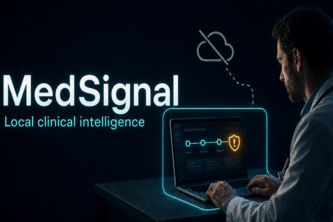
MedSignal is a self-reported local-first healthcare workflow automation tool designed to capture, connect, and review patient information at the bedside. The product is built around a belief that clinical decisions should remain with clinicians, not be made by AI models.
What changed
The project description indicates a shift from general inspiration about fragmented medical records to a specific technical implementation using local inference (gpt-oss:20b), OCR (Tesseract), transcription (Whisper), and deterministic safety checks (Guardian). It also reflects an evolution in how the team approached AI integration — using GPT-5.6/Codex during development but not at runtime.
The single most important open question
Is there evidence of real-world clinical use or pilot testing, or is this a prototype built for a hackathon?
Note: This analysis is based entirely on self-reported information from the author’s own description. No external verification, traction data, revenue figures, or customer names are available.
What The Product Actually Is
The description states that MedSignal is a local-first workflow automation tool for hospitals. It captures patient encounters through speech, typed updates, and prescription images. These inputs are processed using local tools like:
- Faster-whisper for transcription
- Tesseract OCR for image processing
- Local gpt-oss:20b model via Ollama
- SQLite-backed knowledge graph
It then structures this information into a source-linked evidence graph, connects facts across documents and conversations, and runs a bounded agentic workflow with deterministic safety checks (Guardian). The system supports clinician review and handoff views like “Catch Me Up” and SBAR.
Inference: MedSignal appears to be a prototype or proof-of-concept built for a hackathon, not a production-ready product. It is described as running locally without cloud dependencies.
Positioning & Claim Evolution
Original claim
The problem is that the patient story is fractured — clinicians are looking at scattered notes, conversations, and memories, leading to preventable harm.
Evolution of positioning
- Initially framed as a solution to fragmented clinical narratives.
- Later evolved into a local-first approach, emphasizing privacy and clinician control.
- The team explicitly states that AI does not make decisions; it helps organize information.
- They distinguish their tool from generic “AI for healthcare” by focusing on traceability, visibility, and bounded workflows.
Claim: MedSignal believes intelligence should move to the patient data — not the other way around. This is a stated design principle, not verified traction or adoption.
Target Customer & ICP
The description states that MedSignal targets clinical teams in hospitals, particularly those handling patient intake, documentation, safety review, and handoffs.
It is positioned for use by:
- Clinicians
- Nurses
- Care coordinators
ICP inferred from the write-up: Clinical professionals working in hospital environments who need to manage complex patient stories and ensure continuity of care.
Not evidenced: No explicit mention of specific hospital types, departments, or roles beyond general clinical staff. No evidence of customer segmentation or targeting strategy.
Business Model & Pricing Evidence
There is no self-reported information about pricing, monetization, or business model in the description.
Not evidenced: No details on how MedSignal would be sold, licensed, or funded. No mention of enterprise vs. consumer models, subscriptions, or usage fees.
Technical & Delivery Signals
Key technologies mentioned
- FastAPI
- React
- Python
- Node.js
- Ollama
- Whisper (faster-whisper)
- Tesseract
- gpt-oss:20b
- SQLite
- pytest
Delivery approach
- Local-first architecture
- Deterministic safety rules (Guardian)
- Tool orchestration with local inference
- Source-linked facts and evidence traceability
- UI/UX designed for clinician review and workflow visibility
Inference: The system is built as a prototype, likely for demonstration or hackathon use. It uses open-source tools and models rather than proprietary services.
Traction & Maturity Signals
There is no self-reported traction data, revenue, or adoption metrics.
Not evidenced: No customers, users, or real-world deployments are mentioned. The project is described as a prototype built for a hackathon.
Competitive Context
The description does not reference any competitors directly.
Not evidenced: No competitive landscape, market positioning, or differentiation from existing tools in the healthcare workflow space.
Open Questions & Risks
- Prototype vs. Product: The project is described as a hackathon submission and prototype — not a mature product.
- No Clinical Validation: Evaluation results are synthetic and do not reflect real-world accuracy or clinical validation.
- Local-First Assumption: While privacy is emphasized, local execution may limit scalability and performance in large hospital systems.
- AI Integration Limitations: The team used GPT-5.6/Codex only during development — not at runtime — which raises questions about how AI will be integrated in a production environment.
- Lack of Real-World Use Cases: No evidence of actual clinical use or feedback from users.
Inference: This is likely a proof-of-concept with limited commercial viability unless further developed and tested in real-world settings.
Questions the description leaves open
- Has MedSignal been tested in any hospital setting or with actual clinicians?
- What are the plans for scaling beyond local execution (e.g., cloud deployment, multi-site support)?
- How does the team plan to validate clinical safety and accuracy beyond synthetic tests?
- Are there any partnerships or pilot programs already underway?
- What is the roadmap for moving from prototype to production-ready software?
- How will the product be monetized, if at all?
Overall Assessment
Not evidenced: No information available on financials, funding rounds, or investor interest.
Assessment: Based solely on the self-reported description, MedSignal appears to be a hackathon prototype with strong design principles around privacy and clinician control. It lacks evidence of traction, revenue, or real-world deployment. The product shows potential for further development but is not ready for investment or partnership consideration without additional validation and maturity.
User Stories BotA demo video on every pull request
Get a demo video on every new feature
GitHub App that watches your pull requests and records a narrated, captioned demo.
Save time on demo prep and make informed decisions faster with a video walkthrough of every new feature.
Source
Submitted to the OpenAI 2026 hackathon on Devpost. Project home on Devpost. Back to the full gallery on Devpost.
This competitive analysis was produced by top-founders.com (opens in a new tab)
Generated by a language model from this project's public Devpost page — its tagline, the author's own write-up and any built-with tags listed there — as captured in August 2026. Short quotations are the author's words. It is an opinion on the idea as a business, not on the people behind it, and it reflects the description as published then. If the project has moved on, request a correction below. The analysis is not independent research and contains no verified traction, revenue or customer data.
An independent guide by KFG International LLC — not affiliated with, endorsed by, or connected to Devpost or OpenAI.