

Archive position — measured, not model output
2 likes on Devpost
221 of the 7,850 archived projects have more likes, and 284 share exactly 2 — so this project's #313 place in the like-ranked listing is a tie-break inside that group, not a ranking.
Projects (log scale)
Likes on Devpost. ▲ marks this project's group.
Show the figures
| Likes | Projects | Share of archive |
|---|---|---|
| 0 | 5,587 | 71.2% |
| 1 | 1,758 | 22.4% |
| 2 | 284 | 3.6% |
| 3–4 | 132 | 1.7% |
| 5–9 | 75 | 1.0% |
| 10+ | 14 | 0.2% |
 User Stories BotA demo video on every pull request
Get a demo video on every new feature
GitHub App that watches your pull requests and records a narrated, captioned demo.
Save time on demo prep and make informed decisions faster with a video walkthrough of every new feature.
Executive Summary
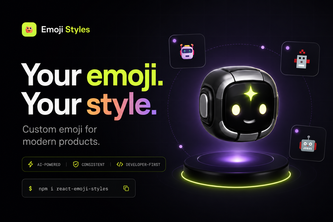
The company appears to be a developer tool for managing emoji visual language in AI-generated interfaces, built as a TypeScript monorepo with Codex (GPT-5.6). The project is self-reported as a typed, provider-agnostic emoji system for React and web environments, aiming to provide consistent rendering across platforms while separating semantic meaning from visual style.
What changed: The author states that the tool was developed during an OpenAI 2026 hackathon using Codex with GPT-5.6. It includes a core package, React bindings, Web Components, CLI tools, and an auditing workflow. The project is published to npm and deployed via GitHub Pages.
The single most important open question: Is there evidence of real-world adoption or usage beyond the demo and self-reported development?
This analysis is based entirely on the self-reported, unverified description provided by the authors. No independent verification or historical data exists for this project.
What The Product Actually Is
- The description states that Emoji-Styles is a typed, provider-agnostic emoji system for React and web environments.
- It provides:
- One API for multiple emoji providers.
- Consistent rendering across operating systems.
- Configurable fallback chains.
- Support for native, static, animated, CDN, and local providers.
- Semantic tokens that separate product intent from artwork.
- Custom emoji generation and local provider packaging.
- React components (e.g., Emoji, EmojiText, EmojiToken), Web Components, CLI tools, and auditing workflow.
- The tool is built as a TypeScript monorepo using Codex with GPT-5.6.
- Packages are published to npm, and the demo is deployed via GitHub Pages.
This is an author-reported description of a developer tool; no evidence of actual product usage or customer feedback exists.
Positioning & Claim Evolution
- The project positions itself as a solution for AI-generated interfaces that currently rely on generic Unicode emoji, which vary across platforms.
- It claims to allow teams to define semantic meaning (e.g., “launch”, “success”) without being locked into one vendor or OS.
- The author states the goal is to make expressive visual language a first-class part of AI-generated interfaces, consistent and easy for developers to control.
- The tool emphasizes:
- Separation of semantic meaning from visual style.
- Licensing, reproducibility, and provenance as core architectural principles.
- Developer experience improvements through CI compatibility, validation, and local publishing workflows.
These are claims made by the authors; no evidence of market positioning or traction is available.
Target Customer & ICP
- The description indicates that Emoji-Styles targets developers working with AI-generated interfaces, particularly those using React or web technologies.
- It aims to support teams building UIs where emoji are used for semantic communication, not just decoration.
- The tool supports multiple frameworks (React, Web Components, potential Vue/Svelte/Angular adapters).
- It is positioned as a developer tool rather than an end-user product.
No evidence of specific customer segments or personas beyond the stated developer audience.
Business Model & Pricing Evidence
- The description does not mention any pricing model or monetization strategy.
- Packages are published to npm, suggesting open-source or freemium distribution.
- There is no indication of paid features, subscriptions, or enterprise tiers.
- No revenue data or customer acquisition information is provided.
Not evidenced — the business model remains unspecified.
Technical & Delivery Signals
- Built with Codex and GPT-5.6, indicating AI-assisted development.
- The tool is a TypeScript monorepo.
- Core functionality includes:
- Provider registry
- Emoji normalization
- Fallback resolution
- Semantic themes
- URL generation
- Includes React bindings, Web Components, CLI tools, and an AST-based auditor.
- Supports:
- Native, static, animated, CDN, and local providers.
- Version-pinned assets with provenance metadata.
- Deployment uses GitHub Pages and npm publishing with GitHub OIDC Trusted Publishing and provenance.
These are technical claims from the author; no evidence of production usage or performance data is available.
Traction & Maturity Signals
- The project was submitted to the OpenAI 2026 hackathon, indicating early-stage development.
- A public demo exists at emoji-styles.space.
- Packages are published to npm.
- The authors mention CI compatibility, local validation, and demo deployment without prebuilt dist directories.
No evidence of user adoption, customer base, or real-world usage beyond the demo and GitHub repository.
Competitive Context
- The description does not reference competitors directly.
- It implies a niche in AI-generated interface design, where emoji are used semantically rather than stylistically.
- It overlaps with tools that manage visual assets in UI systems, but no specific competitive landscape is described.
Not evidenced — no mention of existing or competing products.
Open Questions & Risks
- The project is self-reported and unverified; no third-party validation or traction data exists.
- The tool is built using AI (Codex with GPT-5.6), which may raise concerns about long-term maintainability or scalability.
- It is a monorepo, which can be complex to manage in CI/CD environments without prior experience.
- No evidence of:
- Revenue
- Customers
- Market demand
- Product-market fit
- Long-term roadmap beyond stated goals
These are inferred risks based on the limited self-reported information.
Questions the description leaves open
- What is the actual use case for this tool in AI-generated interfaces?
- How does it differ from existing emoji libraries or UI component systems?
- Are there any real-world users or adopters of Emoji-Styles beyond the demo?
- What are the long-term plans for monetization or commercial viability?
- Has the tool been tested in production environments or CI/CD pipelines?
- How does it handle accessibility and compliance with emoji licensing requirements?
These questions aim to uncover gaps in the self-reported narrative.
Overall Assessment
- The project is early-stage, built during a hackathon, and lacks evidence of traction, revenue, or customer adoption.
- It is positioned as a developer tool for AI-generated interfaces but has no demonstrated market presence.
- The use of AI-assisted development (Codex) raises questions about scalability and maintainability.
- No clear path to monetization or commercial viability is evident.
Not evidenced — no basis for investment or partnership decision. The project appears experimental, with no verified product-market fit or commercial traction.
User Stories BotA demo video on every pull request
Get a demo video on every new feature
GitHub App that watches your pull requests and records a narrated, captioned demo.
Save time on demo prep and make informed decisions faster with a video walkthrough of every new feature.
Source
Submitted to the OpenAI 2026 hackathon on Devpost. Project home on Devpost. Back to the full gallery on Devpost.
This competitive analysis was produced by top-founders.com (opens in a new tab)
Generated by a language model from this project's public Devpost page — its tagline, the author's own write-up and any built-with tags listed there — as captured in August 2026. Short quotations are the author's words. It is an opinion on the idea as a business, not on the people behind it, and it reflects the description as published then. If the project has moved on, request a correction below. The analysis is not independent research and contains no verified traction, revenue or customer data.
An independent guide by KFG International LLC — not affiliated with, endorsed by, or connected to Devpost or OpenAI.