

Archive position — measured, not model output
0 likes on Devpost
2,263 of the 7,850 archived projects have more likes, and 5,587 share exactly 0 — so this project's #2,276 place in the like-ranked listing is a tie-break inside that group, not a ranking.
Projects (log scale)
Likes on Devpost. ▲ marks this project's group.
Show the figures
| Likes | Projects | Share of archive |
|---|---|---|
| 0 | 5,587 | 71.2% |
| 1 | 1,758 | 22.4% |
| 2 | 284 | 3.6% |
| 3–4 | 132 | 1.7% |
| 5–9 | 75 | 1.0% |
| 10+ | 14 | 0.2% |
 User Stories BotA demo video on every pull request
Get a demo video on every new feature
GitHub App that watches your pull requests and records a narrated, captioned demo.
Save time on demo prep and make informed decisions faster with a video walkthrough of every new feature.
Executive Summary
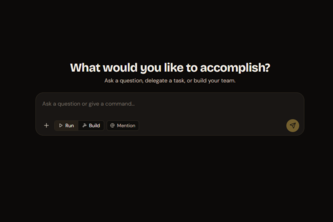
1Business is an AI-powered operating system designed to enable a single founder to run a business autonomously using a team of AI agents. The author describes it as an "agentic OS" that plans, delegates, and executes business tasks, with a core agent coordinating specialist agents for functions like sales, marketing, finance, and support. It is presented as a solution to the challenge of scaling a one-person business into a billion-dollar company through AI automation.
The project is self-reported and unverified. No revenue, customer data, or traction evidence is provided beyond the author's own account. The system is built using React, Vite, Tailwind, Supabase, and OpenAI/Anthropic APIs, with agents defined via Markdown files.
The single most important open question
Is there a viable business model or path to monetization that would support a scalable SaaS offering, or is this a proof-of-concept for a future product?
What The Product Actually Is
The description states that 1Business is an AI operating system composed of multiple agents. It includes:
- A CORE agent, which acts as a chief of staff, planning work and delegating tasks.
- Specialist agents, handling specific functions such as sales, marketing, finance, and support.
- The system uses shared skills like sending emails, updating records, searching knowledge, and interacting with services like Gmail, Stripe, and HubSpot.
The frontend is built with React, Vite, Tailwind, and shadcn/ui. The backend runs on Supabase Edge Functions. Agents are defined by two Markdown files describing personality and responsibilities.
Inference The system appears to be a prototype or hackathon project, not yet a production-ready product. It is described as an “agentic OS” but lacks evidence of actual execution or integration with real business tools at scale.
Positioning & Claim Evolution
The author claims that 1Business enables one founder to become "a full company" by automating business operations through AI agents. The tagline states:
"The AI operating system that turns one founder into a full company an autonomous agent workforce that plans, delegates, and executes your business for you."
This positioning implies:
- A founder-as-company model.
- A team of AI agents functioning like human employees.
- A visionary goal: turning a single person into a billion-dollar business.
The author also notes that the idea evolved from a belief in “one person entrepreneur who builds a billion dollar company,” and that they learned the importance of multiple agents with clear roles, rather than one generic agent.
Claim vs. Fact
These are self-reported claims about intent and vision, not evidence of traction or product-market fit.
Target Customer & ICP
The description states that 1Business targets a single founder who wants to scale their business using AI automation. The author envisions:
- A person who wants to run a business autonomously.
- Someone looking to delegate tasks without needing a full team of humans.
There is no evidence of specific personas, buyer segments, or customer types beyond the founder-as-business owner archetype.
Inference The target is likely early-stage solo founders or small business owners with limited resources and high ambitions. However, there's no indication of whether this aligns with an actual market need or demand.
Business Model & Pricing Evidence
There is no evidence in the description of any business model or pricing structure. The author does not mention:
- How the product would be monetized.
- Whether it’s a SaaS offering.
- Subscription tiers, usage-based pricing, or other revenue mechanisms.
The project appears to be a prototype submitted for a hackathon and lacks commercialization details.
Inference If this is intended as a future product, the business model remains undefined. It may evolve into a SaaS platform, but no evidence supports that yet.
Technical & Delivery Signals
The system is built using:
- Frontend: React, Vite, Tailwind, shadcn/ui
- Backend: Supabase Edge Functions
- AI Tools: OpenAI, Anthropic
- Agent Definition: Markdown files describing agent personalities and responsibilities
Key technical elements include:
- A CORE agent that plans and delegates.
- Specialist agents for various business functions.
- Shared skills like email sending, knowledge search, and service integration (e.g., Gmail, Stripe, HubSpot).
- An approval system to prevent unauthorized actions.
The author notes that the biggest technical challenge was delegation and approvals — suggesting a complex coordination mechanism between agents.
Inference The architecture is modular and agent-based. However, no evidence of scalability, reliability, or production deployment exists.
Traction & Maturity Signals
There is no evidence of traction, customers, revenue, or adoption beyond the author’s own account. The project was submitted to a hackathon (OpenAI 2026), indicating it is likely in early development or prototype stage.
The author mentions learning about prompt design and agent coordination but does not report any real-world usage or performance metrics.
Inference This is a conceptual or experimental project, not yet a product with measurable impact or market validation.
Competitive Context
There is no evidence of competitors or existing solutions in the space. The author does not reference similar tools, platforms, or AI-powered business automation systems.
The idea of an “agentic OS” for business automation aligns with trends in AI agents and workflow automation, but no competitive landscape is described.
Inference No known direct or indirect competitors are mentioned. The space may be nascent or underexplored, though this cannot be confirmed from the description alone.
Open Questions & Risks
- Unproven commercial viability: No evidence of revenue, customers, or monetization strategy.
- Lack of real-world testing: The system is described as a hackathon project with no production use.
- Unclear scalability and reliability: Delegation and approval systems are noted as challenges, suggesting complexity not yet resolved.
- No clear path to product-market fit: The vision is ambitious but lacks evidence of market demand or user validation.
- Self-reported claims only: All descriptions are author-driven, with no third-party verification.
Questions the description leaves open
- What specific business functions do you envision the system handling today?
- Have you tested this with real users or actual business tasks?
- How would you monetize this product if it were to become a commercial offering?
- What are the key assumptions about AI agent behavior and delegation that underpin your design?
- Are there any existing partnerships, integrations, or early adopters?
- What are the main technical limitations of the current system that would need to be overcome for production use?
Overall Assessment
Not evidenced.
The description provides no information on:
- Revenue or financials
- Customer base or adoption
- Product-market fit
- Commercial traction or milestones
This is a self-reported, unverified concept submitted as a hackathon project. It expresses an ambitious vision but lacks any evidence of execution, product development, or commercial viability.
Confidence Level: Low
The author’s own account describes a promising idea in the AI agent space, but there is no indication that this has moved beyond conceptualization or prototype stage. Any investment or partnership decision would require further due diligence into actual functionality, market validation, and business model clarity.
User Stories BotA demo video on every pull request
Get a demo video on every new feature
GitHub App that watches your pull requests and records a narrated, captioned demo.
Save time on demo prep and make informed decisions faster with a video walkthrough of every new feature.
Source
Submitted to the OpenAI 2026 hackathon on Devpost. Project home on Devpost. Back to the full gallery on Devpost.
This competitive analysis was produced by top-founders.com (opens in a new tab)
Generated by a language model from this project's public Devpost page — its tagline, the author's own write-up and any built-with tags listed there — as captured in August 2026. Short quotations are the author's words. It is an opinion on the idea as a business, not on the people behind it, and it reflects the description as published then. If the project has moved on, request a correction below. The analysis is not independent research and contains no verified traction, revenue or customer data.
An independent guide by KFG International LLC — not affiliated with, endorsed by, or connected to Devpost or OpenAI.