

Archive position — measured, not model output
0 likes on Devpost
2,263 of the 7,850 archived projects have more likes, and 5,587 share exactly 0 — so this project's #6,202 place in the like-ranked listing is a tie-break inside that group, not a ranking.
Projects (log scale)
Likes on Devpost. ▲ marks this project's group.
Show the figures
| Likes | Projects | Share of archive |
|---|---|---|
| 0 | 5,587 | 71.2% |
| 1 | 1,758 | 22.4% |
| 2 | 284 | 3.6% |
| 3–4 | 132 | 1.7% |
| 5–9 | 75 | 1.0% |
| 10+ | 14 | 0.2% |
 User Stories BotA demo video on every pull request
Get a demo video on every new feature
GitHub App that watches your pull requests and records a narrated, captioned demo.
Save time on demo prep and make informed decisions faster with a video walkthrough of every new feature.
Executive Summary
What the company appears to be
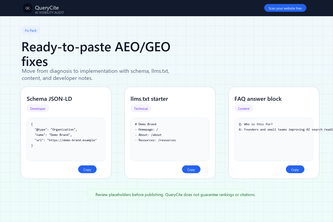
QueryCite is a self-reported AI visibility audit tool for small teams, founders, freelancers, and solo marketers. It claims to help users understand whether their website is ready for AI search by scanning content clarity, structure, crawler readiness, schema signals, and other factors. The product offers an AI-powered advisor that provides actionable fixes.
What changed
The author states they repositioned the tool from technical SEO jargon (e.g., AEO, GEO) to a more accessible framing: “Your customers are asking AI. Is your brand showing up?” This suggests a shift in messaging to improve user comprehension and adoption.
Single most important open question
Does QueryCite have any evidence of traction, revenue, or customer usage beyond the author’s own claims?
What The Product Actually Is
The description states that QueryCite is an AI visibility audit tool for small businesses. It allows users to enter a website and receive a report on how well it performs in AI search visibility.
It scans for:
- Content clarity
- Structure
- Crawler readiness
- Schema signals
- Gaps that may stop AI systems from understanding the brand properly
The product also includes an “AI Advisor” feature that gives ready-to-use fixes, including:
- Practical recommendations
- FAQ ideas
- Schema suggestions
- Developer notes
- Content guidance
It is described as a full-stack SaaS product built with Next.js, TypeScript, Supabase, Gemini, Razorpay, Resend, Vercel, GitHub, Codex, Figma, and others.
Inference The tool appears to be a web-based SaaS platform that provides an audit of AI search readiness for small businesses. It is not a standalone app but a web product with a subscription model.
Positioning & Claim Evolution
The author states that early versions used technical SEO terms like AEO, GEO, LLM optimization, crawler readiness, and schema too early — which made it hard for non-technical users to understand.
They repositioned the tool to focus on:
“Your customers are asking AI. Is your brand showing up?”
This shift in positioning is described as a way to simplify the category and make it more accessible to founders and small teams.
Inference The product evolved from a potentially niche, technical SEO tool into a more general-purpose visibility audit for non-technical users.
Target Customer & ICP
The description states that QueryCite targets:
- Founders
- Entrepreneurs
- Freelancers
- Solo marketers
- Small teams
These are described as people who do not have the time or technical knowledge to understand SEO terms like AEO, GEO, schema, crawler readiness, or llms.txt.
Inference The ICP is small business owners and non-technical users who want to improve their AI search visibility but lack deep SEO expertise.
Business Model & Pricing Evidence
The product is described as a SaaS platform with:
- A free scan flow
- Paid access for full reports and AI Advisor features
It uses Razorpay for payments, and includes:
- Authentication
- Subscription access
- Billing
- Invoices
- Coupons
- Report unlocks
There is no mention of pricing tiers or specific revenue models beyond “optional paid access.”
Inference The business model appears to be freemium with optional paid upgrades. However, there is no evidence of actual pricing, customers, or monetization.
Technical & Delivery Signals
The product was built using:
- Next.js and TypeScript
- Supabase for auth and database
- Gemini for AI recommendations
- Razorpay for payments
- Resend for emails
- Vercel for hosting
- GitHub for version control
- Codex and GPT-5.6 for development, debugging, product thinking, and iteration
- Figma for design support
The author notes that a lot of effort went into making the product feel simple for non-technical users.
Inference The technical stack is standard for modern SaaS products, and the author emphasizes usability and simplicity in the user experience.
Traction & Maturity Signals
The description states:
- QueryCite has a working scan flow
- Report experience
- AI Advisor
- Payment flow
- Billing
- Invoices
- Subscription access
It also mentions that it was built for a hackathon (OpenAI 2026) and is not yet validated with real users beyond the author.
There is no evidence of:
- Customers
- Revenue
- Usage metrics
- Product-market fit validation
Inference The product appears to be in an early development or launch phase. It has functional flows but lacks traction or market validation.
Competitive Context
The description does not mention specific competitors, nor does it provide any data on the competitive landscape.
It does state that people are increasingly turning to AI tools like ChatGPT, Gemini, Perplexity for recommendations and buying advice — which implies a growing demand for AI-based search tools.
Inference The space is emerging, with potential overlap with SEO tools, AI search optimization platforms, and content audit tools. No direct competitors are named or described.
Open Questions & Risks
- No traction or revenue evidence: The product is self-reported as functional but lacks any data on users, customers, or monetization.
- Unverified claims: All descriptions are self-reported by the author — no third-party validation.
- Limited market positioning: The tool is positioned for small teams and solo marketers, which may limit its scalability.
- No pricing or monetization details: There is no evidence of actual pricing, conversion rates, or revenue streams.
- Hackathon origin: The product was built for a hackathon — not necessarily a sign of maturity or commercial viability.
Inference The tool is in an early stage and lacks commercial proof-of-concept. It may be a prototype or MVP with no real-world validation.
Questions the description leaves open
- What is the current user base, if any?
- Are there any paying customers or revenue yet?
- How many users are actively scanning their websites through the tool?
- What is the conversion rate from free scan to paid access?
- How do you plan to scale beyond a single founder?
- Have you validated your positioning with real users?
- What are the key metrics you track for product success?
- Are there any partnerships or integrations in place?
Overall Assessment
The description states that QueryCite is a self-reported AI visibility audit tool built by one person for small teams and solo marketers.
It has:
- A functional product with working flows
- A clear positioning shift toward simplicity
- A technical stack aligned with modern SaaS practices
However, there is no evidence of:
- Revenue
- Customers
- Traction
- Market validation
- Pricing or monetization details
Inference The tool is in an early stage and not yet proven as a commercial product. It may be a promising idea but lacks the evidence to support investment or partnership decisions at this time.
User Stories BotA demo video on every pull request
Get a demo video on every new feature
GitHub App that watches your pull requests and records a narrated, captioned demo.
Save time on demo prep and make informed decisions faster with a video walkthrough of every new feature.
Source
Submitted to the OpenAI 2026 hackathon on Devpost. Project home on Devpost. Back to the full gallery on Devpost.
This competitive analysis was produced by top-founders.com (opens in a new tab)
Generated by a language model from this project's public Devpost page — its tagline, the author's own write-up and any built-with tags listed there — as captured in August 2026. Short quotations are the author's words. It is an opinion on the idea as a business, not on the people behind it, and it reflects the description as published then. If the project has moved on, request a correction below. The analysis is not independent research and contains no verified traction, revenue or customer data.
An independent guide by KFG International LLC — not affiliated with, endorsed by, or connected to Devpost or OpenAI.