

Archive position — measured, not model output
0 likes on Devpost
2,263 of the 7,850 archived projects have more likes, and 5,587 share exactly 0 — so this project's #3,908 place in the like-ranked listing is a tie-break inside that group, not a ranking.
Projects (log scale)
Likes on Devpost. ▲ marks this project's group.
Show the figures
| Likes | Projects | Share of archive |
|---|---|---|
| 0 | 5,587 | 71.2% |
| 1 | 1,758 | 22.4% |
| 2 | 284 | 3.6% |
| 3–4 | 132 | 1.7% |
| 5–9 | 75 | 1.0% |
| 10+ | 14 | 0.2% |
 User Stories BotA demo video on every pull request
Get a demo video on every new feature
GitHub App that watches your pull requests and records a narrated, captioned demo.
Save time on demo prep and make informed decisions faster with a video walkthrough of every new feature.
Executive Summary
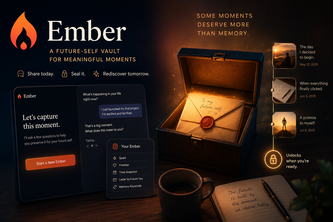
The company appears to be a single-person project (Akin Labs) building a product called Ember, which the description states is a "future-self vault" that uses AI to help users preserve meaningful moments through guided conversations, sealed letters, and reflective prompts. The author describes it as not a journal but an experience designed around ceremony rather than productivity.
What changed: The project was submitted to the OpenAI 2026 hackathon on Devpost. It is described as a prototype or proof-of-concept built in a short timeframe, with no evidence of prior development or commercial traction.
The single most important open question: Is there any evidence that users are actively engaging with Ember beyond its initial creation? The description does not indicate whether the product has been used by anyone other than the author(s), nor does it suggest any form of user feedback loop or adoption metrics.
This analysis is based entirely on self-reported information from the project description. No independent verification, revenue data, customer names, or usage statistics are available.
What The Product Actually Is
- The description states that Ember is a "future-self vault" designed to help people capture meaningful moments.
- It uses GPT-5.6 to power guided conversations and generate structured memory artifacts.
- These artifacts include:
- A meaningful title
- A Spark (capturing the essence of the moment)
- A personal letter to your future self
- An immutable Ember Promise written by the user
- A factual Time Snapshot
- Memory Keywords for retrieval
The product is described as not being a traditional journal, but rather an experience that involves sealing these memories and unlocking them at a future date.
- The application owns the experience—conversation flow, sealing, vault, unlocking, and reflection.
- GPT-5.6 is used to guide conversations and generate memory artifacts, not as a chatbot.
- The architecture separates AI responsibilities from user experience design.
Inference: The product seems to be a digital tool that combines emotional storytelling with AI-generated content, intended for personal use over time.
Positioning & Claim Evolution
- The description states Ember is not a journal, but a "future-self vault".
- It positions itself as a way to preserve moments that change who we become—such as starting a company, graduating, or recovering from failure.
- The author emphasizes that the product is about intentional reflection, not productivity or task management.
- The experience is framed around ceremony and emotional honesty, with editorial standards and guardrails to prevent generic AI responses.
Inference: Ember aims to differentiate itself from typical journaling apps by focusing on long-term memory preservation, emotional depth, and ritualistic engagement rather than daily logging.
Target Customer & ICP
- The description does not name specific customer segments or personas.
- It implies a personal user base, likely individuals who value introspection and want to preserve life-changing moments.
- Users are described as those who might be:
- Starting a company
- Recovering from failure
- Graduating from university
- Experiencing significant transitions
Inference: The target audience appears to be emotionally driven, reflective individuals seeking personal growth or legacy-building tools. However, no explicit segmentation or market research is provided.
Business Model & Pricing Evidence
- No pricing model or monetization strategy is described.
- There is no mention of subscriptions, freemium tiers, or any commercial structure.
- The project is presented as a hackathon submission with no indication of ongoing business development.
Inference: There is no evidence of a defined business model or pricing mechanism. The product appears to be in early-stage conceptualization without commercial intent.
Technical & Delivery Signals
- Built using:
- Next.js 15
- TypeScript
- Tailwind CSS
- Supabase-ready architecture
- GPT-5.6 (author-declared)
- The team used Codex to accelerate development, including scaffolding, UI components, routing, and debugging.
- Architectural decision: separation of AI responsibilities from user experience design.
- GPT-5.6 is used for:
- Guided conversations
- Structured artifact generation
- Personalized letters
- Reflection after unlocking
Inference: The technical stack suggests a modern web application with strong emphasis on AI integration and UI/UX design. However, no evidence of scalability, performance metrics, or production deployment is provided.
Traction & Maturity Signals
- No evidence of users, customers, or adoption.
- The project was submitted to a hackathon (OpenAI 2026).
- The author mentions freezing feature scope early and focusing on quality over quantity.
- No mention of any metrics, feedback loops, or user engagement data.
Inference: There is no indication that Ember has moved beyond prototype status or gained traction among users. It remains a conceptual or experimental tool.
Competitive Context
- No direct competitors are named.
- The description does not reference existing products in the space of memory preservation, journaling, or AI-enhanced reflection tools.
- The author explicitly states they did not want to build another AI journal, implying a desire to stand apart from similar offerings.
Inference: Without competitive analysis or market positioning data, it's unclear how Ember fits into the broader ecosystem of personal development or memory tools. No evidence of prior market research or differentiation strategy is provided.
Open Questions & Risks
- Single-person team: Only one member listed (Akin Labs), which raises concerns about scalability and long-term maintenance.
- No commercial traction: No users, revenue, or adoption data; the project is presented as a hackathon submission.
- Unverified technology claims: GPT-5.6 is mentioned but not validated—this may be aspirational rather than factual.
- Lack of monetization strategy: No business model or pricing structure described.
- Highly subjective experience design: The focus on emotional honesty and editorial voice could limit broad appeal or scalability.
Inference: The project lacks commercial viability indicators, and its success depends heavily on user engagement post-launch, which is not evidenced.
Questions the description leaves open
- What specific use cases have you identified for Ember beyond the ones mentioned in the description?
- How do you plan to validate the emotional resonance of the experience with real users?
- Are there any plans to integrate external data sources (e.g., calendar, social media) into the Time Snapshots?
- What is your timeline for moving from prototype to product, and what resources will be needed?
- Have you considered how to scale beyond a single-person team or initial development phase?
Overall Assessment
- Not evidenced — there is no evidence of revenue, customers, traction, or commercial viability.
- The project is described as a hackathon submission with no indication of ongoing business development or user engagement.
- It is presented as an experimental tool focused on emotional storytelling and AI integration, not a scalable product.
Inference: At this stage, the project does not meet criteria for investment or partnership consideration. Further evidence of traction, user feedback, or commercial intent would be required to assess potential value.
User Stories BotA demo video on every pull request
Get a demo video on every new feature
GitHub App that watches your pull requests and records a narrated, captioned demo.
Save time on demo prep and make informed decisions faster with a video walkthrough of every new feature.
Source
Submitted to the OpenAI 2026 hackathon on Devpost. Project home on Devpost. Back to the full gallery on Devpost.
This competitive analysis was produced by top-founders.com (opens in a new tab)
Generated by a language model from this project's public Devpost page — its tagline, the author's own write-up and any built-with tags listed there — as captured in August 2026. Short quotations are the author's words. It is an opinion on the idea as a business, not on the people behind it, and it reflects the description as published then. If the project has moved on, request a correction below. The analysis is not independent research and contains no verified traction, revenue or customer data.
An independent guide by KFG International LLC — not affiliated with, endorsed by, or connected to Devpost or OpenAI.