

Archive position — measured, not model output
0 likes on Devpost
2,263 of the 7,850 archived projects have more likes, and 5,587 share exactly 0 — so this project's #3,892 place in the like-ranked listing is a tie-break inside that group, not a ranking.
Projects (log scale)
Likes on Devpost. ▲ marks this project's group.
Show the figures
| Likes | Projects | Share of archive |
|---|---|---|
| 0 | 5,587 | 71.2% |
| 1 | 1,758 | 22.4% |
| 2 | 284 | 3.6% |
| 3–4 | 132 | 1.7% |
| 5–9 | 75 | 1.0% |
| 10+ | 14 | 0.2% |
 User Stories BotA demo video on every pull request
Get a demo video on every new feature
GitHub App that watches your pull requests and records a narrated, captioned demo.
Save time on demo prep and make informed decisions faster with a video walkthrough of every new feature.
Executive Summary
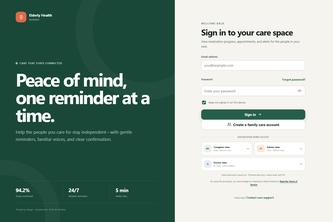
The description states that Elderly Health Assistant (EHA) is a prototype application built for an OpenAI 2026 hackathon. The author describes it as a multi-role platform designed to help elderly people manage medication, appointments and care coordination through phone calls and other communication channels. It includes features such as caregiver dashboards, doctor access, medicine scheduling, supply monitoring, voice recordings and AI integration.
The product appears to be a self-contained web application built with HTML, CSS, JavaScript and Node.js, using JSON for local data persistence and PostgreSQL for production schema design. The author claims it simulates closed-loop call flows, supports multiple voices per medicine, has role-based access controls, and includes privacy-conscious workflows.
Key commercial signals are absent from the description: no revenue, customers, pricing, traction or business model details beyond a fictional subscription model with communication-cost guardrails. The project is described as an MVP built by one developer, with no team size or funding mentioned. The author explicitly states that the prototype does not claim regulatory compliance and is not a production system.
The single most important open question is whether this prototype has any real-world adoption or traction beyond the hackathon context, which cannot be determined from the self-reported description alone.
What The Product Actually Is
The description states that EHA is a "dependency-free web application" built as a hackathon MVP. It is described as:
- A multi-role care platform for elderly health management
- Simulating closed-loop call flows through phone reminders
- Supporting caregiver dashboards, doctor access and family coordination
- Using HTML, CSS, JavaScript frontend with Node.js backend
- Employing JSON for local demo data and PostgreSQL for production schema
- Integrating GPT-5.6 for wellbeing check-ins with structured output and human confirmation
- Including features like medicine scheduling, supply monitoring, voice recordings, appointment management
The author notes that the MVP simulates these functions in a browser environment but does not claim it is a production-ready system.
Positioning & Claim Evolution
The description states that EHA positions itself as:
- An application that reaches elderly patients through landline phones rather than assuming smartphone use
- A solution that allows patients to choose reminder language independent of country
- A platform that closes the loop through self-reported confirmation, retries and escalation
- A system with role isolation, consent behavior and audit events built into its design
- An ecosystem-building tool that aims to connect with pharmacies and other services
The author describes this as a "starting point" rather than a claim of completed regulatory compliance. The positioning appears to have evolved from a simple phone call reminder to a more comprehensive care coordination platform with AI integration, privacy controls and multi-stakeholder access.
Target Customer & ICP
The description states that EHA targets:
- Elderly people who are comfortable using landlines but may struggle with smartphones
- Family caregivers who want reassurance without constant monitoring
- Doctors who need access to specific patient information related to their specialty
- Care organizations managing multiple patients
The author notes that the interface was designed around three roles: family caregiver, doctor and platform administrator. The target customer is described as elderly adults who prefer telephone communication over digital interfaces.
Business Model & Pricing Evidence
The description states that EHA includes:
- A fictional subscription model with communication-cost guardrails
- Care-organization expansion capabilities
- No advertising or sale of health data
- Communication-cost guardrails in the pricing structure
No specific pricing details, revenue streams or monetization methods are provided beyond these general claims about a subscription model.
Technical & Delivery Signals
The description states that EHA was built with:
- HTML, responsive CSS and vanilla JavaScript frontend
- Node.js backend using built-in HTTP and cryptography modules
- JSON endpoints for various API functions
- Local JSON file persistence for demo purposes
- PostgreSQL schema design for production data
- Security patterns including server-side sessions, role-based routes and password hashing
- OpenAI integration with GPT-5.6 responses API
- AI coding agents used to accelerate development across UI, API, schema and testing
The author notes that the MVP uses a local JSON file for persistence rather than production-grade databases.
Traction & Maturity Signals
The description states:
- The project is an MVP built by one developer (team size: 0)
- No revenue, customers or traction data are provided
- The author describes it as a "fictional-data prototype" not a compliant production system
- No mention of user testing, pilot programs or real-world deployment
- The author explicitly states that the prototype is not suitable for real health data
No evidence of traction, adoption or customer validation beyond the hackathon context.
Competitive Context
The description does not provide any information about competitive landscape, existing solutions or market positioning relative to competitors. No mention of similar products or market gaps being addressed.
Open Questions & Risks
The description states:
- The project is a hackathon MVP built by one developer with no team size
- It uses local JSON file persistence rather than production-grade databases
- It explicitly does not claim regulatory compliance (HIPAA, GDPR)
- The author acknowledges that production architecture differs significantly from the demo version
- No revenue, customers or traction data are provided
- The project is described as a "fictional-data prototype" rather than a real system
Questions the description leaves open
- What is the actual market need this addresses and how was it validated?
- How does the team plan to transition from this MVP to a production-ready system?
- What are the specific regulatory compliance requirements the product will need to meet?
- How will the product scale beyond the current single-developer prototype?
- What is the actual business model and monetization strategy beyond the fictional subscription claims?
- How does the team plan to acquire users and build adoption in the elderly care market?
- What are the specific technical challenges in moving from JSON persistence to production databases?
- How will the AI integration be scaled and maintained for real-world use?
Overall Assessment
The description states that this is a hackathon MVP built by one developer with no team size, funding or traction data. The author explicitly describes it as a "fictional-data prototype" not a production system and does not claim regulatory compliance. No evidence of revenue, customers, pricing or business model beyond fictional claims is provided.
The project appears to be an early-stage concept with significant gaps in commercial viability, scalability and regulatory readiness. The lack of any traction, revenue or customer validation makes it difficult to assess its investment potential or partnership value at this stage.
User Stories BotA demo video on every pull request
Get a demo video on every new feature
GitHub App that watches your pull requests and records a narrated, captioned demo.
Save time on demo prep and make informed decisions faster with a video walkthrough of every new feature.
Source
Submitted to the OpenAI 2026 hackathon on Devpost. Project home on Devpost. Back to the full gallery on Devpost.
This competitive analysis was produced by top-founders.com (opens in a new tab)
Generated by a language model from this project's public Devpost page — its tagline, the author's own write-up and any built-with tags listed there — as captured in August 2026. Short quotations are the author's words. It is an opinion on the idea as a business, not on the people behind it, and it reflects the description as published then. If the project has moved on, request a correction below. The analysis is not independent research and contains no verified traction, revenue or customer data.
An independent guide by KFG International LLC — not affiliated with, endorsed by, or connected to Devpost or OpenAI.