

Archive position — measured, not model output
0 likes on Devpost
2,263 of the 7,850 archived projects have more likes, and 5,587 share exactly 0 — so this project's #7,818 place in the like-ranked listing is a tie-break inside that group, not a ranking.
Projects (log scale)
Likes on Devpost. ▲ marks this project's group.
Show the figures
| Likes | Projects | Share of archive |
|---|---|---|
| 0 | 5,587 | 71.2% |
| 1 | 1,758 | 22.4% |
| 2 | 284 | 3.6% |
| 3–4 | 132 | 1.7% |
| 5–9 | 75 | 1.0% |
| 10+ | 14 | 0.2% |
 User Stories BotA demo video on every pull request
Get a demo video on every new feature
GitHub App that watches your pull requests and records a narrated, captioned demo.
Save time on demo prep and make informed decisions faster with a video walkthrough of every new feature.
Executive Summary
What the company appears to be
The project described by the author is a privacy-conscious, local-first workflow tool that connects Zotero (a literature management system) with Obsidian (a knowledge base tool), using AI-assisted processing via Codex and GPT-5.6. It consists of three installable "Skills" designed to automate parts of the literature reading and note-taking process while maintaining user control over data and preventing accidental overwrites or data loss.
What changed
The project evolved from a personal research workflow into a public, reusable bundle of Codex Skills during OpenAI Build Week 2026. It was extended and prepared for release as a safe, open-source tool with explicit safety boundaries and deterministic behavior.
Single most important open question
Is there any evidence that this system has been adopted or used by others beyond the author’s own workflow? The description states no revenue, customers, or traction data are available — only self-reported claims about functionality and design choices.
What The Product Actually Is
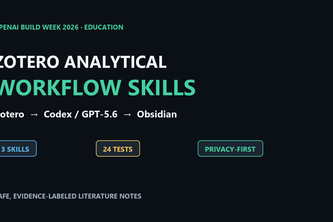
The description states that Zotero Analytical Workflow Skills is a bundle of three installable Codex Skills designed to automate parts of the literature reading and note-taking process between Zotero and Obsidian. These Skills include:
zotero-data-fetcher: retrieves source material by item key or title, organizing metadata, annotations, cached text, and evidence-quality information.zotero-analytical-writer: instructs Codex to transform source material into structured, evidence-aware analytical notes.zotero-collection-manager: coordinates collection queues, resumable processing, first-pass imports, deep-reading upgrades, safe writes, and evidence-schema audits.
These components work together in a Zotero → Codex / GPT-5.6 → Obsidian pipeline.
The system is built using Python 3.11, standard-library-first modules, and interoperates with Zotero and optional scholarly metadata services like Crossref, OpenAlex, and Unpaywall.
It uses GPT-5.6 through Codex for semantic interpretation during Skill execution but does not require an OpenAI API key for normal use.
Inference: The system is described as deterministic in its Python modules and safety-critical logic, while AI is used only for transformation tasks within defined boundaries.
Positioning & Claim Evolution
The author positions the tool as a privacy-first, repeatable, and safe way to move from Zotero to Obsidian without uploading private research data to hosted services. It emphasizes:
- Separation of source evidence from model-generated interpretation.
- Preventing accidental overwrites or loss of data.
- Maintaining long-running research project integrity.
- Supporting large-scale processing with resumable and safe operations.
The tool is framed as a personal research workflow turned into a public, reusable bundle, not a commercial product or SaaS offering.
Inference: The positioning reflects an emphasis on local execution, user control, and safety — not scalability or monetization. It is presented more as a developer utility than a consumer-facing tool.
Target Customer & ICP
The description states that the primary users are researchers who use Zotero for literature management and Obsidian for knowledge organization. The author notes that this includes students and researchers new to Codex Skills, suggesting an educational or academic audience.
There is no explicit mention of enterprise customers, B2B buyers, or non-academic professionals.
Inference: The ICP appears to be individual researchers, particularly those working in academia or fields requiring extensive literature review and note-taking. It may appeal to users who value privacy and local-first workflows.
Business Model & Pricing Evidence
Not evidenced.
The description does not contain any information about pricing, monetization, revenue streams, or business model. The project is described as a public release, with no indication of paid features, subscriptions, or commercial offerings.
Inference: There is no evidence of a business model beyond the author’s own personal use and open-source sharing.
Technical & Delivery Signals
The system is built using:
- Python 3.11
- Standard-library-first modules
- Integration with Zotero and optional scholarly metadata services (Crossref, OpenAlex, Unpaywall)
- Codex / GPT-5.6 for semantic interpretation during Skill execution
- CLI-based interaction with explicit safety flags (
--write,--overwrite) - Dry-run defaults for file-changing operations
- Fail-closed behavior when required templates are missing or malformed
It includes:
- 24 deterministic offline unit tests
- Mocked scholarly metadata responses
- Synthetic templates and test fixtures
- Provenance audits and licensing checks
- Agent metadata for discoverability
Inference: The technical stack suggests a developer-focused, local-first tool with strong emphasis on safety, reproducibility, and privacy. It is not a hosted service or cloud-based solution.
Traction & Maturity Signals
Not evidenced.
There is no mention of:
- Users, customers, or adoption
- Revenue or monetization
- Product usage metrics
- Customer feedback or testimonials
- Market traction or growth indicators
The description focuses on the development process, including audits, testing, and safety measures, but does not report any real-world impact or user engagement.
Inference: No evidence of traction or maturity beyond the author’s own development and internal use.
Competitive Context
Not evidenced.
There is no mention of:
- Competitors
- Market positioning relative to existing tools
- Differentiation from similar workflows or platforms (e.g., other Zotero-Obsidian integrations, AI-assisted note-taking tools)
The project is described as a personal workflow turned into a public bundle, without reference to broader market dynamics.
Inference: No competitive context is provided. The tool may be unique in its approach but lacks evidence of how it fits into the existing ecosystem.
Open Questions & Risks
- No traction or adoption: The project is described as a personal workflow, not a product with users or customers.
- Self-reported only: All claims are unverified and self-reported; no third-party validation or external data exists.
- Limited audience: It targets researchers and developers, but there’s no indication of broader market appeal or demand.
- No commercial viability: No evidence of monetization, pricing, or business model.
- Developer-centric tool: The complexity and CLI-based interface suggest it is not designed for general consumers.
Inference: The project appears to be a personal utility turned into an open-source tool, with no signs of commercial traction or scalability.
Questions the description leaves open
- What is the actual usage or adoption rate among researchers beyond your own workflow?
- Are there any plans to monetize this tool, or is it purely a personal project?
- How does the tool handle edge cases in metadata or citation formats from different sources?
- Has the tool been tested by others outside of the author’s environment?
- What are the long-term maintenance plans for the Skills and their compatibility with evolving Zotero/Obsidian versions?
Overall Assessment
Not evidenced.
There is no evidence of any investment interest, partnership potential, or commercial viability beyond the author's own use case. The tool is described as a personal research utility, not a scalable product or business opportunity.
Inference: Based on the self-reported description alone, there is no indication that this project has investment or partnership potential. It appears to be a developer-side project with limited commercial appeal.
User Stories BotA demo video on every pull request
Get a demo video on every new feature
GitHub App that watches your pull requests and records a narrated, captioned demo.
Save time on demo prep and make informed decisions faster with a video walkthrough of every new feature.
Source
Submitted to the OpenAI 2026 hackathon on Devpost. Project home on Devpost. Back to the full gallery on Devpost.
This competitive analysis was produced by top-founders.com (opens in a new tab)
Generated by a language model from this project's public Devpost page — its tagline, the author's own write-up and any built-with tags listed there — as captured in August 2026. Short quotations are the author's words. It is an opinion on the idea as a business, not on the people behind it, and it reflects the description as published then. If the project has moved on, request a correction below. The analysis is not independent research and contains no verified traction, revenue or customer data.
An independent guide by KFG International LLC — not affiliated with, endorsed by, or connected to Devpost or OpenAI.