

Archive position — measured, not model output
0 likes on Devpost
2,263 of the 7,850 archived projects have more likes, and 5,587 share exactly 0 — so this project's #3,894 place in the like-ranked listing is a tie-break inside that group, not a ranking.
Projects (log scale)
Likes on Devpost. ▲ marks this project's group.
Show the figures
| Likes | Projects | Share of archive |
|---|---|---|
| 0 | 5,587 | 71.2% |
| 1 | 1,758 | 22.4% |
| 2 | 284 | 3.6% |
| 3–4 | 132 | 1.7% |
| 5–9 | 75 | 1.0% |
| 10+ | 14 | 0.2% |
 User Stories BotA demo video on every pull request
Get a demo video on every new feature
GitHub App that watches your pull requests and records a narrated, captioned demo.
Save time on demo prep and make informed decisions faster with a video walkthrough of every new feature.
Executive Summary
What the company appears to be: ElectroBuddy is a self-reported project submitted to the OpenAI 2026 hackathon. The description states it is a tool for children inventing and parents learning when to help, with a focus on hardware projects. It uses AI and cloud infrastructure but emphasizes evidence-based decision-making over AI confidence.
What changed: This is a single-person hackathon submission with no evidence of prior development or traction. The project has not evolved beyond its initial concept as presented in the Devpost entry.
The single most important open question: Is there any evidence that this project has moved beyond the prototype stage, or whether it has any commercial viability or adoption?
What The Product Actually Is
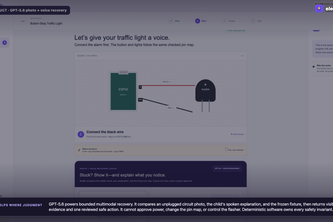
The description states: “A child invents. A parent learns when to help. Evidence—not AI confidence—decides what reaches hardware.” This suggests a system where children build hardware projects and parents are guided on when to intervene, based on evidence rather than AI-generated confidence.
It is not clear how the product functions beyond this high-level description. The author does not describe the interface, workflow, or mechanism by which “evidence” is determined or used to decide what reaches hardware.
Evidence: The tagline and self-reported purpose only.
Inference: This may be a tool for guiding child-led STEM learning with hardware components, but no details are provided on how it works technically or commercially.
Positioning & Claim Evolution
The author states: “A child invents. A parent learns when to help.” This is a positioning statement focused on the intersection of child creativity and parental guidance in hardware innovation.
There is no evidence of prior positioning, evolution of claims, or marketing history. The project appears to be a single submission with no prior development or public positioning.
Evidence: Only the tagline and self-description are available.
Inference: The positioning may evolve if the project gains traction or moves beyond the hackathon stage.
Target Customer & ICP
The description states: “A child invents. A parent learns when to help.” This implies a dual customer base — children (as inventors) and parents (as guides).
There is no evidence of further segmentation, user personas, or identification of specific needs within these groups.
Evidence: The tagline and self-description only.
Inference: The ICP may be families or educators involved in STEM learning with hardware, but this is speculative without more detail.
Business Model & Pricing Evidence
There is no evidence of pricing, monetization strategy, or business model in the description. The author does not state how the product would generate revenue or whether it is intended to be a paid service.
Evidence: Not evidenced.
Inference: If this were to become a commercial product, it might involve subscription or one-time purchase models, but no such details are provided.
Technical & Delivery Signals
The author lists technologies used: “cloudflare-d1, cloudflare-workers, codex, esptool-js, gpt-5.6, next.js, react, remotion, typescript, vinext.”
This suggests a tech stack involving:
- Cloud infrastructure (Cloudflare)
- AI tools (Codex, GPT-5.6)
- Frontend (React, Next.js)
- Hardware interaction (esptool-js)
- Video rendering (Remotion)
However, the description does not explain how these components interact or what the product delivers.
Evidence: The list of technologies is self-reported and unverified.
Inference: The project likely involves a web-based interface with AI-assisted hardware guidance, but no functional details are provided.
Traction & Maturity Signals
There is no evidence of traction, adoption, or user engagement. The project is described as a hackathon submission, and there is no mention of users, customers, or usage metrics.
Evidence: Not evidenced.
Inference: If the project were to mature, it would need to demonstrate user engagement or product-market fit, but none is evident.
Competitive Context
There is no evidence of competitors or market context. The description does not reference existing tools in the space of child STEM learning, hardware innovation, or parental guidance.
Evidence: Not evidenced.
Inference: If this project were to be commercialized, it might compete with platforms for maker education or STEM learning tools, but no such competitive landscape is described.
Open Questions & Risks
- No traction or adoption: The project is a hackathon submission with no evidence of real-world use.
- Unverified claims: The description is self-reported and unverified; there is no third-party validation.
- Unclear product functionality: The mechanism by which “evidence” decides what reaches hardware is not explained.
- Single founder: The team size is listed as one, suggesting limited development capacity.
Evidence: These are inferred from the lack of evidence in the description.
Questions the description leaves open
- What specific problem does ElectroBuddy solve for children and parents?
- How does the system determine what “evidence” means in practice?
- Has the product been tested with real users (children and parents)?
- What is the path to commercialization, if any?
- Are there plans to expand beyond the hackathon prototype?
Overall Assessment
There is no evidence of a viable business model, traction, or market fit. The project is described as a single-person hackathon submission with no indication of prior development or adoption.
Evidence: Not evidenced.
Inference: At this stage, there is no basis for investment or partnership consideration. Any potential value would depend on future development and demonstration of product-market fit.
User Stories BotA demo video on every pull request
Get a demo video on every new feature
GitHub App that watches your pull requests and records a narrated, captioned demo.
Save time on demo prep and make informed decisions faster with a video walkthrough of every new feature.
Source
Submitted to the OpenAI 2026 hackathon on Devpost. Project home on Devpost. Back to the full gallery on Devpost.
This competitive analysis was produced by top-founders.com (opens in a new tab)
Generated by a language model from this project's public Devpost page — its tagline and any built-with tags listed there, since the author published no write-up — as captured in August 2026. Short quotations are the author's words. It is an opinion on the idea as a business, not on the people behind it, and it reflects the description as published then. If the project has moved on, request a correction below. The analysis is not independent research and contains no verified traction, revenue or customer data.
An independent guide by KFG International LLC — not affiliated with, endorsed by, or connected to Devpost or OpenAI.