

Archive position — measured, not model output
0 likes on Devpost
2,263 of the 7,850 archived projects have more likes, and 5,587 share exactly 0 — so this project's #3,896 place in the like-ranked listing is a tie-break inside that group, not a ranking.
Projects (log scale)
Likes on Devpost. ▲ marks this project's group.
Show the figures
| Likes | Projects | Share of archive |
|---|---|---|
| 0 | 5,587 | 71.2% |
| 1 | 1,758 | 22.4% |
| 2 | 284 | 3.6% |
| 3–4 | 132 | 1.7% |
| 5–9 | 75 | 1.0% |
| 10+ | 14 | 0.2% |
 User Stories BotA demo video on every pull request
Get a demo video on every new feature
GitHub App that watches your pull requests and records a narrated, captioned demo.
Save time on demo prep and make informed decisions faster with a video walkthrough of every new feature.
Executive Summary
What the company appears to be
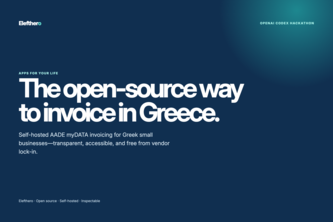
Elefthero is a self-hosted, open-source invoicing application for Greek small businesses that complies with AADE myDATA requirements. It is built around specific invoice workflows (sales, service, retail receipts, credit documents) and supports bilingual operation in Greek and English.
What changed
The project was submitted as part of the OpenAI 2026 hackathon. The author describes it as a working prototype with real AADE Test and Production integration, built using Python, Flask, and AI-assisted development tools like GPT-5.6 and Codex.
Single most important open question
Is there any evidence of actual usage or adoption by Greek small businesses beyond the hackathon submission? The description does not indicate any traction or revenue generation.
What The Product Actually Is
The description states that Elefthero is a self-hosted, bilingual invoicing application for Greek small businesses. It supports AADE myDATA workflows including:
- Sales invoices
- Service invoices
- Retail receipts
- Credit documents
It generates and submits AADE XML, retains sent/received XML logs, provides inline PDFs, and includes optional Viva.com POS automation.
The product is built with:
- Python, Flask, SQLite, Jinja, Tailwind CSS, ReportLab
- Integration with AADE myDATA REST/XML API, VIES, ΓΕΜΗ, Resend, Viva.com POS webhooks
It also uses AI tools like GPT-5.6 and Codex for development.
Inference The product is a technical solution tailored to Greek compliance needs, not a general-purpose invoicing platform.
Positioning & Claim Evolution
The description states that Elefthero was inspired by the need for small businesses in Greece to comply with AADE myDATA without sacrificing control over their data. The name “Elefthero” (Greek for “free”) reflects this intent.
It positions itself as:
- Open-source
- Self-hosted
- Bilingual (Greek/English)
- Transparent and designed to keep data, XML, and costs under the business owner’s control
The author claims it allows owners to see what was sent, understand why something was rejected, keep records locally, and discuss them clearly with an accountant.
Inference This is a positioning statement aimed at small businesses seeking compliance while maintaining autonomy. It does not indicate market traction or adoption.
Target Customer & ICP
The description states that Elefthero targets Greek small businesses, including freelancers, local shops, and family-owned enterprises that must comply with AADE myDATA.
It is designed for users who:
- Must transmit invoice data to AADE myDATA
- Want control over their own business data
- Do not want to rely on opaque or expensive software
Inference The ICP appears to be small, self-employed businesses in Greece that are subject to AADE myDATA regulations and value transparency and control.
Business Model & Pricing Evidence
There is no evidence of a pricing model or business model in the description. The product is described as open-source and self-hosted.
Inference The business model is not evident from the provided information. It may be based on community support, donations, or future monetization through premium features or services (not mentioned).
Technical & Delivery Signals
The project is built with:
- Python, Flask, SQLite, Jinja, Tailwind CSS, ReportLab
- AI tools: GPT-5.6 and Codex used for development
- Integration with AADE myDATA REST/XML API, VIES, ΓΕΜΗ, Resend, Viva.com POS webhooks
It includes features like:
- XML validation and logging
- PDF generation
- Client analytics
- Security controls (2FA, encrypted settings)
- POS automation with webhook verification
Inference The technical stack is consistent with a small-scale, developer-built product. The use of AI tools suggests rapid prototyping but does not indicate scalability or enterprise-grade infrastructure.
Traction & Maturity Signals
There is no evidence of traction, revenue, or customer adoption beyond the hackathon submission. The project is described as a prototype built for a competition and is MIT-licensed.
Inference No evidence of real-world usage or product maturity beyond a proof-of-concept.
Competitive Context
The description does not mention any direct competitors. It implies that existing solutions in Greece may be expensive, opaque, or unsuitable for small businesses.
Inference The competitive landscape is not described, but the author positions Elefthero as an alternative to opaque or costly software.
Open Questions & Risks
- No traction or revenue: The product is a hackathon submission with no evidence of adoption.
- Single-person team: Limited development capacity and scalability.
- Self-hosted model: May limit usability for non-technical users.
- AI dependency: Heavy reliance on GPT-5.6 and Codex may not be sustainable or replicable.
- Limited scope: Focused only on Greek compliance, with no indication of expansion plans.
Questions the description leaves open
- Has the product been used by any real Greek small businesses beyond the hackathon?
- What is the plan for ongoing maintenance and support?
- Are there any legal or regulatory risks associated with self-hosted invoicing in Greece?
- How does the team plan to scale beyond a single developer?
- Is there any intention to monetize the product or offer paid services?
Overall Assessment
Not evidenced
The project is described as a hackathon submission and prototype, with no evidence of revenue, customers, or traction. It is self-hosted, open-source, and built for a specific regulatory context in Greece.
Confidence Low This analysis is based entirely on the author’s own description, which is unverified and self-reported. No third-party data or independent verification is available.
User Stories BotA demo video on every pull request
Get a demo video on every new feature
GitHub App that watches your pull requests and records a narrated, captioned demo.
Save time on demo prep and make informed decisions faster with a video walkthrough of every new feature.
Source
Submitted to the OpenAI 2026 hackathon on Devpost. Project home on Devpost. Back to the full gallery on Devpost.
This competitive analysis was produced by top-founders.com (opens in a new tab)
Generated by a language model from this project's public Devpost page — its tagline, the author's own write-up and any built-with tags listed there — as captured in August 2026. Short quotations are the author's words. It is an opinion on the idea as a business, not on the people behind it, and it reflects the description as published then. If the project has moved on, request a correction below. The analysis is not independent research and contains no verified traction, revenue or customer data.
An independent guide by KFG International LLC — not affiliated with, endorsed by, or connected to Devpost or OpenAI.