

Archive position — measured, not model output
0 likes on Devpost
2,263 of the 7,850 archived projects have more likes, and 5,587 share exactly 0 — so this project's #3,893 place in the like-ranked listing is a tie-break inside that group, not a ranking.
Projects (log scale)
Likes on Devpost. ▲ marks this project's group.
Show the figures
| Likes | Projects | Share of archive |
|---|---|---|
| 0 | 5,587 | 71.2% |
| 1 | 1,758 | 22.4% |
| 2 | 284 | 3.6% |
| 3–4 | 132 | 1.7% |
| 5–9 | 75 | 1.0% |
| 10+ | 14 | 0.2% |
 User Stories BotA demo video on every pull request
Get a demo video on every new feature
GitHub App that watches your pull requests and records a narrated, captioned demo.
Save time on demo prep and make informed decisions faster with a video walkthrough of every new feature.
Executive Summary
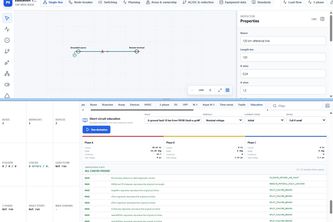
The company appears to be a solo developer project named "Electric System Analyzator and Simulator", self-described as an educational tool for electrical network analysis and simulation. The author states it began as a university assignment to help students verify calculations, but has since evolved into a broader power system simulation tool with potential industrial applications.
Key changes noted
- Started as a basic GPT-5.5 scaffold
- Transitioned to GPT-5.6 for serious development
- Expanded beyond initial student-focused scope
The single most important open question
What is the actual commercial viability of this tool, and whether it has any traction or revenue-generating potential beyond the author's personal educational use?
Analysis basis
Self-reported only. No evidence of revenue, customers, partnerships, or independent validation.
What The Product Actually Is
- The description states: "An electrical network analysis and simulation software that will be capable of fully modeling the losses, oscillations, faults and the effects of any changes within a more complex electrical network"
- It performs load flow analysis, fault calculations, and several other power system studies
- It includes an educational module to help students understand faults, sequence networks, and calculation methods
- The author states: "By now the software is starting to grow beyond this single function, but that original idea was that"
- Built with: codex, gpt5.6, python, react, typescript
- The author reports: "I built the first prototype with GPT-5.5 about a month ago, but that was really just a bare-bones scaffold, not even worth mentioning yet"
Inference The product appears to be an educational software tool for power systems engineering, initially focused on student use but expanding into broader functionality.
Positioning & Claim Evolution
- Original positioning: "One of the major topics at university was the calculation of short-circuit currents, and loadflow analysis and it was quite difficult to find practice problems that were solved flawlessly, which would have made studying much easier"
- Current claim: "The goal of this program is to let students verify their calculations on an arbitrarily configured network"
- Evolution: The author states: "By now the software is starting to grow beyond this single function, but that original idea was that"
- Expanded scope: "It will provide an extremely useful interface for students, and potentially even for industry use as well"
- Author's own claim: "I’m proud of the program that’s starting to take shape as a whole"
Inference The positioning has evolved from a narrow student aid tool to a broader educational and potentially industrial simulation platform.
Target Customer & ICP
- The description states: "The goal of this program is to let students verify their calculations on an arbitrarily configured network"
- It includes "an educational module to help students understand faults, sequence networks, and calculation methods"
- The author mentions: "potentially even for industry use as well"
- The author's own claim: "It will provide an extremely useful interface for students"
Not evidenced No specific customer segments, user personas, or target industries beyond general student and potential industrial users.
Business Model & Pricing Evidence
- The author states: "I’d like to add a proper licensing option to the software"
- No pricing information provided
- No revenue model described
- No evidence of any commercial transactions or monetization strategy
Inference The project appears to be in early development with potential for licensing-based monetization, but no concrete business model is evidenced.
Technical & Delivery Signals
- Built with: codex, gpt5.6, python, react, typescript
- Development approach: "I built the first prototype with GPT-5.5 about a month ago, but that was really just a bare-bones scaffold"
- The author reports: "Since the core parts of the project felt important, I decided to wait for the release of GPT-5.6, and only then started to seriously continue development"
- Technical challenges mentioned: "This has been one of the most complex tasks I’ve worked on so far"
- The author states: "I feel more like a tester who tries out the results of what Codex has produced"
Inference The project uses AI-assisted development with GPT-5.6, shows technical complexity, and is being developed by a solo developer.
Traction & Maturity Signals
- No evidence of users, customers, or adoption
- No revenue data
- No customer testimonials or case studies
- The author states: "By now the software is starting to grow beyond this single function, but that original idea was that"
- The project appears to be in early development stage with no clear maturity indicators
Inference No traction signals are evidenced. The project appears to be in early development.
Competitive Context
- No evidence of competitors or market analysis
- No mention of existing tools in the electrical network simulation space
- No competitive positioning or differentiation claims
- No evidence of market size or competitive landscape
Inference No competitive context is evidenced. The author does not describe any existing solutions or market position.
Open Questions & Risks
- Solo developer model with no team or external validation
- Self-reported only, no independent verification
- No revenue, customers, or traction evidence
- The project appears to be in early development stage
- Reliance on AI tools (Codex, GPT) for development raises questions about scalability and control
- Potential technical complexity without proven delivery capability
Inference The main risk is that this remains a personal project with no commercial viability or traction.
Questions the description leaves open
- What specific educational institutions or engineering programs are interested in using this tool?
- How do you plan to validate the accuracy of your simulation results against real-world data?
- What is your timeline for achieving commercial viability and monetization?
- Have you identified any potential enterprise customers beyond academic use?
- What specific technical challenges have you encountered that could impact delivery or accuracy?
- How do you plan to handle software maintenance and updates as the tool evolves?
Overall Assessment
Not evidenced No commercial viability, traction, or revenue data is provided.
Inference The project appears to be an early-stage educational tool with no demonstrated commercial potential or market traction. It lacks evidence of any business model, customers, or revenue streams beyond the author's personal use case. The solo developer approach and AI-assisted development raise questions about scalability and long-term viability. The project is positioned as potentially useful for students and industry professionals but has not demonstrated any commercial success or adoption.
User Stories BotA demo video on every pull request
Get a demo video on every new feature
GitHub App that watches your pull requests and records a narrated, captioned demo.
Save time on demo prep and make informed decisions faster with a video walkthrough of every new feature.
Source
Submitted to the OpenAI 2026 hackathon on Devpost. Project home on Devpost. Back to the full gallery on Devpost.
This competitive analysis was produced by top-founders.com (opens in a new tab)
Generated by a language model from this project's public Devpost page — its tagline, the author's own write-up and any built-with tags listed there — as captured in August 2026. Short quotations are the author's words. It is an opinion on the idea as a business, not on the people behind it, and it reflects the description as published then. If the project has moved on, request a correction below. The analysis is not independent research and contains no verified traction, revenue or customer data.
An independent guide by KFG International LLC — not affiliated with, endorsed by, or connected to Devpost or OpenAI.