

Archive position — measured, not model output
1 like on Devpost
505 of the 7,850 archived projects have more likes, and 1,758 share exactly 1 — so this project's #982 place in the like-ranked listing is a tie-break inside that group, not a ranking.
Projects (log scale)
Likes on Devpost. ▲ marks this project's group.
Show the figures
| Likes | Projects | Share of archive |
|---|---|---|
| 0 | 5,587 | 71.2% |
| 1 | 1,758 | 22.4% |
| 2 | 284 | 3.6% |
| 3–4 | 132 | 1.7% |
| 5–9 | 75 | 1.0% |
| 10+ | 14 | 0.2% |
 User Stories BotA demo video on every pull request
Get a demo video on every new feature
GitHub App that watches your pull requests and records a narrated, captioned demo.
Save time on demo prep and make informed decisions faster with a video walkthrough of every new feature.
Executive Summary
What the company appears to be
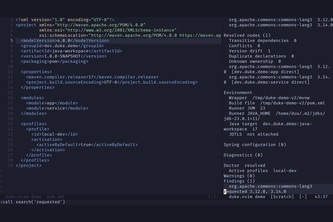
The description states that duke.nvim is a pure Lua plugin for Neovim 0.11+, designed to enable developers to manage Maven, Gradle, and Spring workspaces directly within Neovim. It offers project creation, dependency management, upgrade planning, and workspace inspection features without leaving the editor.
What changed
The author describes an evolution from a simple project scaffolding tool into a more comprehensive Java workspace manager that maintains safety through session-scoped plans and local-first models.
Single most important open question
Is there any evidence of user adoption or feedback beyond the author's own account?
Note: This analysis is based entirely on the self-reported, unverified description provided by the author. No third-party data, revenue figures, customer names, or traction metrics are available.
What The Product Actually Is
The description states that duke.nvim is a pure Lua plugin for Neovim 0.11 and newer, intended to allow developers to manage Maven, Gradle, and Spring workspaces inside Neovim without leaving the editor.
It supports:
- Creating Maven, Gradle, and Spring Boot projects
- Discovering workspaces without running builds
- Refreshing resolved build information
- Showing dependency drift, ownership, and paths
- Building and applying upgrade plans with conflict protection
- Adding, upgrading, inspecting, and removing dependencies
- Safely creating Maven reactor modules
- Navigating Spring configuration files and generated Java sources
The plugin includes a Project Center that separates fast local inspection from explicit build-backed refreshes. Dependency upgrades are session-scoped plans, allowing users to review changes before applying them.
Inference: The product is described as a Neovim plugin built in Lua using GPT-5.6 via Codex CLI for development assistance.
Positioning & Claim Evolution
The author states that the goal was not to recreate an IDE but to give Neovim a focused project and build-model layer, similar to how cargo new and cargo add work in Rust.
It evolved from:
- A project scaffold tool
- Into a safe Java workspace manager
Key claims include:
- The plugin provides a “cargo new plus cargo add feeling for JVM”
- It avoids interrupting the editing flow
- It gives Neovim a focused layer beside tools like
nvim-jdtls
Claim: The product is positioned as a lightweight, safe, and integrated tool for Java developers working inside Neovim.
Target Customer & ICP
The description does not explicitly name target customers or define an ideal customer profile (ICP). However, it implies:
- Developers using Neovim
- Working with Maven, Gradle, or Spring Boot projects
- Preferring to stay within Neovim for build and project management tasks
Inference: The primary user base likely consists of Java developers who use Neovim as their main editor and want seamless integration with JVM tooling.
Business Model & Pricing Evidence
There is no evidence in the description regarding:
- Revenue model
- Pricing structure
- Monetization strategy
- Paid features or subscriptions
Not evidenced
Technical & Delivery Signals
The author states that duke.nvim was built using:
- Lua
- Neovim 0.11+
- GPT-5.6 via Codex CLI
- Tools such as Plenary tests, vimdoc, and README synchronization
Key technical decisions mentioned:
- Pure Lua implementation
- No dependency on UI frameworks, JDTLS managers, JDK vendors, or plugin ecosystems
- Session-scoped upgrade plans
- Safety rules to prevent corruption during file changes
- Separation of target Java version from runner JVM version
Inference: The tool is lightweight and designed for developer productivity with strong safety guarantees.
Traction & Maturity Signals
There is no evidence in the description of:
- Users or customer base
- Downloads or usage statistics
- Adoption rate or feedback
- Product maturity beyond initial development
Not evidenced
Competitive Context
The description does not mention competitors or direct market comparisons. However, it references:
- Tools like
nvim-jdtls - Rust’s
cargocommands as a point of comparison
Inference: The tool competes in the space of developer productivity tools for Neovim and JVM environments, potentially overlapping with IDE-like functionality.
Open Questions & Risks
- No external validation or user feedback — all claims are self-reported
- Single-person team — raises questions about scalability and long-term maintenance
- Limited scope: Only supports Maven, Gradle, and Spring; no mention of other build systems
- Dependency on GPT-5.6 — suggests a high level of AI involvement in development, which may not be sustainable or replicable
Inference: The lack of traction, users, or third-party validation makes it difficult to assess commercial viability.
Questions the description leaves open
- Have you received any feedback from other developers using duke.nvim?
- How do you plan to scale beyond a single developer?
- Are there any known edge cases or limitations with real-world projects?
- What is your roadmap for expanding support to other build tools (e.g., Bazel, sbt)?
- Do you have plans for monetization or commercial partnerships?
Overall Assessment
The description provides no evidence of traction, revenue, or customer adoption. The product appears to be a developer-side tool built by one person with strong technical execution and safety design principles.
Assessment: Based on the self-reported description alone, duke.nvim is an early-stage developer tool with potential but lacks commercial due-diligence signals such as users, revenue, or market validation. It should be considered speculative at this stage unless further evidence emerges.
User Stories BotA demo video on every pull request
Get a demo video on every new feature
GitHub App that watches your pull requests and records a narrated, captioned demo.
Save time on demo prep and make informed decisions faster with a video walkthrough of every new feature.
Source
Submitted to the OpenAI 2026 hackathon on Devpost. Project home on Devpost. Back to the full gallery on Devpost.
This competitive analysis was produced by top-founders.com (opens in a new tab)
Generated by a language model from this project's public Devpost page — its tagline, the author's own write-up and any built-with tags listed there — as captured in August 2026. Short quotations are the author's words. It is an opinion on the idea as a business, not on the people behind it, and it reflects the description as published then. If the project has moved on, request a correction below. The analysis is not independent research and contains no verified traction, revenue or customer data.
An independent guide by KFG International LLC — not affiliated with, endorsed by, or connected to Devpost or OpenAI.