

Archive position — measured, not model output
1 like on Devpost
505 of the 7,850 archived projects have more likes, and 1,758 share exactly 1 — so this project's #983 place in the like-ranked listing is a tie-break inside that group, not a ranking.
Projects (log scale)
Likes on Devpost. ▲ marks this project's group.
Show the figures
| Likes | Projects | Share of archive |
|---|---|---|
| 0 | 5,587 | 71.2% |
| 1 | 1,758 | 22.4% |
| 2 | 284 | 3.6% |
| 3–4 | 132 | 1.7% |
| 5–9 | 75 | 1.0% |
| 10+ | 14 | 0.2% |
 User Stories BotA demo video on every pull request
Get a demo video on every new feature
GitHub App that watches your pull requests and records a narrated, captioned demo.
Save time on demo prep and make informed decisions faster with a video walkthrough of every new feature.
Executive Summary
What the company appears to be
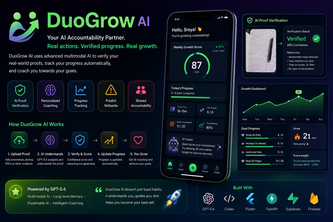
DuoGrow AI is an AI-powered accountability platform for habit formation, built as a hackathon project. The product enables two users (a "duo") to track and verify progress toward shared goals using AI-assisted proof verification. It includes modules like Duo Wake, Duo Study, Duo Workout, and a Problem of the Day feature.
What changed
The project is self-described as an evolution from traditional habit-tracking apps that rely on self-reporting ("honor system"). It introduces real-world proof submission and AI validation to enforce accountability between paired users.
Single most important open question
Is there evidence of user traction, revenue or adoption beyond the hackathon demo? The description states no such data exists.
Analysis basis
Self-reported only. No third-party verification, archived history, or independent sources. All claims are from the author's own submission and must be treated as unverified.
What The Product Actually Is
The description states that DuoGrow AI is a platform where two users pair up to track progress on shared goals using modules such as:
- Duo Wake (alarm-style wake missions)
- Duo Study (Pomodoro-based learning)
- Duo Workout
- Duo Diet with calorie tracking
- Shared tasks
- Daily Problem of the Day (POTD) pulled from a question bank
Users upload screenshots, photos, or PDFs to prove their activity. AI (via Claude API) verifies these proofs and returns an assessment with confidence score.
Claim
The product is described as an accountability tool for habit formation.
Evidence Author's own write-up; no external validation provided.
Positioning & Claim Evolution
The project positions itself as a response to "habit apps that run on the honor system." It claims to introduce real-world proof verification and shared accountability between paired users, aiming to make streaks meaningful.
It evolved from a simple idea: instead of checking off tasks, users must prove they did them — with AI helping validate this proof.
Claim
The product aims to improve habit tracking by introducing accountability.
Evidence Author's own write-up; no external claims or market positioning data provided.
Target Customer & ICP
The description does not name specific customer segments or personas. It implies a general audience interested in personal development, productivity, and goal-setting who may benefit from peer accountability.
It focuses on individuals pairing up — suggesting a B2C or niche B2B use case where users form pairs to track progress together.
Claim
The target is people seeking structured, accountable habit tracking.
Evidence Author's own write-up; no explicit ICP defined.
Business Model & Pricing Evidence
There is no mention of pricing models, monetization strategies, or business model in the description. The project was built for a hackathon and has no stated revenue streams or customer acquisition plans.
Claim
No evidence of business model or pricing.
Evidence Not evidenced; author did not describe any commercial aspects beyond concept.
Technical & Delivery Signals
The team used:
- Frontend: Vite + React + TypeScript
- Backend: Hono API server
- Storage: better-sqlite3
- AI integration: Claude API (vision and structured outputs)
- Deployment: Render, auto-deploy on push
- Demo mode: Deterministic fake verifier for graceful failure handling
The system supports real-time syncing between paired users via polling and allows session scoping per browser tab.
Claim
The tech stack and architecture support real-time proof verification and user sync.
Evidence Author's own write-up; no independent technical review or performance data.
Traction & Maturity Signals
No evidence of traction, customers, or usage beyond the hackathon project. The team is small (2 members), and the product was built for a single competition event.
Claim
No traction or adoption data.
Evidence Not evidenced; no user base, revenue, or engagement metrics provided.
Competitive Context
The description does not reference competitors or existing solutions in the habit-tracking or productivity space. It only contrasts itself with "habit apps that run on the honor system."
Claim
No competitive landscape described.
Evidence Not evidenced; author did not name or analyze competitors.
Open Questions & Risks
- Unproven market demand: No evidence of users beyond the hackathon.
- Small team size: Only 2 founders, which may limit execution capacity.
- AI dependency risk: Reliance on Claude API for proof verification introduces potential failure points.
- Lack of commercial viability: No pricing, monetization or business model described.
- Demo-only functionality: The demo mode suggests the product may not yet be fully production-ready.
Inference These risks stem from lack of evidence and reliance on a single hackathon project.
Evidence Author's own write-up; no external data to confirm or refute these concerns.
Questions the description leaves open
- What is your plan for scaling beyond the current demo?
- Are there any users currently testing or using the product outside of the hackathon?
- How do you intend to monetize this platform?
- What are the key assumptions about user behavior that underpin your design choices?
- Have you considered how to handle edge cases in AI verification (e.g., poor image quality, ambiguous inputs)?
- Is there a roadmap for expanding beyond duos into larger accountability groups?
Inference These questions aim to uncover gaps in the self-reported narrative.
Evidence Not evidenced; all are derived from the lack of clarity in the description.
Overall Assessment
There is no evidence of traction, revenue, or commercial viability beyond a hackathon project. The product concept appears innovative but lacks validation through real-world usage or data.
Claim
No investment or partnership readiness indicated.
Evidence Not evidenced; no financials, users, or market traction provided.
User Stories BotA demo video on every pull request
Get a demo video on every new feature
GitHub App that watches your pull requests and records a narrated, captioned demo.
Save time on demo prep and make informed decisions faster with a video walkthrough of every new feature.
Source
Submitted to the OpenAI 2026 hackathon on Devpost. Project home on Devpost. Back to the full gallery on Devpost.
This competitive analysis was produced by top-founders.com (opens in a new tab)
Generated by a language model from this project's public Devpost page — its tagline, the author's own write-up and any built-with tags listed there — as captured in August 2026. Short quotations are the author's words. It is an opinion on the idea as a business, not on the people behind it, and it reflects the description as published then. If the project has moved on, request a correction below. The analysis is not independent research and contains no verified traction, revenue or customer data.
An independent guide by KFG International LLC — not affiliated with, endorsed by, or connected to Devpost or OpenAI.