

Archive position — measured, not model output
0 likes on Devpost
2,263 of the 7,850 archived projects have more likes, and 5,587 share exactly 0 — so this project's #4,908 place in the like-ranked listing is a tie-break inside that group, not a ranking.
Projects (log scale)
Likes on Devpost. ▲ marks this project's group.
Show the figures
| Likes | Projects | Share of archive |
|---|---|---|
| 0 | 5,587 | 71.2% |
| 1 | 1,758 | 22.4% |
| 2 | 284 | 3.6% |
| 3–4 | 132 | 1.7% |
| 5–9 | 75 | 1.0% |
| 10+ | 14 | 0.2% |
 User Stories BotA demo video on every pull request
Get a demo video on every new feature
GitHub App that watches your pull requests and records a narrated, captioned demo.
Save time on demo prep and make informed decisions faster with a video walkthrough of every new feature.
Executive Summary
What the company appears to be
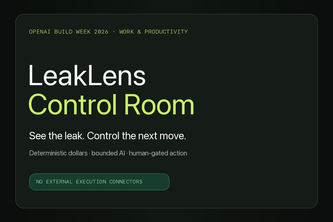
LeakLens Control Room is a self-reported prototype for restaurant margin control that uses deterministic logic and bounded AI to surface financial exceptions and require human approval before any action. It is described as an evidence-first system, with no autonomous execution, and built around a daily control loop.
What changed
The project description indicates a shift from traditional post-month-end financial discovery to a real-time, daily control loop that surfaces exceptions using store-isolated metrics and deterministic thresholds. It introduces human-gated actions and audit trails for decisions.
Single most important open question
Is there evidence of traction or early adoption beyond the prototype stage, and how does the system scale beyond synthetic CSV data and median-plus-threshold rules?
What The Product Actually Is
The description states that LeakLens Control Room:
- Analyzes store-isolated daily metrics.
- Verifies financial identity and compares current rates with each store’s own short historical median.
- Ranks locations by material scenario impact.
- Shows exact evidence and caveats behind labor, discount, and refund exceptions.
- Requires human approval or rejection for any proposed action.
- Executes no autonomous actions; only opens a measurement step upon approval.
- Uses SQLite to preserve three audit facts: original estimate, human decision, and measured outcome.
- Is built with deterministic Python logic, GPT-5.6 (via Codex CLI), and a standard library CLI, HTTP API, and dashboard.
Inference The system is described as a control loop that surfaces exceptions and enforces human oversight, but it does not appear to be a full-fledged SaaS product or production-ready system at this stage.
Positioning & Claim Evolution
The description states:
- The system is “evidence-first”.
- It aims to prevent AI from inventing financial claims or executing operational changes.
- It emphasizes deterministic dollars, bounded AI explanations, and human-gated actions.
- It positions itself as a way to surface exceptions without autonomous execution.
Inference The positioning evolved from a hackathon prototype to a system focused on operational AI control and auditability. The claim is that it offers a safer, more inspectable approach than autonomous systems, but no evidence of real-world deployment or adoption exists.
Target Customer & ICP
The description states:
- The target audience is restaurant operators.
- It focuses on discovering discount misuse, refund spikes, and labor overruns.
- It operates at the store level with isolated metrics.
Inference The ICP appears to be small-to-mid-sized restaurant chains or individual operators who want real-time visibility into financial exceptions. However, no evidence of customer interviews, user personas, or market validation is provided.
Business Model & Pricing Evidence
Not evidenced.
Inference There is no mention of pricing, licensing, or monetization strategy in the description. The system is described as a prototype with a public demo and synthetic data, suggesting no commercial model has been implemented yet.
Technical & Delivery Signals
The description states:
- Built with Python, GPT-5.6 (via Codex CLI), Docker, HTML/CSS/JS, SQLite.
- Uses deterministic logic for all rate, threshold, ranking, and dollar calculations.
- GPT-5.6 is used in a read-only sandbox with structured output schema, timeout, and no shell execution.
- The system includes a CLI, HTTP API, responsive dashboard, and SQLite audit store.
- Public demo on Render uses synthetic CSV fixtures and ephemeral database.
- 23/23 unit and integration tests passed.
- Fresh GitHub clone is reproducible.
Inference The technical stack suggests a lightweight, deterministic, and inspectable system. The use of GPT in a sandboxed mode indicates an attempt to control AI behavior, but no evidence of production-grade infrastructure or scalability is provided.
Traction & Maturity Signals
Not evidenced.
Inference There is no evidence of revenue, customers, or adoption beyond the prototype and public demo. The system is described as a hackathon submission with synthetic data and no commercial roadmap implemented yet.
Competitive Context
Not evidenced.
Inference No mention of competitors or market positioning beyond the claim that it’s a safer alternative to autonomous AI systems. No competitive analysis, pricing comparison, or differentiation from existing tools is provided.
Open Questions & Risks
- The system is described as a prototype with synthetic data and no real-world deployment.
- No evidence of customer feedback, user testing, or market traction.
- The use of GPT-5.6 in a sandboxed mode may not scale to complex operational needs.
- The system does not appear to integrate with real POS systems (e.g., Toast/Square), which is mentioned as a future roadmap item.
- No evidence of scalability beyond three stores or short-term historical data.
Questions the description leaves open
- What is the current status of POS integration, and how does it align with your commercial roadmap?
- How do you plan to validate the effectiveness of median-plus-threshold rules in real-world settings?
- Are there any early adopters or pilot customers using this system beyond the prototype?
- What are the key assumptions behind the human-gated workflow, and how do they scale?
- How does the system handle edge cases or anomalies not covered by current thresholds?
Overall Assessment
Not evidenced.
Inference Given that this is a hackathon prototype with synthetic data and no commercial traction, there is insufficient evidence to support an investment or partnership decision at this stage. The system shows potential in its design but lacks real-world validation or scalability indicators.
User Stories BotA demo video on every pull request
Get a demo video on every new feature
GitHub App that watches your pull requests and records a narrated, captioned demo.
Save time on demo prep and make informed decisions faster with a video walkthrough of every new feature.
Source
Submitted to the OpenAI 2026 hackathon on Devpost. Project home on Devpost. Back to the full gallery on Devpost.
This competitive analysis was produced by top-founders.com (opens in a new tab)
Generated by a language model from this project's public Devpost page — its tagline, the author's own write-up and any built-with tags listed there — as captured in August 2026. Short quotations are the author's words. It is an opinion on the idea as a business, not on the people behind it, and it reflects the description as published then. If the project has moved on, request a correction below. The analysis is not independent research and contains no verified traction, revenue or customer data.
An independent guide by KFG International LLC — not affiliated with, endorsed by, or connected to Devpost or OpenAI.