

Archive position — measured, not model output
0 likes on Devpost
2,263 of the 7,850 archived projects have more likes, and 5,587 share exactly 0 — so this project's #6,871 place in the like-ranked listing is a tie-break inside that group, not a ranking.
Projects (log scale)
Likes on Devpost. ▲ marks this project's group.
Show the figures
| Likes | Projects | Share of archive |
|---|---|---|
| 0 | 5,587 | 71.2% |
| 1 | 1,758 | 22.4% |
| 2 | 284 | 3.6% |
| 3–4 | 132 | 1.7% |
| 5–9 | 75 | 1.0% |
| 10+ | 14 | 0.2% |
 User Stories BotA demo video on every pull request
Get a demo video on every new feature
GitHub App that watches your pull requests and records a narrated, captioned demo.
Save time on demo prep and make informed decisions faster with a video walkthrough of every new feature.
Executive Summary
What the company appears to be
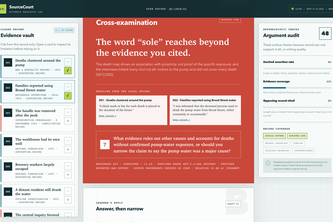
SourceCourt is a self-reported educational tool built for historical reasoning instruction, using AI to simulate adversarial cross-examination of student claims against primary-source evidence. It is described as a zero-build Node.js application with a plain HTML/CSS/JS interface, using GPT-5.6 via OpenAI API and structured outputs.
What changed
The project was submitted to the OpenAI 2026 hackathon. No prior version or evolution is evidenced; this is a single self-reported product description.
Single most important open question
Is there any evidence of real-world adoption, classroom use, or measurable learning impact beyond the MVP demo?
What The Product Actually Is
The description states that SourceCourt is a zero-build Node.js application with a plain JavaScript, HTML, and CSS interface, using GPT-5.6 via OpenAI API and structured outputs. It simulates adversarial cross-examination of student claims against a closed set of primary-source evidence.
Inference The product appears to be a prototype or MVP built for a hackathon, not a commercial product. It is described as having no account requirements, no browser-side secrets, and keyboard-operable functionality.
Evidence
- “SourceCourt is a zero-build Node.js application with a plain JavaScript, HTML, and CSS interface.”
- “The server calls the OpenAI Responses API with GPT-5.6 Sol at max reasoning effort and a strict Structured Outputs schema.”
- “No account or API key is required.”
Not evidenced
- No mention of any production deployment beyond the demo.
- No evidence of real-world use, customer base, or revenue.
Positioning & Claim Evolution
The description states that SourceCourt "reverses the relationship: the learner must do the reasoning, and the AI becomes disciplined opposing counsel." It is positioned as an educational tool to teach historical reasoning by forcing students to defend claims against source-grounded AI cross-examination.
Inference The positioning is centered on educational friction, not task completion. It aims to make AI a learning aid rather than a replacement for student work.
Evidence
- “Students often confuse fluent writing with supported reasoning, while many AI tutors simply produce a better answer for them.”
- “SourceCourt reverses that relationship: the learner must do the reasoning, and the AI becomes disciplined opposing counsel.”
Not evidenced
- No evidence of prior positioning or evolution in claims.
- No mention of any marketing or branding beyond the hackathon submission.
Target Customer & ICP
The description states that SourceCourt is intended for students, particularly in historical reasoning instruction, where they must defend claims against source-grounded AI cross-examination.
Inference The target customer is likely K-12 or higher education students, with a focus on historical inquiry and critical thinking skills. The tool may be used by educators or institutions for classroom instruction.
Evidence
- “Students defend historical claims against source-grounded AI cross-examination.”
- “The judge path is simple: open the live app, choose evidence, submit a claim, inspect the source-linked cross-examination…”
Not evidenced
- No mention of teachers, schools, or institutional adoption.
- No evidence of any specific ICP beyond student use.
Business Model & Pricing Evidence
The description does not provide any information about pricing, monetization, or business model.
Inference The project is a hackathon MVP and likely not monetized at this stage.
Evidence
- “No account or API key is required.”
- “Try it live: https://sourcecourt.online/”
- “The current MVP demonstrates task-level improvement only; it does not claim proven learning gains without a classroom study.”
Not evidenced
- No pricing, subscription model, or revenue streams.
- No evidence of any commercialization or monetization strategy.
Technical & Delivery Signals
The product is described as a Node.js application with HTML/CSS/JS frontend, using GPT-5.6 via OpenAI API and structured outputs. It includes server-side validation to prevent invented or repeated source IDs, and uses Codex for development assistance.
Inference The technical stack is minimal and self-contained, suggesting a prototype or MVP built quickly for a hackathon.
Evidence
- “SourceCourt is a zero-build Node.js application with a plain JavaScript, HTML, and CSS interface.”
- “The server calls the OpenAI Responses API with GPT-5.6 Sol at max reasoning effort and a strict Structured Outputs schema.”
- “Codex was the primary build collaborator.”
Not evidenced
- No evidence of scalability, infrastructure, or production deployment beyond demo.
- No mention of data persistence, user accounts, or long-term storage.
Traction & Maturity Signals
The description states that the project is a hackathon MVP, and includes public demo and source code. It mentions accomplishments such as deterministic checks passing and a fixture judge path improving scores.
Inference The product is at an early stage of development, likely not yet in production or widely used.
Evidence
- “This project was submitted to the OpenAI 2026 hackathon on Devpost.”
- “The public app is keyboard-operable, requires no account, and exposes no browser-side secret.”
- “All 32 deterministic checks pass.”
Not evidenced
- No evidence of user adoption, customer base, or real-world usage.
- No mention of any traction metrics, revenue, or growth.
Competitive Context
The description does not provide any information about competitors or the competitive landscape.
Inference The project is self-contained and does not reference existing tools in the educational AI or historical reasoning space.
Evidence
- No mention of competitors, similar products, or market positioning.
- “The judge path is simple: open the live app…”
Not evidenced
- No competitive analysis or differentiation strategy.
- No evidence of prior or existing solutions in this domain.
Open Questions & Risks
Risk 1
The product is described as a hackathon MVP with no commercialization, traction, or monetization strategy.
Risk 2
The use of GPT-5.6 via API raises concerns about dependency on external providers and lack of control over output quality or availability.
Risk 3
No evidence of classroom adoption or learning impact beyond a demo.
Inference The project is not yet mature for commercial or institutional use, and lacks any clear path to traction or scalability.
Evidence
- “The current MVP demonstrates task-level improvement only; it does not claim proven learning gains without a classroom study.”
- “No account or API key is required.”
Not evidenced
- No evidence of risk mitigation strategies.
- No mention of long-term sustainability or scalability plans.
Questions the description leaves open
- What are the actual learning outcomes you’ve observed from using SourceCourt in a classroom setting?
- How do you plan to scale beyond the current MVP and demo environment?
- Are there any plans for monetization, partnerships with educational institutions, or product development beyond this hackathon project?
- What is your strategy for ensuring consistent performance of GPT-5.6 and handling API failures or downtime?
- Have you conducted any user testing or feedback collection from students or educators?
Overall Assessment
Assessment Not evidenced.
Inference The project is a hackathon MVP with no commercial traction, revenue, or institutional adoption. It does not appear to be ready for investment or partnership at this stage.
Evidence
- “This project was submitted to the OpenAI 2026 hackathon on Devpost.”
- “The current MVP demonstrates task-level improvement only; it does not claim proven learning gains without a classroom study.”
Not evidenced
- No evidence of any investment interest, partnership discussions, or commercial viability.
- No data on user engagement, adoption, or impact beyond the demo.
User Stories BotA demo video on every pull request
Get a demo video on every new feature
GitHub App that watches your pull requests and records a narrated, captioned demo.
Save time on demo prep and make informed decisions faster with a video walkthrough of every new feature.
Source
Submitted to the OpenAI 2026 hackathon on Devpost. Project home on Devpost. Back to the full gallery on Devpost.
This competitive analysis was produced by top-founders.com (opens in a new tab)
Generated by a language model from this project's public Devpost page — its tagline, the author's own write-up and any built-with tags listed there — as captured in August 2026. Short quotations are the author's words. It is an opinion on the idea as a business, not on the people behind it, and it reflects the description as published then. If the project has moved on, request a correction below. The analysis is not independent research and contains no verified traction, revenue or customer data.
An independent guide by KFG International LLC — not affiliated with, endorsed by, or connected to Devpost or OpenAI.