

Archive position — measured, not model output
0 likes on Devpost
2,263 of the 7,850 archived projects have more likes, and 5,587 share exactly 0 — so this project's #6,873 place in the like-ranked listing is a tie-break inside that group, not a ranking.
Projects (log scale)
Likes on Devpost. ▲ marks this project's group.
Show the figures
| Likes | Projects | Share of archive |
|---|---|---|
| 0 | 5,587 | 71.2% |
| 1 | 1,758 | 22.4% |
| 2 | 284 | 3.6% |
| 3–4 | 132 | 1.7% |
| 5–9 | 75 | 1.0% |
| 10+ | 14 | 0.2% |
 User Stories BotA demo video on every pull request
Get a demo video on every new feature
GitHub App that watches your pull requests and records a narrated, captioned demo.
Save time on demo prep and make informed decisions faster with a video walkthrough of every new feature.
Executive Summary
What the company appears to be
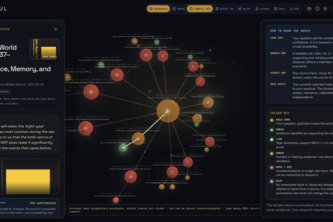
Sourceful is a self-reported tool that builds information graphs around user-submitted claims, primarily for history/humanities research. It aims to show which source passages support, refute, or contextualise each claim, and where corroboration may simply be repeated origin.
What changed
The project was built as a hackathon submission (OpenAI 2026) using GPT-5.6 and various AI technologies. It is described as a minimal prototype with no user database or observability features.
Single most important open question
Is there any evidence of actual user adoption, revenue, or traction beyond the author's self-reported account?
Note: This analysis is based entirely on the self-reported, unverified description provided by the project author. No independent verification or external data is available. All claims are stated by the author and not independently confirmed.
What The Product Actually Is
The description states that Sourceful "builds info graphs around user-submitted claims" and is "intended for history/humanities topics research." It aims to identify sources that go into a certain idea or preconception, focusing on legitimate resources. The tool shows how a version of something might be formed by mapping evidence.
It uses AI technologies including Codex, GPT-5.6, and others (as declared by the author). The system is described as being built entirely within a single chat environment from idea to deployment, with minimal conceptual scaffolding from the author.
Inference: The product appears to be an early-stage prototype for truth modeling or evidence mapping in research contexts.
Positioning & Claim Evolution
The author states that Sourceful is "as close as it gets to a narrative dissector" and aims to show how ideas are formed through source mapping. It is positioned as a tool for exploring written content and making knowledge acquisition more illustrative and engaging.
It claims to provide a relatively non-biased response based on all sources pulled in, though the author notes that finding sources is easy but determining their independence or relevance is harder.
Claim: The tool makes knowledge acquisition more engaging and illustrative.
Inference: It positions itself as an exploratory research assistant for humanities topics.
Target Customer & ICP
The description states that Sourceful is primarily intended for "history/humanities topics research." It is described as a tool for researchers or individuals interested in exploring ideas through source mapping.
No specific customer segments, personas, or use cases beyond this general domain are mentioned.
Not evidenced: No clear indication of target customer types, user roles, or specific buyer personas.
Business Model & Pricing Evidence
There is no evidence of any pricing model, monetization strategy, or business model in the description. The project is presented as a hackathon submission with no mention of revenue streams or commercial viability.
Not evidenced: No information on how the product would be sold, priced, or monetized.
Technical & Delivery Signals
The author reports that the entire system was built using Codex and GPT-5.6, deployed via Docker, Express.js, React, Tailwind, Three.js, TypeScript, Vite, WebGL, and other technologies. It was developed within a single chat environment from idea to deployment.
Challenges noted include lack of observability, no user database, and limited work with embeddings or multiple indexes.
Inference: The tool is built on AI-as-a-service platforms and lacks advanced technical infrastructure for scalability or deep indexing.
Traction & Maturity Signals
The description indicates that this is a hackathon project submitted to the OpenAI 2026 hackathon. It was built quickly, with no user database or feedback loops implemented. The author notes it's "all basics" and still "cool."
There is no evidence of users, customers, revenue, or adoption beyond the author’s own account.
Not evidenced: No signs of traction, usage metrics, or product maturity beyond prototype stage.
Competitive Context
No competitive analysis or market positioning is provided in the description. The author does not reference existing tools or platforms that do similar work.
Not evidenced: No information on competitors or market landscape.
Open Questions & Risks
- Prototype-only status: The project is described as a hackathon submission with no user database, observability, or advanced features.
- No commercial viability: No pricing, monetization, or business model is evident.
- Unproven traction: No evidence of users, customers, or adoption.
- Limited technical depth: The system relies heavily on AI-as-a-service and lacks deep indexing or embedding capabilities.
Inference: This is a proof-of-concept with no demonstrated path to commercialization or product-market fit.
Questions the description leaves open
- What specific use cases have you identified for this tool beyond history/humanities research?
- Have you tested the system with actual users or researchers? If so, what feedback did you receive?
- How do you plan to scale beyond the current prototype and build a sustainable product?
- Are there any plans to integrate with existing academic or research databases?
- What are your thoughts on data privacy and source attribution in this type of tool?
Overall Assessment
This is a self-reported hackathon project with no evidence of traction, revenue, or commercial viability. It is described as a minimal prototype built quickly using AI tools, without user feedback loops or advanced features.
Not evidenced: No data to assess product-market fit, scalability, or investment potential.
Confidence level: Low — based entirely on unverified self-reporting.
User Stories BotA demo video on every pull request
Get a demo video on every new feature
GitHub App that watches your pull requests and records a narrated, captioned demo.
Save time on demo prep and make informed decisions faster with a video walkthrough of every new feature.
Source
Submitted to the OpenAI 2026 hackathon on Devpost. Project home on Devpost. Back to the full gallery on Devpost.
This competitive analysis was produced by top-founders.com (opens in a new tab)
Generated by a language model from this project's public Devpost page — its tagline, the author's own write-up and any built-with tags listed there — as captured in August 2026. Short quotations are the author's words. It is an opinion on the idea as a business, not on the people behind it, and it reflects the description as published then. If the project has moved on, request a correction below. The analysis is not independent research and contains no verified traction, revenue or customer data.
An independent guide by KFG International LLC — not affiliated with, endorsed by, or connected to Devpost or OpenAI.