

Archive position — measured, not model output
0 likes on Devpost
2,263 of the 7,850 archived projects have more likes, and 5,587 share exactly 0 — so this project's #2,949 place in the like-ranked listing is a tie-break inside that group, not a ranking.
Projects (log scale)
Likes on Devpost. ▲ marks this project's group.
Show the figures
| Likes | Projects | Share of archive |
|---|---|---|
| 0 | 5,587 | 71.2% |
| 1 | 1,758 | 22.4% |
| 2 | 284 | 3.6% |
| 3–4 | 132 | 1.7% |
| 5–9 | 75 | 1.0% |
| 10+ | 14 | 0.2% |
 User Stories BotA demo video on every pull request
Get a demo video on every new feature
GitHub App that watches your pull requests and records a narrated, captioned demo.
Save time on demo prep and make informed decisions faster with a video walkthrough of every new feature.
Executive Summary
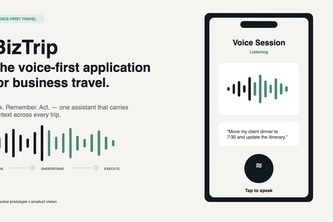
The description states that BizTrip Voice Assistant is a voice-first travel companion for business travelers, designed to operate hands-free while users are on the move. It claims to understand speech and text input, resolve tasks using company policies, project documents, and organizational knowledge, and take actions based on user requests.
The author describes building a system with an agent server, RAG service, speech processing, and an iOS app. They report MVP performance metrics including recall, precision, tool-calling accuracy, and task correctness.
This is a self-reported project description from a hackathon submission. No evidence of revenue, customers, traction or commercial adoption is provided. The author states that the system is fully functional as designed but does not describe any real-world use or deployment.
The single most important open question
What is the actual business model and how will this be monetized? The description provides no indication of a path to revenue or customer acquisition beyond the MVP.
What The Product Actually Is
The description states that BizTrip Voice Assistant is:
- A voice-first travel companion for business travelers
- Designed to operate hands-free while users are on the move
- Capable of listening to user requests and understanding both speech and text input
- Able to resolve tasks using company policies, project documents, travel preferences, and organizational knowledge
- Capable of taking actions based on user requests
The system consists of:
- Core Agent Server (Search + Info + Memory)
- RAG Service with Admin Console
- Speech Processing Service
- iOS Mobile App
- LangSmith Tracing
The author states that the mobile app and backend system are fully functioning as designed.
Positioning & Claim Evolution
The description states that BizTrip Voice Assistant was inspired by the need for a hands-free assistant while business travelers move between airports, train stations, hotels, and meeting locations where typing or manual searching is inconvenient.
It positions itself as:
- A voice-first travel companion
- For staff on business trips
- That knows user itinerary, company policy, meetings, expenses, and local culture
- Capable of taking actions while users are moving
The author claims the system can:
- Listen to user requests
- Understand both speech and text input
- Resolve tasks using company policies, project documents, travel preferences, and organizational knowledge
- Take actions based on user requests
Target Customer & ICP
The description states that BizTrip Voice Assistant is intended for:
- Business travelers
- Staff on business trips
It claims to know:
- User itinerary
- Company policy
- Meetings
- Expenses
- Local culture
The author does not specify any细分 customer segments or identify a specific ideal customer profile beyond "staff on business trips."
Business Model & Pricing Evidence
Not evidenced.
The description makes no mention of pricing, revenue model, monetization strategy, or any commercial aspects beyond the MVP development. No evidence of customers, contracts, or sales activities is provided.
Technical & Delivery Signals
The description states that the system was built with:
- Codex
- Docker
- FastAPI
- iOS
- Langgraph
- Langsmith
- OpenAI
- Python
- Vectordb
- Websocket
The author reports technical accomplishments including:
- Retrieval chain achieving 97.5% recall and 67.56% precision on average
- MVP reaching 88% tool-calling accuracy and 80% task correctness
- Handling high-quality audio streaming input via websocket server contract
- Designing efficient retrieval pipeline using query rewrite and HNSW indexing techniques
- Structuring agent graph around business travel subtasks (planning, in-trip assistance, reimbursement, follow-up management)
Traction & Maturity Signals
Not evidenced.
The description states that the mobile app and backend system are fully functioning as designed, but provides no evidence of:
- Real users or customers
- Revenue or monetization
- Customer adoption or engagement
- Product-market fit
- Growth metrics
- Deployment in production environments
Competitive Context
Not evidenced.
The description does not mention any competitors, market analysis, or positioning relative to existing solutions. No information is provided about the competitive landscape or differentiation strategy.
Open Questions & Risks
- The project is described as a hackathon submission with no evidence of commercial traction or revenue
- No evidence of customers, users, or real-world deployment beyond MVP functionality
- No indication of how the product will be monetized or scaled
- The team size is listed as 2 members, which may limit execution capacity
- The description lacks any evidence of market validation or customer feedback
- The system appears to be designed for enterprise use but no evidence of enterprise adoption or partnerships
Questions the description leaves open
- What specific enterprise use cases are you targeting and how do you plan to validate these?
- How will you monetize this product beyond the MVP stage?
- What is your go-to-market strategy for enterprise customers?
- How do you plan to scale from a 2-person team to support enterprise adoption?
- What specific customer feedback have you received about the MVP functionality?
- How do you plan to handle privacy and data security concerns in enterprise settings?
- What are the key technical challenges you anticipate scaling this solution?
- How do you plan to integrate with existing enterprise systems and workflows?
Overall Assessment
Not evidenced.
The description provides no information about:
- Revenue or financial performance
- Customer acquisition or retention metrics
- Market size or TAM
- Competitive positioning
- Go-to-market strategy
- Financial projections or funding requirements
This appears to be a hackathon project with an MVP that has not demonstrated commercial traction, revenue, or customer adoption. The author states the system is fully functioning as designed but does not provide evidence of any real-world use or business impact beyond the development phase.
User Stories BotA demo video on every pull request
Get a demo video on every new feature
GitHub App that watches your pull requests and records a narrated, captioned demo.
Save time on demo prep and make informed decisions faster with a video walkthrough of every new feature.
Source
Submitted to the OpenAI 2026 hackathon on Devpost. Project home on Devpost. Back to the full gallery on Devpost.
This competitive analysis was produced by top-founders.com (opens in a new tab)
Generated by a language model from this project's public Devpost page — its tagline, the author's own write-up and any built-with tags listed there — as captured in August 2026. Short quotations are the author's words. It is an opinion on the idea as a business, not on the people behind it, and it reflects the description as published then. If the project has moved on, request a correction below. The analysis is not independent research and contains no verified traction, revenue or customer data.
An independent guide by KFG International LLC — not affiliated with, endorsed by, or connected to Devpost or OpenAI.