

Archive position — measured, not model output
0 likes on Devpost
2,263 of the 7,850 archived projects have more likes, and 5,587 share exactly 0 — so this project's #2,951 place in the like-ranked listing is a tie-break inside that group, not a ranking.
Projects (log scale)
Likes on Devpost. ▲ marks this project's group.
Show the figures
| Likes | Projects | Share of archive |
|---|---|---|
| 0 | 5,587 | 71.2% |
| 1 | 1,758 | 22.4% |
| 2 | 284 | 3.6% |
| 3–4 | 132 | 1.7% |
| 5–9 | 75 | 1.0% |
| 10+ | 14 | 0.2% |
 User Stories BotA demo video on every pull request
Get a demo video on every new feature
GitHub App that watches your pull requests and records a narrated, captioned demo.
Save time on demo prep and make informed decisions faster with a video walkthrough of every new feature.
Executive Summary
BK Market is a self-reported visual marketplace for reusable code blocks aimed at non-technical users who want to build personal web apps without writing prompts. The project is described as a hackathon submission with no verified revenue, customers or traction. It uses AI (Codex + GPT-5.6) and modern frontend/backend technologies (Next.js, React, Cloudflare Workers). The author states that the product allows users to visually search, preview and combine code blocks into working apps, but does not claim to be live or monetized today.
The single most important open question is: What is the actual commercial viability of a marketplace for reusable code blocks, and how will BK Market differentiate itself from existing developer tooling and low-code platforms?
This analysis is based entirely on the self-reported description provided by the author. No independent verification, revenue data, customer feedback or traction metrics are available.
What The Product Actually Is
The description states that BK Market:
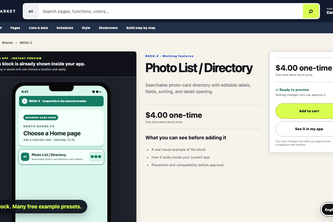
- Turns reusable code blocks into visual products
- Allows users to search by need, open a product, see it working inside their app, and choose exactly where it belongs
- Uses a cart system showing selected screens, features, and styles with deterministic compatibility checks
- Generates real personal web apps with an App Code and Edit PIN after review
- Supports reopening apps in other browsers and extending with Gallery while keeping same code/content
The author claims the product uses Next.js, React, TypeScript, Zod, Vitest, Playwright, Cloudflare Workers, OpenNext, and Cloudflare D1. The implementation is said to be powered by Codex (GPT-5.6 Sol) for core functionality.
Inference: The product appears to be a visual marketplace interface that enables non-developers to assemble web applications from pre-built components, with an emphasis on avoiding traditional AI prompting workflows.
Positioning & Claim Evolution
The author positions BK Market as:
- A solution to the problem of "describing every screen, field, and behavior in technical language" being harder than seeing what you want
- An alternative to traditional AI prompting that favors people who already know how to describe software
- A platform where users can "see it, choose it, then make it yours"
- A tool that offers "recognition before perfect description"
The project is described as a hackathon submission for the OpenAI 2026 hackathon. The author states that:
- Today BK sells verified blocks
- Tomorrow invited creators can submit and sell them
- Future verification pipeline will include sandboxing, malware scanning, dependency review, compatibility testing, accessibility checks, performance tests, code signing, and human approval
Inference: The positioning evolves from a proof-of-concept hackathon idea to a vision of a full marketplace ecosystem with creator monetization and quality control mechanisms. However, the current implementation is described as not yet live or monetized.
Target Customer & ICP
The description states:
- The author is a mother raising two children who began building software without knowing which key was Command
- The target audience includes people who want to build personal web apps without describing everything perfectly
- Users can change titles and fields without buying duplicates, suggesting they are looking for customization options
Inference: The primary customer segment appears to be non-technical individuals or beginners who want to create simple web applications but lack technical writing skills. However, the description does not clearly define a specific ICP beyond "people who don't know how to describe software well."
Business Model & Pricing Evidence
The author states:
- Colors, presets, and an Empty Box are free
- Small local capabilities can be one-time purchases that the customer keeps
- Only services with continuing server costs (accounts, sync, uploads, invitations, or chat) belong in a separate annual plan
- The public demo has no real payment or customer login
Inference: There is a hybrid model combining freemium elements with subscription-based services for ongoing server costs. However, there is no evidence of actual pricing tiers, revenue streams or monetization mechanisms beyond the stated future plans.
Technical & Delivery Signals
The author reports:
- Built with Next.js, React, TypeScript, Zod, Vitest, Playwright, Cloudflare Workers, OpenNext, and Cloudflare D1
- The implementation uses Codex (GPT-5.6 Sol) for core functionality
- The runtime stays deterministic by design rather than adding unnecessary AI calls
- Interface was repeatedly rebuilt after visual testing showed similarity issues
- Final flow uses familiar search, departments, product pages, cart, and one persistent live preview
Inference: The technical stack suggests a modern full-stack web application with serverless components. The use of deterministic runtime implies an attempt to avoid unpredictable AI behavior in core functionality.
Traction & Maturity Signals
The description states:
- This is a hackathon submission
- Public demo has no real payment or customer login
- No revenue, customer or traction data is available beyond what they state
Inference: There are no evidence-based signals of traction or maturity. The project is explicitly described as a prototype submitted to a hackathon with no commercial deployment or user base.
Competitive Context
The author does not provide any information about competitors or the competitive landscape. The description states that this is a hackathon submission and does not reference existing platforms or tools in the space.
Inference: No competitive context is evident from the provided description. It's unclear whether BK Market competes with low-code platforms, developer marketplaces, or AI-assisted development tools.
Open Questions & Risks
- The project is described as a hackathon submission with no verified traction or revenue
- No evidence of customer acquisition, retention or monetization
- The author claims the marketplace is not yet live or monetized
- The business model relies on future verification pipelines and creator participation that are not currently operational
- The use of AI (Codex + GPT-5.6 Sol) raises questions about scalability, cost, and control over generated content
- No clear differentiation from existing low-code or no-code platforms
Inference: The main risk is the lack of commercial viability or traction, with the project still in early conceptual stages.
Questions the description leaves open
- What specific problem are you solving that current tools don't address?
- How do you plan to attract and retain creators who will submit verified blocks?
- What is your timeline for moving from the hackathon prototype to a live, monetized marketplace?
- How do you intend to ensure quality control and prevent malicious or low-quality submissions?
- What are the key assumptions behind your pricing model and revenue projections?
- Have you conducted any user research with potential customers beyond yourself?
- What is the competitive advantage of your approach over existing low-code/no-code platforms?
Overall Assessment
The description states that BK Market is a hackathon submission with no verified traction, revenue or monetization. The author explicitly says the marketplace is not yet live or monetized.
Inference: Based on the self-reported evidence alone, there is insufficient commercial due-diligence signal to support investment or partnership decisions. The project appears to be in early conceptual stages with no demonstrated product-market fit or business viability.
User Stories BotA demo video on every pull request
Get a demo video on every new feature
GitHub App that watches your pull requests and records a narrated, captioned demo.
Save time on demo prep and make informed decisions faster with a video walkthrough of every new feature.
Source
Submitted to the OpenAI 2026 hackathon on Devpost. Project home on Devpost. Back to the full gallery on Devpost.
This competitive analysis was produced by top-founders.com (opens in a new tab)
Generated by a language model from this project's public Devpost page — its tagline, the author's own write-up and any built-with tags listed there — as captured in August 2026. Short quotations are the author's words. It is an opinion on the idea as a business, not on the people behind it, and it reflects the description as published then. If the project has moved on, request a correction below. The analysis is not independent research and contains no verified traction, revenue or customer data.
An independent guide by KFG International LLC — not affiliated with, endorsed by, or connected to Devpost or OpenAI.