

Archive position — measured, not model output
0 likes on Devpost
2,263 of the 7,850 archived projects have more likes, and 5,587 share exactly 0 — so this project's #6,877 place in the like-ranked listing is a tie-break inside that group, not a ranking.
Projects (log scale)
Likes on Devpost. ▲ marks this project's group.
Show the figures
| Likes | Projects | Share of archive |
|---|---|---|
| 0 | 5,587 | 71.2% |
| 1 | 1,758 | 22.4% |
| 2 | 284 | 3.6% |
| 3–4 | 132 | 1.7% |
| 5–9 | 75 | 1.0% |
| 10+ | 14 | 0.2% |
 User Stories BotA demo video on every pull request
Get a demo video on every new feature
GitHub App that watches your pull requests and records a narrated, captioned demo.
Save time on demo prep and make informed decisions faster with a video walkthrough of every new feature.
Executive Summary
What the company appears to be
Spacehole is a self-reported mobile-first browser game built by one person (Nariek-Game Hicks) using AI tools like Codex and GPT-5.6. It is described as an educational tool for young learners, guiding players through cosmic scales from asteroids to the observable universe.
What changed
The project was submitted to the OpenAI 2026 hackathon on Devpost. The author states that it was built in under three days and uses AI-assisted development without any runtime AI or network dependencies.
Single most important open question
Is there evidence of actual user engagement, learning outcomes, or adoption beyond the creator's personal playtesting?
Note: This analysis is based solely on the self-reported description provided by the author. No external verification, revenue data, customer feedback, or traction metrics are available.
What The Product Actually Is
The description states that Spacehole is a mobile-first browser game built with:
- JavaScript
- Three.js
- Vite
- CSS
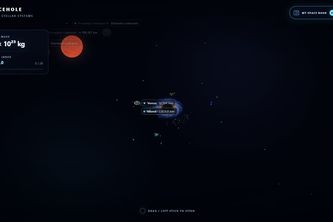
It is described as a game where players guide a growing black hole through various cosmic scales, including:
- The Solar System
- Nearby stellar systems
- The Local Arm
- The Milky Way and its satellites
- The Local Group
- The cosmic web and deep observable Universe
Key features include:
- 151 named celestial discoveries
- Child-friendly facts, size comparisons, uncertainty labels, and interactive 3D models
- 16 landmarks for scale reference (from a house to the Sun)
- Support for touch, keyboard, compatible gamepad, sound controls, and reduced-motion support
The author claims that no code or art assets were written by hand—the entire product was built using AI tools like Codex and GPT-5.6.
Inference: The product is a prototype or proof-of-concept, not a commercial offering.
Evidence: The description states the project was built in under three days and submitted to a hackathon.
Positioning & Claim Evolution
The author positions Spacehole as:
- An educational tool for young learners
- A way to make cosmic scale understandable through play
- A child-friendly exploration game, not a quiz or knowledge test
It is described as:
- Teaching through curiosity and play
- Using facts as rewards for exploration
- Allowing players to return to discoveries in a "My Space Book"
- Focusing on natural learning rather than interruption by quizzes or formal instruction
The author also emphasizes that the game avoids overwhelming children with information, instead focusing on:
- Visual and interactive exploration
- Memorable experiences over rote learning
- Scientific honesty, while adapting scale for gameplay
Claim: The product is designed to spark curiosity and memory retention in young learners.
Inference: This is a niche educational game, not a scalable commercial product.
Target Customer & ICP
The description states:
- The target audience is young learners, specifically a five-year-old
- The author’s own child was the primary playtester
- The game is designed to be playful and visual, suitable for children
There is no mention of:
- Age range beyond 5 years old
- Parents or educators as direct users
- Broader educational institutions or platforms
Inference: The ICP is likely a child aged 5–8, with the creator’s own child being the primary user.
Evidence: No explicit customer segments or personas are provided.
Business Model & Pricing Evidence
The description does not state:
- Any pricing model
- Revenue streams
- Monetization strategy
- Subscription or one-time purchase plans
It is described as a personal project submitted to a hackathon, with no indication of commercial intent or monetization.
Claim: No business model or pricing information is provided.
Evidence: Not evidenced.
Technical & Delivery Signals
The author states:
- The game was built using JavaScript, Three.js, Vite, and CSS
- AI tools (Codex and GPT-5.6) were used for development
- No runtime AI or network dependencies
- The project was completed in under three days
- The author is a game designer, not a programmer
The game supports:
- Touch, keyboard, compatible gamepad
- Sound controls and reduced-motion support
- Responsive design (mobile-first)
Inference: This is a prototype built quickly using AI tools.
Evidence: The project was submitted to a hackathon and completed in under three days.
Traction & Maturity Signals
The description states:
- The author’s five-year-old was the main playtester
- The child drew celestial bodies after playing, indicating engagement
- No other users or feedback are mentioned
- No metrics on usage, retention, or adoption
Claim: There is anecdotal evidence of user engagement.
Evidence: Not evidenced.
Competitive Context
The description does not mention:
- Competitors in the educational gaming space
- Similar products or platforms
- Market positioning relative to existing tools
Inference: No competitive analysis is provided.
Evidence: Not evidenced.
Open Questions & Risks
- The project is described as a personal hackathon submission, not a commercial product
- No evidence of:
- Revenue or monetization
- Customer base or user traction
- Scalability or long-term viability
- The author is a single individual (1-person team), which may limit development capacity
- AI tools were used for creation, but no runtime AI or network dependency implies limited dynamic features
Inference: This is a prototype with no commercial traction.
Evidence: Not evidenced.
Questions the description leaves open
- What is the intended long-term vision for Spacehole beyond this hackathon project?
- Are there plans to monetize or scale the product?
- Has the game been tested with more than one child or age group?
- How does the team plan to validate learning outcomes or educational impact?
- Is there any intention to build a sustainable business model around this tool?
Overall Assessment
The description states that Spacehole is a personal project built in under three days for a hackathon, with no evidence of:
- Revenue
- Customers
- Traction
- Commercial viability
Assessment: Not evidenced.
Confidence: Low — based on self-reported, unverified information only.
This appears to be an early-stage prototype or proof-of-concept, not a commercial product ready for investment or partnership.
User Stories BotA demo video on every pull request
Get a demo video on every new feature
GitHub App that watches your pull requests and records a narrated, captioned demo.
Save time on demo prep and make informed decisions faster with a video walkthrough of every new feature.
Source
Submitted to the OpenAI 2026 hackathon on Devpost. Project home on Devpost. Back to the full gallery on Devpost.
This competitive analysis was produced by top-founders.com (opens in a new tab)
Generated by a language model from this project's public Devpost page — its tagline, the author's own write-up and any built-with tags listed there — as captured in August 2026. Short quotations are the author's words. It is an opinion on the idea as a business, not on the people behind it, and it reflects the description as published then. If the project has moved on, request a correction below. The analysis is not independent research and contains no verified traction, revenue or customer data.
An independent guide by KFG International LLC — not affiliated with, endorsed by, or connected to Devpost or OpenAI.