

Archive position — measured, not model output
0 likes on Devpost
2,263 of the 7,850 archived projects have more likes, and 5,587 share exactly 0 — so this project's #3,714 place in the like-ranked listing is a tie-break inside that group, not a ranking.
Projects (log scale)
Likes on Devpost. ▲ marks this project's group.
Show the figures
| Likes | Projects | Share of archive |
|---|---|---|
| 0 | 5,587 | 71.2% |
| 1 | 1,758 | 22.4% |
| 2 | 284 | 3.6% |
| 3–4 | 132 | 1.7% |
| 5–9 | 75 | 1.0% |
| 10+ | 14 | 0.2% |
 User Stories BotA demo video on every pull request
Get a demo video on every new feature
GitHub App that watches your pull requests and records a narrated, captioned demo.
Save time on demo prep and make informed decisions faster with a video walkthrough of every new feature.
Executive Summary
The description states that Desktop Coding Stack is a Windows-first control plane for AI-driven development, designed to enable reliable autonomy across repositories with evidence-bound actions. The author describes it as an infrastructure tool that governs how Codex (an AI agent) operates within a local workspace, ensuring bounded execution, auditability, and reversibility of changes.
The project appears to be a single-person effort built around PowerShell, Python, and React components, targeting a niche in multi-repository AI development workflows. It emphasizes governance over autonomy, using concepts like one-owner worktrees, evidence receipts, and deterministic validators.
Key commercial due-diligence questions include: Is there a clear market need for this type of control plane? What is the actual adoption or traction beyond the author's own use? How does it differ from existing tools in the space?
The single most important open question
Does the described solution address a real, unmet need in AI-assisted development workflows, or is it an experimental prototype with unclear commercial viability?
What The Product Actually Is
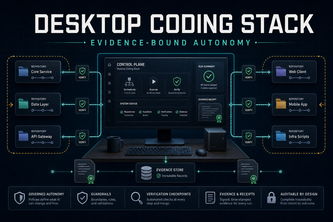
- The description states that Desktop Coding Stack turns a Windows workstation into a governed, multi-repository AI development control plane.
- It defines a workspace map that includes canonical repositories, safe worktree locations, retained evidence, and no-write zones.
- Commands like "Doctor", "Enter", and "Sync" are used to manage the workspace.
- The system uses a "Builder" as the governance source of truth while Codex executes bounded work in disposable worktrees.
- Evidence receipts bind claims to exact repository state (base, head, tree, validation run, reviewer identity).
- It supports Python, PowerShell, TypeScript/React, GitHub Actions, and local-first workflows without storing secrets in repositories.
- The system enforces one-owner rules to prevent duplicate writers and cross-lane collisions.
- Deterministic validators, schemas, CI, negative controls, rollback rules, and stop conditions are part of the architecture.
This is a self-reported technical infrastructure tool for managing AI agent behavior within a local Windows environment, focused on governance, auditability, and safety in multi-repository development workflows.
Positioning & Claim Evolution
- The description states that the product was inspired by the fragility of autonomy when real work spans multiple repositories, worktrees, pull requests, CI, reviewers, credentials, and human authority.
- It positions itself as a solution to problems such as context loss, lane collisions, stale reviews, and lack of proof for “done” claims.
- The author frames it not as an "agent that can do anything", but as infrastructure for reliable autonomy.
- It aims to allow agents to move quickly inside an accepted envelope and fail closed when reaching real boundaries.
- The project is described as a "governed" control plane, emphasizing bounded execution and auditability over raw capability.
This evolution shows a shift from generic AI agent tools toward specialized governance mechanisms tailored for complex, multi-repository workflows. It reflects a move from capability-focused to safety-and-governance-focused positioning.
Target Customer & ICP
- Not evidenced.
The description does not identify specific customer segments or personas. There is no mention of who would use this tool beyond the author’s own development needs.
Business Model & Pricing Evidence
- Not evidenced.
There is no indication of pricing, monetization strategy, or business model in the provided description.
Technical & Delivery Signals
- The project is Windows-first and intentionally uses simple, inspectable components.
- Built with PowerShell for orchestration wrappers, Python for validation and automation logic, YAML/JSON Schema for contracts, TypeScript/React/Vite for UI templates, Git/GitHub for change delivery.
- Uses GPT-5.6 as the primary engineering agent.
- Supports Python, PowerShell, TypeScript/React, GitHub Actions, and local-first workflows.
- Implements deterministic negative-control testing, exact-head evidence flows, and immutable review packets.
- The stack is designed to avoid storing secrets in repositories.
These technical signals suggest a developer-focused tool built on open-source or standard components with an emphasis on safety, reproducibility, and auditability. It appears to be a prototype or early-stage product aimed at advanced developers or engineering teams managing complex AI workflows.
Traction & Maturity Signals
- Not evidenced.
There is no evidence of revenue, customers, usage metrics, or product maturity beyond the author’s own development efforts.
Competitive Context
- Not evidenced.
The description does not compare Desktop Coding Stack to existing tools or platforms in the AI development space. No competitors are mentioned.
Open Questions & Risks
- The project is described as a single-person effort (team size: 1), which raises questions about scalability and long-term maintenance.
- It is a Windows-first solution, limiting its applicability to non-Windows environments.
- The focus on governance and safety may be too niche or experimental for mainstream adoption.
- There is no evidence of market demand, customer feedback, or traction beyond the author’s own use case.
- The claim that it allows agents to "move quickly inside an accepted envelope" implies a level of abstraction that may not yet be proven in practice.
These risks point to potential challenges in product-market fit and commercial viability.
Questions the description leaves open
- What specific problems are you solving, and how do you know they exist beyond your own experience?
- Who would actually use this tool, and what is their current workflow or pain points?
- How does this differ from existing tools like GitHub Copilot, LangChain, or other AI development platforms?
- Are there any early adopters or users who have tested the system in real-world conditions?
- What are the key assumptions behind the governance model, and how do you validate them?
- Is there a plan to expand beyond Windows or support more diverse environments?
- How do you intend to monetize this product if at all?
Overall Assessment
- Not evidenced.
There is no evidence of funding rounds, valuations, or investment interest in the project. No indication whether this is intended for commercial development or remains a prototype. The lack of traction, revenue, or customer data makes it difficult to assess its readiness for investment or partnership.
User Stories BotA demo video on every pull request
Get a demo video on every new feature
GitHub App that watches your pull requests and records a narrated, captioned demo.
Save time on demo prep and make informed decisions faster with a video walkthrough of every new feature.
Source
Submitted to the OpenAI 2026 hackathon on Devpost. Project home on Devpost. Back to the full gallery on Devpost.
This competitive analysis was produced by top-founders.com (opens in a new tab)
Generated by a language model from this project's public Devpost page — its tagline, the author's own write-up and any built-with tags listed there — as captured in August 2026. Short quotations are the author's words. It is an opinion on the idea as a business, not on the people behind it, and it reflects the description as published then. If the project has moved on, request a correction below. The analysis is not independent research and contains no verified traction, revenue or customer data.
An independent guide by KFG International LLC — not affiliated with, endorsed by, or connected to Devpost or OpenAI.