

Archive position — measured, not model output
0 likes on Devpost
2,263 of the 7,850 archived projects have more likes, and 5,587 share exactly 0 — so this project's #3,694 place in the like-ranked listing is a tie-break inside that group, not a ranking.
Projects (log scale)
Likes on Devpost. ▲ marks this project's group.
Show the figures
| Likes | Projects | Share of archive |
|---|---|---|
| 0 | 5,587 | 71.2% |
| 1 | 1,758 | 22.4% |
| 2 | 284 | 3.6% |
| 3–4 | 132 | 1.7% |
| 5–9 | 75 | 1.0% |
| 10+ | 14 | 0.2% |
 User Stories BotA demo video on every pull request
Get a demo video on every new feature
GitHub App that watches your pull requests and records a narrated, captioned demo.
Save time on demo prep and make informed decisions faster with a video walkthrough of every new feature.
Executive Summary
What the company appears to be
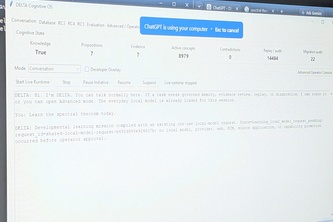
The description states that DELTA is a governed AI development runtime designed to transform AI from a chatbot into an "engineer" capable of proposing, developing, and testing new capabilities under controlled human governance. It is presented as a system for transparent, evidence-driven AI development with strong emphasis on safety, autonomy control, and human oversight.
What changed
This project represents the author's personal exploration of a new direction in AI assistant design — one that prioritizes governance over pure conversational utility. The author describes it as a variant of their DARPA CLARA project, suggesting prior work or conceptual development in this space.
The single most important open question
Is there any evidence of actual usage, testing, or traction beyond the author’s own development? The description contains no data on customers, revenue, adoption, or real-world deployment. It is entirely self-reported and unverified.
What The Product Actually Is
- The description states that DELTA is a "governed AI development runtime."
- It can identify areas for improvement, generate development proposals, test them in isolated environments, collect evidence, and present results for human review.
- Every capability follows a structured approval process before becoming part of the system.
- The system is built using Python, with modular architecture focused on governance and testing.
- It uses tools such as Codex, GPT, LLMs (e.g., Llama, Mistral), and SQLite, among others.
- It supports a workflow involving code review, test generation, and iteration.
Note
The author does not describe a product for end-users but rather an internal framework or tooling used in AI development. No mention of a user-facing interface or API is provided.
Positioning & Claim Evolution
- The author positions DELTA as a variant of a DARPA CLARA project, implying prior conceptual or technical groundwork.
- It aims to transform AI from a chatbot into a governed engineer that can safely propose, develop, and test new capabilities.
- The system is framed as transparent, evidence-driven, and evidence-based in its approach to AI development.
- The author claims it makes AI development more trustworthy through governance, validation, and human oversight.
- The long-term vision includes an AI assistant that can safely evolve over time, continuously improving through evidence, testing, and human approval.
Inference The positioning suggests a shift from general-purpose AI assistants toward specialized, controlled systems for AI research or development workflows. However, no external validation or market positioning is described.
Target Customer & ICP
- Not evidenced.
- No information is provided about who uses DELTA, whether it targets developers, researchers, enterprises, or end-users.
- The description does not define a specific customer segment or ideal customer profile (ICP).
- The system appears to be built for internal use by the developer, not for external consumption.
Absence of evidence
There is no indication of target personas, buyer motivations, or market fit beyond the author’s personal interest in AI governance.
Business Model & Pricing Evidence
- Not evidenced.
- No pricing model, monetization strategy, or business model is described.
- The project appears to be a personal development effort, not a commercial product.
- No indication of whether DELTA will be offered as SaaS, open-source, or another format.
Absence of evidence
There is no mention of how the system would be sold, licensed, or monetized.
Technical & Delivery Signals
- Built in Python using a modular architecture.
- Uses LLMs (Codex, GPT, Llama, Mistral) and local models (GGUF, SLM).
- Integrates with GitHub, SQLite, Tkinter, and JSON.
- Designed for isolated testing environments, rollback mechanisms, and human approval checkpoints.
- The author used Codex to assist in implementation, code review, test generation, and workflow iteration.
Inference The technical stack suggests a developer-oriented tool with emphasis on AI integration, local execution, and governance. However, no production-ready delivery or scalability signals are evident.
Traction & Maturity Signals
- Not evidenced.
- No data on user adoption, customer engagement, revenue, or usage metrics is provided.
- The project was submitted to a hackathon, indicating early-stage development.
- The author states that the system is working and has been tested, but no real-world deployment or impact is described.
Absence of evidence
There is no indication of traction, user feedback, or product maturity beyond the author's own development efforts.
Competitive Context
- Not evidenced.
- No mention of competitors or similar products in the market.
- The author references a DARPA CLARA project, but does not compare DELTA to existing tools or platforms.
- No indication of how DELTA fits into current AI governance, AI development tooling, or autonomous system frameworks.
Absence of evidence
There is no competitive analysis or positioning relative to other AI systems or governance tools.
Open Questions & Risks
- The project is self-reported and unverified, with no external corroboration.
- It appears to be a personal development effort rather than a scalable product or business.
- No evidence of traction, revenue, or customer base.
- The system is described as not yet commercialized — it's a prototype or proof-of-concept.
- There’s no indication of how the governance model would scale or be applied in enterprise settings.
- The author is a single individual (1-person team), which raises questions about long-term maintenance and development capacity.
Inference The lack of external validation, traction, or commercialization suggests that DELTA remains at a very early stage — likely a prototype or personal project with no clear path to market.
Questions the description leaves open
- What specific problems in AI governance or development workflows does DELTA aim to solve?
- How does the system ensure that human oversight is meaningful and not just a formality?
- Has the system been tested in any real-world scenarios beyond personal use?
- Are there plans to expand beyond the current single-developer scope?
- What are the intended use cases for DELTA — internal R&D, enterprise AI teams, or something else?
- How does DELTA handle edge cases where human judgment may be ambiguous or inconsistent?
Overall Assessment
- Not evidenced.
- No financials, funding history, or investment potential are described.
- The project is presented as a personal exploration, not a commercial venture.
- There is no indication of whether the author intends to build a company around this idea or if it will remain a prototype.
Inference Based on the self-reported description alone, DELTA does not appear to be a viable investment or partnership opportunity at this stage. It lacks evidence of traction, scalability, or commercial viability.
User Stories BotA demo video on every pull request
Get a demo video on every new feature
GitHub App that watches your pull requests and records a narrated, captioned demo.
Save time on demo prep and make informed decisions faster with a video walkthrough of every new feature.
Source
Submitted to the OpenAI 2026 hackathon on Devpost. Project home on Devpost. Back to the full gallery on Devpost.
This competitive analysis was produced by top-founders.com (opens in a new tab)
Generated by a language model from this project's public Devpost page — its tagline, the author's own write-up and any built-with tags listed there — as captured in August 2026. Short quotations are the author's words. It is an opinion on the idea as a business, not on the people behind it, and it reflects the description as published then. If the project has moved on, request a correction below. The analysis is not independent research and contains no verified traction, revenue or customer data.
An independent guide by KFG International LLC — not affiliated with, endorsed by, or connected to Devpost or OpenAI.