

Archive position — measured, not model output
0 likes on Devpost
2,263 of the 7,850 archived projects have more likes, and 5,587 share exactly 0 — so this project's #3,695 place in the like-ranked listing is a tie-break inside that group, not a ranking.
Projects (log scale)
Likes on Devpost. ▲ marks this project's group.
Show the figures
| Likes | Projects | Share of archive |
|---|---|---|
| 0 | 5,587 | 71.2% |
| 1 | 1,758 | 22.4% |
| 2 | 284 | 3.6% |
| 3–4 | 132 | 1.7% |
| 5–9 | 75 | 1.0% |
| 10+ | 14 | 0.2% |
 User Stories BotA demo video on every pull request
Get a demo video on every new feature
GitHub App that watches your pull requests and records a narrated, captioned demo.
Save time on demo prep and make informed decisions faster with a video walkthrough of every new feature.
Executive Summary
What the company appears to be
DeltaForceHUD is a self-reported local OCR-powered HUD for Delta Force streamers, designed to track asset gains and losses without accessing game memory or network traffic. It uses OBS Virtual Camera, OpenCV, Tesseract Japanese OCR, and FastAPI to read on-screen values and display live gain/loss through an OBS browser-source overlay.
What changed
The project was reportedly completed during a hackathon event (Devpost submission), where the author used AI tools like Codex and GPT-5.6 to complete missing backend functionality, validate endpoints, and produce a demo. The tool existed before the event but had incomplete features at baseline.
Single most important open question
Is there any evidence of real-world usage or adoption by streamers beyond this single hackathon project? The description states no revenue, customers, or traction data are available.
What The Product Actually Is
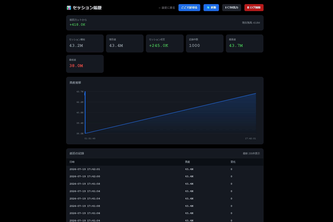
The description states that DeltaForceHUD is a Windows-first, local OCR HUD for Delta Force streamers. It captures the user’s own screen through OBS Virtual Camera, uses OpenCV and Tesseract Japanese OCR to read on-screen asset values, and displays live gain/loss via an OBS browser-source overlay.
It also includes:
- A browser setup wizard
- Lobby-state detection
- Session history
- Trend graph
- CSV export
- Cut-based segment tracking
- Camera-freeze recovery
The tool is built with technologies including: claude, codex, css, fastapi, git, github, gpt-5.6, html, javascript, obs, opencv, python, tesseract-ocr.
Inference This is a developer-created tool intended for use in streamer workflows, not a commercial product with users or monetization.
Positioning & Claim Evolution
The author states that the inspiration behind DeltaForceHUD was to make asset progression visible during extraction-shooter streams, without relying on game memory or network traffic access. The positioning is framed as a viewer-facing tool that enhances storytelling in stream content.
It claims to be:
- A local tool (no game memory access)
- Non-intrusive (does not modify network traffic)
- Designed for streamers who want to show asset changes
There is no indication of prior versions or evolution beyond the hackathon project. The description does not mention any commercial positioning, branding, or marketing claims.
Inference The tool is positioned as a fan-made utility, not a product with a defined market or brand strategy.
Target Customer & ICP
The author states that DeltaForceHUD is intended for Delta Force streamers, specifically those who want to show asset gains and losses during gameplay. It targets users of OBS Virtual Camera and the game Delta Force, which is a military-themed tactical shooter.
No further segmentation or targeting details are provided in the description.
Inference The ICP appears to be streamers using OBS for live broadcasts, particularly those playing Delta Force, with no evidence of broader targeting or customer personas.
Business Model & Pricing Evidence
There is no mention of pricing, monetization, or business model in the description. The tool is described as unofficial fan-made and not affiliated with any official game publisher or platform.
The author states:
“DeltaForceHUD is an unofficial fan-made tool.”
No evidence of revenue streams, subscriptions, or paid features is provided.
Inference There is no business model or pricing structure evidenced. The tool appears to be a hobbyist project with no commercial intent.
Technical & Delivery Signals
The author reports that the tool:
- Uses OBS Virtual Camera
- Implements OpenCV and Tesseract Japanese OCR
- Runs on FastAPI backend
- Has a browser-source overlay
- Includes a setup wizard, session history, and cut-based tracking
It was built using:
- Claude for structured specs and review
- Codex on GPT-5.6 for repository inspection, implementation, endpoint verification, and demo validation
- A dedicated Windows video-production harness
The author also notes that the tool was completed during a hackathon event, with Codex handling backend completion and validation.
Inference The technical stack is consistent with a developer-built utility, not a commercial-grade product. The use of AI tools like Codex suggests a human-directed development workflow, but no evidence of scalability or production deployment.
Traction & Maturity Signals
There is no evidence of traction, adoption, or user base beyond the single hackathon project. The author states that:
- The tool existed before the event
- It was completed during Build Week
- No revenue, customers, or usage data are available
The description does not mention any public release, downloads, or community engagement.
Inference No traction or maturity signals are evident. This is a single-use project, not a product with ongoing development or user engagement.
Competitive Context
There is no evidence of competitors or market analysis in the description. The author does not reference similar tools or platforms for tracking asset progression in games or stream overlays.
Inference No competitive context is provided, and it's unclear whether this tool addresses a known gap or overlaps with existing solutions.
Open Questions & Risks
- Unverified claims: All descriptions are self-reported and unverified.
- No traction or adoption: No evidence of real-world usage beyond one hackathon project.
- Single developer: The team size is listed as 1, suggesting limited development capacity.
- Fan-made tool: Not affiliated with official game publishers or platforms.
- No monetization: No indication of business model or revenue potential.
- Limited scope: Designed for a specific game (Delta Force) and audience (streamers).
- AI dependency: Relies heavily on AI tools, which may not be scalable or replicable.
Inference The project is a hobbyist tool with no commercial viability, and the author does not appear to have a plan for scaling or monetizing it.
Questions the description leaves open
- What is the actual use case for this tool beyond the hackathon demo?
- Are there any plans to expand support for other games or platforms?
- Has the tool been tested in real-world streaming environments?
- Is there any intention to commercialize or monetize this tool?
- How does it handle OCR accuracy across different screen resolutions or languages?
- What is the long-term maintenance plan for the project?
Overall Assessment
Not evidenced.
The description provides no evidence of:
- Revenue
- Customers
- Traction
- Market demand
- Commercial viability
- Scalability
This is a single-use, hackathon-level project, not a product with investment or partnership potential.
Inference There is no basis for commercial due diligence. The tool is a fan-made utility, not a business or product with commercial intent or traction.
User Stories BotA demo video on every pull request
Get a demo video on every new feature
GitHub App that watches your pull requests and records a narrated, captioned demo.
Save time on demo prep and make informed decisions faster with a video walkthrough of every new feature.
Source
Submitted to the OpenAI 2026 hackathon on Devpost. Project home on Devpost. Back to the full gallery on Devpost.
This competitive analysis was produced by top-founders.com (opens in a new tab)
Generated by a language model from this project's public Devpost page — its tagline, the author's own write-up and any built-with tags listed there — as captured in August 2026. Short quotations are the author's words. It is an opinion on the idea as a business, not on the people behind it, and it reflects the description as published then. If the project has moved on, request a correction below. The analysis is not independent research and contains no verified traction, revenue or customer data.
An independent guide by KFG International LLC — not affiliated with, endorsed by, or connected to Devpost or OpenAI.