

Archive position — measured, not model output
0 likes on Devpost
2,263 of the 7,850 archived projects have more likes, and 5,587 share exactly 0 — so this project's #3,679 place in the like-ranked listing is a tie-break inside that group, not a ranking.
Projects (log scale)
Likes on Devpost. ▲ marks this project's group.
Show the figures
| Likes | Projects | Share of archive |
|---|---|---|
| 0 | 5,587 | 71.2% |
| 1 | 1,758 | 22.4% |
| 2 | 284 | 3.6% |
| 3–4 | 132 | 1.7% |
| 5–9 | 75 | 1.0% |
| 10+ | 14 | 0.2% |
 User Stories BotA demo video on every pull request
Get a demo video on every new feature
GitHub App that watches your pull requests and records a narrated, captioned demo.
Save time on demo prep and make informed decisions faster with a video walkthrough of every new feature.
Executive Summary
What the company appears to be
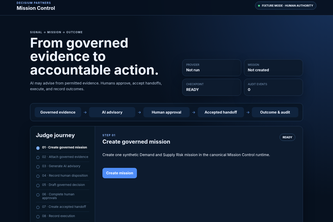
Decisium Partners - Mission Control Module is a self-reported software module designed to govern commercial decision-making workflows using AI advisory systems, with strict human oversight and audit trails. It is described as part of a larger "Commercial Decision Operating System" but is presented here as an isolated, working slice of that system.
What changed
The author states they built this during a hackathon (Devpost submission), focusing on implementing a governed decision path from signal to outcome using AI advisory tools and structured human approvals. The module includes deterministic fixtures, schema validation, and explicit authority boundaries.
Single most important open question
Is there any evidence of real-world usage or integration beyond the demo? The description states that no live GPT-5.6 response was claimed, and all testing was done in fixture mode — this raises uncertainty about whether the system has been tested under production-like conditions or used by actual users.
What The Product Actually Is
The description states that Mission Control is a module within a broader "Commercial Decision Operating System" developed by Decisium Partners. It converts commercial risks into governed missions, presenting traceable evidence and generating bounded AI advisories while ensuring human decisions remain authoritative.
Key components include:
- A structured AI advisory process with risk summary, known references, missing evidence, options, trade-offs, one recommended action, confidence level, and
requires_human_approval=true. - Role-based authority controls.
- Two-person approval requirements.
- Handoff acceptance by the receiving role.
- Execution tracking and outcome recording.
- Hash-chained audit trail for every transition.
The system uses a Python API backend with SQLite storage, React frontend, TypeScript, and integrates with OpenAI’s Responses API via JSON Schema validation. It also supports deterministic fixture mode for reproducible judging.
Not evidenced: actual revenue, customer base, or live usage beyond the demo.
Positioning & Claim Evolution
The author claims that commercial teams often have dashboards but lack a reliable path from signal to accountable decision. The module aims to close this gap without allowing AI to invent evidence or overstep human authority.
Positioning:
- Focuses on governance and accountability in commercial decision-making.
- Positions itself as a “judge-safe” system where AI provides advisory support, not autonomous action.
- Emphasizes traceability, structured workflows, and auditability.
Inferences:
- The module is positioned as part of a larger platform — but the full system is not described or demonstrated.
- It appears to be built for enterprise or high-risk commercial environments where compliance and control are critical.
Not evidenced: prior versions, market positioning beyond this submission, or competitive differentiation from other decision-making tools.
Target Customer & ICP
The description implies that the target customer is an organization with complex commercial decision-making needs — likely in regulated industries or those requiring strict governance. The system is designed for use by authorized roles within a company who must make decisions based on governed evidence.
Key characteristics:
- Organizations needing to ensure accountability and traceability in commercial decisions.
- Teams that want structured AI assistance without bypassing human judgment.
- Users who value audit-ready workflows and segregation of duties.
Not evidenced: specific industry verticals, named customers, or use cases beyond the synthetic example provided.
Business Model & Pricing Evidence
There is no evidence of pricing, licensing terms, or business model in the description. The module is presented as a working prototype built during a hackathon, not a commercial product.
Inferences:
- If this becomes a full platform, it may be sold as SaaS or enterprise software.
- It could potentially be offered through subscription or per-user models, but no indication exists.
Not evidenced: revenue model, pricing tiers, or monetization strategy.
Technical & Delivery Signals
The system is built using:
- Python (backend)
- React (frontend)
- TypeScript
- SQLite (database)
- OpenAI Responses API with JSON Schema validation
- Codex for development assistance
Key technical features:
- Deterministic fixture mode used for reproducible judging.
- Strict schema enforcement to prevent malformed outputs.
- No silent fallbacks in live mode.
- Same-origin portal architecture.
- Authority boundaries between roles and actions.
- Audit trail using hash-chained events.
Not evidenced: scalability, deployment infrastructure, or integration capabilities beyond the demo environment.
Traction & Maturity Signals
The author reports:
- 80 backend and authority tests passed.
- Three consecutive fixture journeys ending at OUTCOME_RECORDED.
- Clean-folder startup and browser journey validation with 19 audit events.
- Archive inventory and checksum verification.
- Zero restricted-term or sensitive-configuration findings.
However, the description explicitly states that no live GPT-5.6 response was claimed, and all testing was conducted in fixture mode.
Inferences:
- The system shows technical maturity in its architecture and testing.
- It is not yet proven in production-like conditions.
Not evidenced: customer adoption, real-world usage, or performance metrics beyond the demo.
Competitive Context
No direct competitors are named. The author does not reference existing tools for commercial decision-making or AI advisory systems.
Inferences:
- This may compete with enterprise workflow platforms, compliance tools, or AI-augmented decision systems.
- It is distinct in its focus on governance and human-authority boundaries rather than pure automation.
Not evidenced: competitive landscape, market size, or comparison to existing solutions.
Open Questions & Risks
- No live usage or production testing: All demonstrations were run in fixture mode; no real-world or live GPT-5.6 responses are claimed.
- Limited scope: The module is described as a slice of a larger system, not a standalone product.
- Unverified claims: The author states that the system is “not independently verified,” and there is no evidence of traction, revenue, or customer data.
- Dependency on single founder: The team size is listed as one person (Roy Ngo), which raises questions about scalability and ongoing development.
Not evidenced: risk assessments, failure rates, or third-party validation.
Questions the description leaves open
- What is the current status of the full Decisium Partners platform? Is it being built in parallel with this demo?
- Has any live AI advisory been tested in production-like conditions?
- Are there plans to integrate external data sources or business connectors?
- How does the system handle edge cases or failures in human decision-making?
- What are the intended enterprise use cases and how do they align with current market demand?
- Is there a roadmap for moving from demo to full product, including SSO, configuration management, and public hosting?
Overall Assessment
The module demonstrates strong technical design and clear intent around governance and accountability in commercial decision-making. However, the lack of real-world usage, live AI integration, or customer traction raises significant uncertainty.
Confidence Level: Low
This is a self-reported, unverified prototype built during a hackathon. There is no evidence of revenue, customers, or production deployment beyond the demo environment.
Assessment: Not ready for investment or partnership unless further development and validation are demonstrated. The module shows promise as a concept but lacks commercial proof-of-concept.
User Stories BotA demo video on every pull request
Get a demo video on every new feature
GitHub App that watches your pull requests and records a narrated, captioned demo.
Save time on demo prep and make informed decisions faster with a video walkthrough of every new feature.
Source
Submitted to the OpenAI 2026 hackathon on Devpost. Project home on Devpost. Back to the full gallery on Devpost.
This competitive analysis was produced by top-founders.com (opens in a new tab)
Generated by a language model from this project's public Devpost page — its tagline, the author's own write-up and any built-with tags listed there — as captured in August 2026. Short quotations are the author's words. It is an opinion on the idea as a business, not on the people behind it, and it reflects the description as published then. If the project has moved on, request a correction below. The analysis is not independent research and contains no verified traction, revenue or customer data.
An independent guide by KFG International LLC — not affiliated with, endorsed by, or connected to Devpost or OpenAI.