

Archive position — measured, not model output
0 likes on Devpost
2,263 of the 7,850 archived projects have more likes, and 5,587 share exactly 0 — so this project's #7,605 place in the like-ranked listing is a tie-break inside that group, not a ranking.
Projects (log scale)
Likes on Devpost. ▲ marks this project's group.
Show the figures
| Likes | Projects | Share of archive |
|---|---|---|
| 0 | 5,587 | 71.2% |
| 1 | 1,758 | 22.4% |
| 2 | 284 | 3.6% |
| 3–4 | 132 | 1.7% |
| 5–9 | 75 | 1.0% |
| 10+ | 14 | 0.2% |
 User Stories BotA demo video on every pull request
Get a demo video on every new feature
GitHub App that watches your pull requests and records a narrated, captioned demo.
Save time on demo prep and make informed decisions faster with a video walkthrough of every new feature.
Executive Summary
What the company appears to be
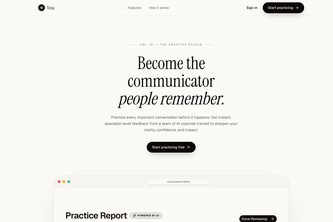
VOXA-AI is an AI-powered communication coach designed to help users improve their speaking skills across real-world scenarios such as job interviews, presentations, public speaking, sales pitches, and difficult conversations. It offers a "Growth Loop" feature that allows users to record a response, receive coaching feedback, and immediately try again with improvements applied.
What changed
The project was submitted as part of the OpenAI 2026 hackathon. The author describes it as a self-contained prototype built using modern web technologies (Next.js, Tailwind CSS, Supabase) and AI providers like OpenAI Whisper, OpenAI Structured Outputs, and Groq/Gemini for fallbacks.
The single most important open question
Is there evidence of user traction or commercial viability beyond the hackathon submission? The description states no revenue, customers, or adoption data are available.
What The Product Actually Is
The description states that VOXA-AI is an AI communication coach. It supports recording audio responses to prompts related to job interviews, presentations, public speaking, sales pitches, and difficult conversations. After recording:
- Audio is transcribed using OpenAI Whisper.
- Communication quality is analyzed using AI.
- Metrics such as speaking pace, filler words, confidence, clarity, storytelling, delivery, engagement, and expertise are measured.
- An executive summary with actionable coaching feedback is generated.
- Users can click “Try That Again” to re-record and compare attempts side-by-side.
The core innovation described is the "Growth Loop" — a feature that enables iterative practice and improvement rather than one-time evaluation.
Evidence
- The author states: “Voxa is an AI-powered communication coach that helps users improve how they communicate across real-world scenarios...”
- “After recording a response, Voxa transcribes the audio... evaluates confidence, clarity, storytelling, delivery, engagement, and expertise... generates an executive summary with actionable coaching feedback.”
- “Voxa's signature feature is the Growth Loop. Instead of ending the experience with a score, users can immediately click 'Try That Again'.”
Inference The product appears to be a web-based application focused on personal development through AI-assisted practice and feedback.
Positioning & Claim Evolution
The author positions VOXA-AI as an AI communication coach aimed at helping people become more effective communicators. The key claim is that it goes beyond simple evaluation by enabling continuous practice and measurable improvement.
Evidence
- “We wanted to build something different... What if AI could coach you, let you immediately try again, and actually prove that you improved?”
- “The goal isn't simply to evaluate communication—it's to help people improve it.”
- “We're proud of building the Growth Loop, which transforms AI feedback into measurable improvement instead of a one-time evaluation.”
Inference This suggests a shift from generic AI performance scoring toward personalized coaching with iterative practice.
Target Customer & ICP
The description does not explicitly define a target customer segment or ideal customer profile (ICP). However, it implies that the product is intended for individuals looking to improve communication skills in professional contexts such as job interviews, presentations, and public speaking.
Evidence
- “Voxa helps users build confidence and become more effective communicators through continuous practice and measurable progress.”
- “It supports real-world scenarios including: Job Interviews, Presentations, Public Speaking, Sales Pitches, Difficult Conversations.”
Inference The likely audience includes professionals seeking to enhance their communication abilities, particularly in high-stakes situations.
Business Model & Pricing Evidence
There is no evidence provided regarding pricing models or monetization strategies. The description does not mention subscriptions, freemium tiers, enterprise plans, or any form of revenue generation.
Evidence
- No mention of pricing, payment methods, or business model.
- “We're excited to continue expanding Voxa into a comprehensive AI communication platform.” (This is a future roadmap item.)
Inference The business model remains undefined at this stage.
Technical & Delivery Signals
The project was built using modern web technologies including Next.js 16, Tailwind CSS, Supabase, and various AI services like OpenAI Whisper, OpenAI Structured Outputs, Groq, and Google Gemini. It includes a resilient AI orchestration pipeline with fallback mechanisms.
Evidence
- “Built with (author-declared): framer-motion, groq, next.js, openai, postgresql, react, shadcn-ui, supabase, tailwind-css, typescript, whisper”
- “Our technology stack includes: Next.js 16, Tailwind CSS, Framer Motion, OpenAI Whisper for speech transcription...”
- “One of the core engineering decisions was building a resilient AI orchestration pipeline.”
- “If OpenAI is unavailable or rate-limited, the orchestrator automatically falls back to Google Gemini. If Gemini is also unavailable, it retries using Groq.”
Inference The technical architecture shows attention to reliability and scalability, especially in handling AI provider outages.
Traction & Maturity Signals
There is no evidence of user traction, revenue, or adoption beyond the hackathon submission. The project is described as a prototype built for a competition.
Evidence
- “This project was submitted to the OpenAI 2026 hackathon on Devpost.”
- “No revenue, customer or traction data is available beyond what they state.”
Inference The product has not yet reached market maturity or demonstrated real-world usage.
Competitive Context
The description does not provide information about competitors or competitive positioning. It does not reference existing tools in the AI communication coaching space.
Evidence
- No mention of competitor analysis, market landscape, or differentiation strategy.
- “We're excited to continue expanding Voxa into a comprehensive AI communication platform.” (Future roadmap item.)
Inference Competitive context is unknown and not described by the author.
Open Questions & Risks
Several risks are implied from the lack of evidence:
- No commercial traction or revenue: The product exists only as a hackathon submission.
- Unclear monetization strategy: No pricing or business model details.
- Limited scalability assumptions: The system is described as resilient but lacks data on actual usage patterns.
- Dependency on AI providers: Heavy reliance on external APIs may pose risks if those services change or become unavailable.
- Unproven user engagement: There’s no evidence of sustained use or retention beyond initial interaction.
Evidence
- “Everything above is the authors' own account. It is not independently verified, and no revenue, customer or traction data is available beyond what they state.”
- “We're proud of creating a product that helps people improve one of the most valuable professional skills they can develop.” (This is aspirational.)
Inference Without real-world usage or financial metrics, the viability of this product as a commercial venture remains unproven.
Questions the description leaves open
- What specific user problems are you solving, and how do you know?
- How many users have tried the platform so far? Have they provided feedback?
- What is your plan for monetization beyond the prototype phase?
- Are there any existing competitors in this space, and how does Voxa differentiate itself?
- How do you intend to scale beyond a single developer’s effort?
- What are the key metrics you track to measure improvement or engagement?
- Do you have plans for data privacy compliance (e.g., GDPR, CCPA)?
- How do you plan to onboard and retain users post-hackathon?
Overall Assessment
Not evidenced.
There is no evidence of revenue, customers, or traction beyond the hackathon submission. The description does not indicate whether this represents a viable business opportunity or a prototype with potential for further development.
Confidence Level Low The project is described as a self-contained hackathon submission with no indication of commercial viability or market validation.
User Stories BotA demo video on every pull request
Get a demo video on every new feature
GitHub App that watches your pull requests and records a narrated, captioned demo.
Save time on demo prep and make informed decisions faster with a video walkthrough of every new feature.
Source
Submitted to the OpenAI 2026 hackathon on Devpost. Project home on Devpost. Back to the full gallery on Devpost.
This competitive analysis was produced by top-founders.com (opens in a new tab)
Generated by a language model from this project's public Devpost page — its tagline, the author's own write-up and any built-with tags listed there — as captured in August 2026. Short quotations are the author's words. It is an opinion on the idea as a business, not on the people behind it, and it reflects the description as published then. If the project has moved on, request a correction below. The analysis is not independent research and contains no verified traction, revenue or customer data.
An independent guide by KFG International LLC — not affiliated with, endorsed by, or connected to Devpost or OpenAI.