

Archive position — measured, not model output
0 likes on Devpost
2,263 of the 7,850 archived projects have more likes, and 5,587 share exactly 0 — so this project's #3,681 place in the like-ranked listing is a tie-break inside that group, not a ranking.
Projects (log scale)
Likes on Devpost. ▲ marks this project's group.
Show the figures
| Likes | Projects | Share of archive |
|---|---|---|
| 0 | 5,587 | 71.2% |
| 1 | 1,758 | 22.4% |
| 2 | 284 | 3.6% |
| 3–4 | 132 | 1.7% |
| 5–9 | 75 | 1.0% |
| 10+ | 14 | 0.2% |
 User Stories BotA demo video on every pull request
Get a demo video on every new feature
GitHub App that watches your pull requests and records a narrated, captioned demo.
Save time on demo prep and make informed decisions faster with a video walkthrough of every new feature.
Executive Summary
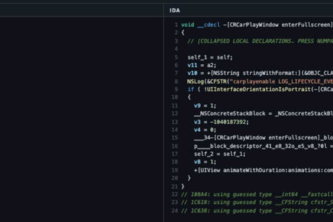
The description states that this is a decompiler for ARM64 iOS and macOS binaries, specifically targeting Objective-C and Swift applications. The author, Ethan Arbuckle, describes building a specialized tool using Python and Capstone, with contributions from Codex and GPT-5.6 in architectural design and correctness validation.
Key claims include:
- It converts ARM64 Mach-O machine code into source-like C, Objective-C, and Swift pseudocode
- It recovers constructs like Objective-C message-send syntax, Swift metadata operations, and UIKit API calls
- It uses a multi-stage compiler-style pipeline with provenance tracking and correctness validation
- It has 8,480 tests and 95% line coverage across core package
The project appears to be a technical prototype or early-stage tool built by one person. No evidence of revenue, customers, or commercial traction is provided. The author emphasizes that it's not a general-purpose decompiler but a specialized tool for iOS/macOS environments.
Most important open question
Is this a working tool that can be used in practice, or is it still largely experimental? What are the actual capabilities and limitations of the decompiler as described?
What The Product Actually Is
The description states that this is a "decompiler that turns ARM64 iOS and macOS binaries into source-like Objective-C and Swift."
It is described as:
- A tool that converts ARM64 Mach-O machine code into source pseudocode
- Built specifically for Objective-C, Swift, Foundation, UIKit, blocks, and Apple-specific ABI patterns
- Written in Python using Capstone
- Using a multi-stage compiler-style pipeline with intermediate representations
- Focused on ARM64 Mach-O binaries containing Objective-C, Swift, Foundation, UIKit, blocks, and Apple-specific ABI patterns
The author states it does not aim to support every architecture or programming language, but instead focuses deeply on the iOS/macOS environment.
Positioning & Claim Evolution
The description states that this is a decompiler built specifically for ARM64 Mach-O binaries containing Objective-C, Swift, Foundation, UIKit, blocks, and Apple-specific ABI patterns. The author claims it goes "much deeper on the binaries iOS and macOS researchers encounter every day."
Key positioning elements:
- Specialized focus on iOS/macOS ARM64 binaries
- Targeting Objective-C and Swift applications specifically
- Claims to go "deeper" than existing decompilers that expose compiler/runtime machinery instead of application logic
- Positions itself as a tool for iOS/macOS researchers who want to avoid manual reconstruction
The claim evolution shows:
- Initial inspiration: reverse engineering iOS/macOS apps still involves large amounts of manual reconstruction
- Current state: produces output that is "more source-like and easier to understand" than established decompilers
- Future goal: practical reverse-engineering tool that lets researchers begin with recognizable application logic instead of first spending hours manually removing compiler and runtime scaffolding
Target Customer & ICP
The description states that the target users are "iOS and macOS researchers" who encounter ARM64 binaries daily.
The author's own write-up indicates:
- The tool is built for developers working with iOS/macOS applications
- It addresses people who want to avoid manual reconstruction of reverse-engineered code
- It targets those who work with Objective-C, Swift, Foundation, UIKit, blocks, and Apple-specific ABI patterns
No specific customer segments or personas are identified beyond "iOS/macOS researchers." The description does not indicate whether this is intended for security researchers, app developers, or other specific user groups.
Business Model & Pricing Evidence
Not evidenced. The description provides no information about pricing, revenue streams, monetization strategies, or business model.
Technical & Delivery Signals
The description states:
- Built with Python and Capstone
- Uses a multi-stage compiler-style pipeline
- Parses Mach-O metadata, symbols, relocations, Objective-C runtime data, and Swift metadata
- Lifts ARM64 instructions into intermediate representation with explicit registers, memory accesses, flags, branches, calls, and side effects
- Performs control-flow graph construction, static single-assignment and dataflow analysis, stack and register variable recovery, type inference, interprocedural analysis
- Objective-C and Swift semantic recovery, block and closure reconstruction, source-level control-flow structuring
- Tracks instruction provenance and observable effects through transformations
- Uses Codex with GPT-5.6 for architectural design and correctness validation
The author states that the project is "still evolving" particularly around difficult Swift ABI cases, C++ cleanup regions, complex aggregate values, and unusual floating-point calling conventions.
Traction & Maturity Signals
Not evidenced. The description does not provide any information about:
- Revenue or monetization
- Customers or user base
- Adoption metrics
- Market traction
- Product usage statistics
- Commercial deployment
The author states that the project is "still evolving" and "already a practical specialized decompiler rather than a toy or syntax-only prototype."
Competitive Context
Not evidenced. The description does not mention:
- Competitors in the reverse engineering/decompilation space
- Market positioning relative to existing tools like IDA, Hopper, Ghidra, Binary Ninja
- Competitive advantages or differentiators
- Market size or competitive landscape
The author mentions that existing decompilers "can process ARM64 binaries, but on Objective-C and Swift applications they often expose compiler and runtime machinery instead of the application logic a developer originally wrote."
Open Questions & Risks
Inferences based on self-reported information:
- Single-person development: The project is built by one person (Ethan Arbuckle), which may limit scalability, maintenance, and feature development
- Limited commercial evidence: No revenue, customers, or traction data provided - this appears to be a technical prototype rather than a commercial product
- Narrow focus: While specialization can be an advantage, focusing only on ARM64 Mach-O Objective-C/Swift applications may limit market reach
- Technical complexity: The author notes significant challenges in Swift ABI recovery, Objective-C blocks, and control-flow structuring, suggesting ongoing technical difficulties
- AI dependency: Heavy reliance on Codex and GPT-5.6 for architectural design raises questions about long-term sustainability and proprietary dependencies
- Unproven commercial viability: No evidence of market demand or business model
Questions the description leaves open
- What is the actual current state of the tool - is it usable in practice, or still experimental?
- How does this compare to existing decompilers like IDA, Hopper, Ghidra, Binary Ninja in terms of accuracy and usability?
- What are the specific use cases where this tool provides value over existing alternatives?
- Are there any commercial partnerships or customers currently using this tool?
- What is the roadmap for expanding beyond the current ARM64 Mach-O Objective-C/Swift focus?
- How does the tool handle edge cases and complex scenarios that might not be covered in the test corpus?
- What are the technical limitations of the current implementation that prevent broader adoption?
- How do you plan to monetize this tool or build a sustainable business around it?
Overall Assessment
Not evidenced. The description provides no information about:
- Financial performance
- Market opportunity size
- Competitive positioning
- Go-to-market strategy
- Team capabilities beyond the single founder
- Commercial traction or customer feedback
- Revenue models or monetization plans
The project appears to be a technical prototype built by one person with significant AI assistance. It has not demonstrated commercial viability, revenue, customers, or market traction. The author states it's "still evolving" and "already a practical specialized decompiler rather than a toy or syntax-only prototype," but provides no evidence of actual usage or adoption.
The tool shows technical sophistication and appears to address a specific need in iOS/macOS reverse engineering, but lacks any commercial due-diligence signals. The single-founder nature and lack of traction data make it difficult to assess investment potential or partnership value without additional information.
User Stories BotA demo video on every pull request
Get a demo video on every new feature
GitHub App that watches your pull requests and records a narrated, captioned demo.
Save time on demo prep and make informed decisions faster with a video walkthrough of every new feature.
Source
Submitted to the OpenAI 2026 hackathon on Devpost. Project home on Devpost. Back to the full gallery on Devpost.
This competitive analysis was produced by top-founders.com (opens in a new tab)
Generated by a language model from this project's public Devpost page — its tagline, the author's own write-up and any built-with tags listed there — as captured in August 2026. Short quotations are the author's words. It is an opinion on the idea as a business, not on the people behind it, and it reflects the description as published then. If the project has moved on, request a correction below. The analysis is not independent research and contains no verified traction, revenue or customer data.
An independent guide by KFG International LLC — not affiliated with, endorsed by, or connected to Devpost or OpenAI.