

Archive position — measured, not model output
0 likes on Devpost
2,263 of the 7,850 archived projects have more likes, and 5,587 share exactly 0 — so this project's #5,644 place in the like-ranked listing is a tie-break inside that group, not a ranking.
Projects (log scale)
Likes on Devpost. ▲ marks this project's group.
Show the figures
| Likes | Projects | Share of archive |
|---|---|---|
| 0 | 5,587 | 71.2% |
| 1 | 1,758 | 22.4% |
| 2 | 284 | 3.6% |
| 3–4 | 132 | 1.7% |
| 5–9 | 75 | 1.0% |
| 10+ | 14 | 0.2% |
 User Stories BotA demo video on every pull request
Get a demo video on every new feature
GitHub App that watches your pull requests and records a narrated, captioned demo.
Save time on demo prep and make informed decisions faster with a video walkthrough of every new feature.
Executive Summary
What the company appears to be
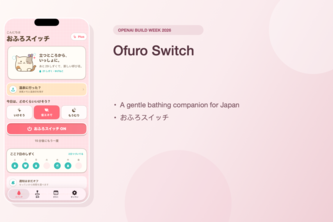
Ofuro Switch is a self-reported iOS app designed for Japanese users to support gentle bathing routines and record onsen experiences. The author describes it as a "gentle three-step nudge" for difficult evenings, with an integrated local notebook for onsen visits. It is built as a native SwiftUI app using GPT-5.6 and Codex, with no backend or cloud dependencies.
What changed
During Build Week, the app evolved from a focused MVP (bathing prompts + local history) into a more complete companion that includes an “Onsen Notebook” tab for detailed onsen visit logging. The changes include structured data models, new views, and expanded functionality while maintaining its core tone of kindness and minimalism.
The single most important open question
Is there any evidence of user adoption or engagement beyond the author’s own use? The description contains no data on users, revenue, or traction — only self-reported claims about design intent and development process.
Note: This analysis is based entirely on the self-reported project description provided by the caller. No external verification or historical data is available.
What The Product Actually Is
The description states that Ofuro Switch is a native iOS app built with SwiftUI, targeting Japanese users. It offers two main features:
- A bathing prompt system with three energy-based routes:
- いけそう — I think I can do it
- 省エネで — Low-energy mode
- もうむり — I cannot do much more today
- A local onsen journal, where users can record details like:
- Facility, prefecture, visit date
- Spring type, pH, source temperature
- Water handling (e.g., filtration, disinfection)
- Personal impressions: color, scent, feel, revisit intention, and free notes
All data is stored locally on the device. There is no user account, backend, analytics SDK, or location permission required.
Inference: The app appears to be a personal tool for self-care and memory-making, not a commercial product or platform.
Positioning & Claim Evolution
The author positions Ofuro Switch as a kind, non-judgmental companion for people who struggle with starting a bath. It aims to reduce friction in low-energy moments by offering small actions and gentle nudges.
It also introduces the idea of memory-making through bathing, particularly around onsen visits. The app is framed not just as a utility but as a quiet way to preserve meaningful experiences.
Claim: The app brings together "gentle help to begin an everyday bath" and "a quiet record of the baths that become memories."
Inference: The positioning evolved from a simple bathing prompt system to a dual-purpose tool combining daily care with long-term memory capture. This evolution was driven by the author’s desire to make both parts feel connected emotionally.
Target Customer & ICP
The description does not name specific customer segments or personas. However, it implies:
- Users who are exhausted or low on energy and need encouragement to bathe.
- People interested in traditional Japanese bathing culture, especially onsen visits.
- Individuals who value personal reflection and memory-making without digital clutter.
Claim: The app targets users seeking a kind, private way to begin bathing and remember onsen experiences.
Inference: Based on the tone and features, the ICP likely includes:
- Japanese-speaking individuals aged 25–45
- Those interested in wellness, mindfulness, or cultural practices
- Users who prefer local-first tools over cloud-based ones
Business Model & Pricing Evidence
The app uses a local-first model with no backend services, ads, or external analytics. It includes an optional lifetime Plus purchase via StoreKit 2, which unlocks deeper history and summaries.
Claim: The basic functionality is free; payment only enhances the experience.
Inference: This suggests a freemium model, where core features are available without charge, and premium access provides richer historical views or visualizations. There is no mention of recurring subscriptions or in-app purchases beyond the one-time Plus upgrade.
Technical & Delivery Signals
The app is built natively for iOS using:
- SwiftUI
- StoreKit 2
- Swift
- XCTest (for testing)
- Codex + GPT-5.6 as development environment
It supports:
- VoiceOver selection states
- Dynamic Type
- Reduce Motion
- Local storage only (no cloud sync or backend)
Claim: The app uses AI tools like GPT-5.6 during development but does not send personal data to any AI model.
Inference: The technical stack indicates a lightweight, focused product with strong accessibility and privacy considerations. The use of Codex suggests rapid prototyping and iterative development.
Traction & Maturity Signals
There is no evidence of users, customers, or revenue in the description. The project was submitted to a hackathon (OpenAI 2026), and the author notes that it started from a pre-existing MVP.
Claim: The app has been tested through automated tests (17/17 pass) and includes a clean checkout process.
Inference: No data on user engagement, retention, or monetization is available. The product appears to be in early-stage development with no commercial traction.
Competitive Context
The description does not mention competitors or similar products. It focuses solely on the unique aspects of Ofuro Switch — its tone, local-first approach, and cultural relevance to Japanese bathing traditions.
Claim: There are no known direct competitors mentioned.
Inference: Given the niche focus (Japanese bathing culture + gentle nudges), the competitive landscape may be limited or undefined. However, this could also reflect a lack of market research by the author.
Open Questions & Risks
- No evidence of user adoption or feedback — The app is described only in terms of its design and development.
- Limited commercial viability — No monetization strategy beyond a one-time purchase, with no indication of scalability or growth potential.
- Niche appeal — The cultural specificity (e.g., onsen, Japanese language) may limit broader market reach.
- Self-reported nature — All claims are unverified and based on the author’s own account.
Inference: If the app does not gain traction beyond the developer's personal use, it may remain a prototype or hobby project rather than a scalable business.
Questions the description leaves open
- What is the actual user base? Are there any real-world users beyond the author?
- How many people have purchased the Plus upgrade, if any?
- Is there any feedback from beta testers or early adopters?
- Has the app been tested on real devices beyond simulator builds?
- What are the long-term plans for expansion or localization?
- Are there any plans to integrate with third-party services or APIs (e.g., onsen databases)?
- How does the author plan to validate the emotional promise of "gentleness" in practice?
Overall Assessment
There is no evidence of commercial traction, revenue, or customer engagement. The app appears to be a personal project developed during a hackathon, with no indication of market demand or scalability.
Assessment: Not suitable for investment or partnership at this stage. It lacks the foundational signals (users, monetization, growth) needed to assess viability as a business. The product is interesting from a design and cultural perspective but has not demonstrated commercial potential.
Confidence Level: Low — based entirely on self-reported evidence without external validation or data.
User Stories BotA demo video on every pull request
Get a demo video on every new feature
GitHub App that watches your pull requests and records a narrated, captioned demo.
Save time on demo prep and make informed decisions faster with a video walkthrough of every new feature.
Source
Submitted to the OpenAI 2026 hackathon on Devpost. Project home on Devpost. Back to the full gallery on Devpost.
This competitive analysis was produced by top-founders.com (opens in a new tab)
Generated by a language model from this project's public Devpost page — its tagline, the author's own write-up and any built-with tags listed there — as captured in August 2026. Short quotations are the author's words. It is an opinion on the idea as a business, not on the people behind it, and it reflects the description as published then. If the project has moved on, request a correction below. The analysis is not independent research and contains no verified traction, revenue or customer data.
An independent guide by KFG International LLC — not affiliated with, endorsed by, or connected to Devpost or OpenAI.